
CASE NAME: Taher Vajiyuddin Rangwala & Anr. v. The State of Gujarat, 2026 INSC 859
CASE NUMBER: Criminal Appeal No. 76 of 2020
COURT: Supreme Court of India
DATE: 13 August, 2026
QUORUM: Hon’ble Justice J.B. Pardiwala and Hon’ble Justice K. Vinod Chandran
FACTS
On 17 July 2006, the appellants allegedly took their friend, the deceased, from his home in the early morning hours under the pretext of travelling to Ankleshwar to play volleyball. The deceased did not return home that evening, and his family began searching for him. His clothes and belongings were later found on the bank of a river, and his body was recovered the following morning. The post-mortem examination attributed the death to cardio-respiratory arrest caused by drowning. Except for the appellants, no other person was present at the spot, and no other person saw the appellants last with the deceased. The prosecution case was predominantly based on the conduct of the appellants after the incident. They fled from the spot without raising any alarm, went to watch a movie, and also did not inform the family of the deceased in time. The second accused gave a false version about his whereabouts. The Trial Court convicted both the appellants under Sections 302, 34 and 201 read with Section 120B of the Indian Penal Code, 1860 and sentenced them to life imprisonment with additional sentences for conspiracy and causing disappearance of evidence. The Gujarat High Court confirmed the conviction and the appellants came to the Supreme Court.
ISSUES
- Whether the prosecution proved homicidal death beyond reasonable doubt on the strength of the medical and post-mortem evidence.
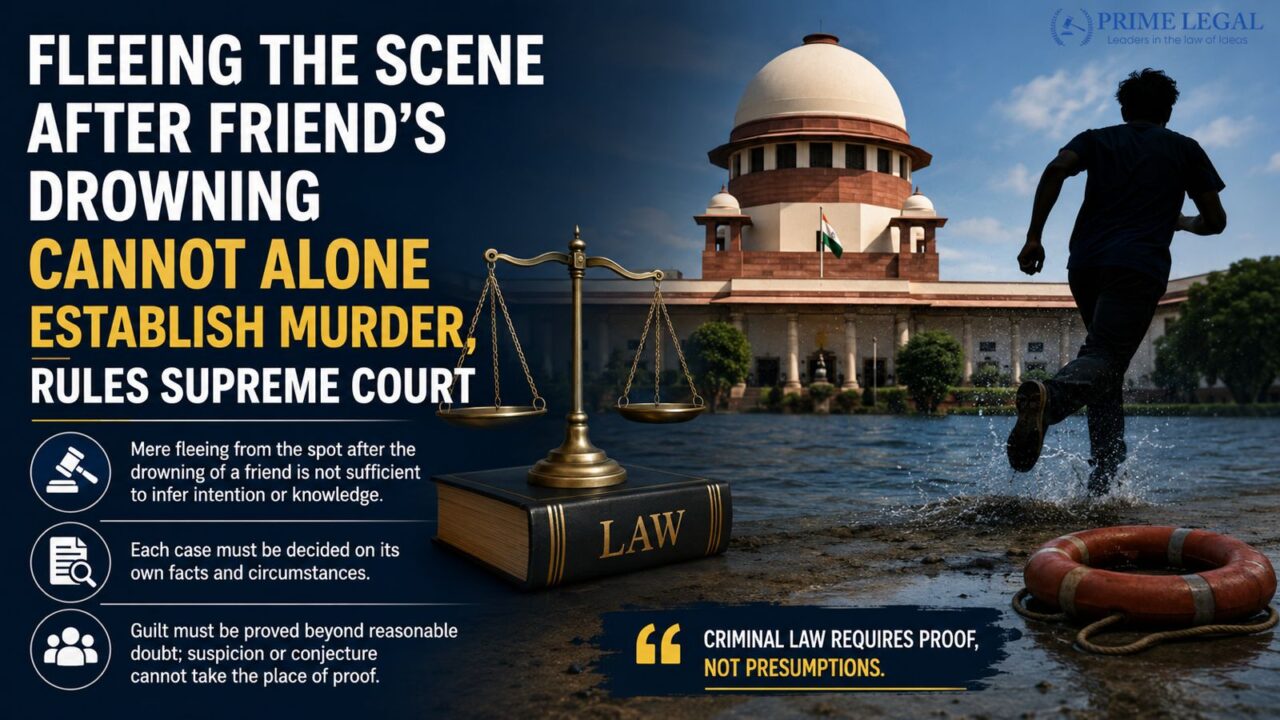
- Whether the post-incident conduct of the accused, fleeing the scene, watching a movie, and delaying disclosure to the deceased’s family, could by itself be treated as an incriminating circumstance sufficient to sustain a murder conviction based on circumstantial evidence.
LEGAL PROVISIONS
- Sections 302, 34, 201 read with Section 120B of Indian Penal Code, 1860 relating to, respectively, murder, common intention, causing disappearance of evidence and criminal conspiracy. (2) The settled principles of law relating to conviction on circumstantial evidence which require that the chain of proved circumstances must be complete and consistent only with the guilt of the accused and exclude every other reasonable hypothesis.
ARGUMENTS
APPELLANTS:
The appellants contended that there was no eyewitness to the incident, and that the post-mortem report did not establish a homicidal death. They submitted that the three injuries found on the deceased’s body were explicable as accidental, arising either while bathing in the river or from the body being dragged and struck against a hard object by the current. They further argued that the prosecution’s theory that a broken soda bottle had been used as a weapon was unsupported, since no such bottle or blood-stained fragment was ever seized or sent for forensic examination. Fleeing the spot and going to a movie, though possibly reprehensible, was submitted to be a probable human reaction rather than proof of guilt.
RESPONDENT:
The State contended that the appellants’ conduct, fleeing without raising an alarm, watching a movie shortly afterward, delaying disclosure to the deceased’s family, and giving a false account of their whereabouts, together formed a chain of incriminating circumstances sufficient to establish that the appellants had murdered the deceased and attempted to conceal the crime.
ANALYSIS
The Court found nothing in the post-mortem report or the doctor’s testimony to establish a homicidal death, noting there was no reliable evidence that the victim had been struck on the head, rendered unconscious, and deliberately drowned. The three injuries on the body were held to be equally explicable by accidental causes. The Court also rejected the broken bottle theory, since no such object or blood-stained fragment had ever been recovered or forensically examined. On the question of conduct, the Court held that the appellants’ silence and failure to inform the deceased’s family, though reprehensible, was probable conduct even in a case of accidental drowning, and could not by itself be elevated into an incriminating circumstance establishing homicide. Reiterating the settled rule that a conviction based on circumstantial evidence requires a complete chain excluding every hypothesis other than guilt, the Court found that the hypothesis of accidental drowning remained the more probable version, and that none of the circumstances relied upon by the prosecution had been proved.
JUDGMENT
The Supreme Court allowed the appeal, set aside the judgments of the Trial Court and the Gujarat High Court, and acquitted both appellants, directing their release unless required in connection with any other case.
CONCLUSION
The judgment reinforces the settled principle that morally questionable or suspicious post-incident conduct, such as fleeing a scene or delaying disclosure, cannot substitute for actual proof of homicide in a case built on circumstantial evidence. Courts must be satisfied that the proved circumstances are consistent only with guilt and inconsistent with any hypothesis of innocence. Where the medical evidence is equally, or more, consistent with an accidental death, a murder conviction cannot be sustained merely because the accused behaved in a manner that appears suspicious or reprehensible after the fact.
“PRIME LEGAL is a National Award-winning law firm with over two decades of experience across diverse legal sectors. We are dedicated to setting the standard for legal excellence in civil, criminal, and family law.”
WRITTEN BY: GAURAV VIBHU RANJAN
Read the Judgement copy below:
Taher Vajiyuddin Rangwala & Anr. Versus The State of Gujarat

