
INTRODUCTION
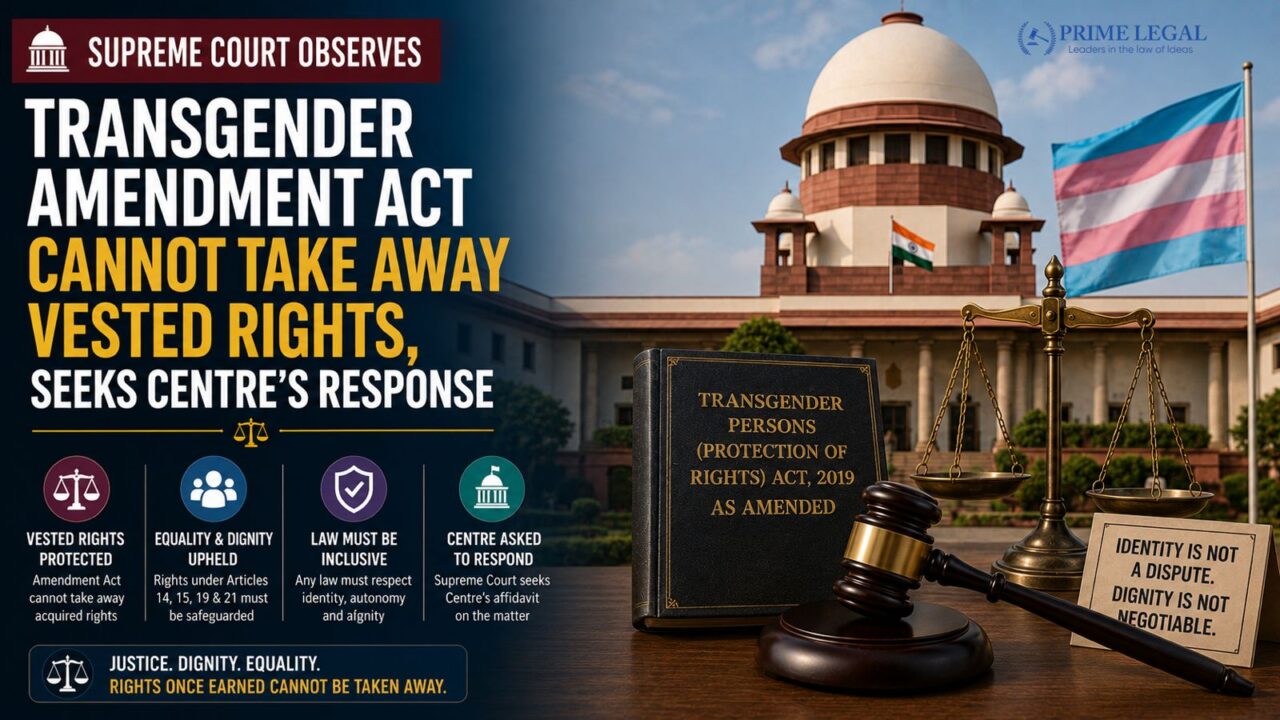
It has been held by the Supreme Court in an oral observation that the Transgender Persons (Protection of Rights) Amendment Act, 2026 being a prospective legislation, cannot be interpreted in such a way as to deprive the transgender people of their vested rights including the identity card or other benefits under the 2019 Act. A bench comprising Chief Justice of India Surya Kant, Justice Joymalya Bagchi and Justice V. Mohana made the observation on 03 August 2026 while hearing petitions challenging the constitutional validity of the 2026 Amendment. The Court stopped short of a formal order, instead directing the Union Government to respond and posting the matter for further hearing on 17 August.
BACKGROUND
The 2026 Amendment modifies the Transgender Persons (Protection of Rights) Act, 2019, which followed the Supreme Court’s judgment in National Legal Services Authority (NALSA) v. Union of India (2014), recognising self-perceived gender identity as intrinsic to dignity under Article 21. The 2019 Act allowed a person to obtain a certificate of identity from the District Magistrate through a purely administrative process, without medical examination.
This amendment, approved by the President on 30 March 2026, adopts a new model that necessitates a recommendation from a medical board headed by a Chief Medical Officer prior to granting a certification by the District Magistrate. In addition to that, the statutory definition of “transgender person” is reduced to certain socio-cultural categories as well as biologically proven cases only, with an exclusion of people having “self-perceived” gender identity, and the provision of increased punishment for offences related to forced gender reassignment procedures.
KEY POINTS
- Petitions before the Supreme Court, and separately before the High Courts of Kerala, Delhi, Karnataka and Bombay, challenge the Amendment as violative of Articles 14, 15, 19 and 21.
- The Centre’s transfer petitions to consolidate the High Court matters were allowed, and the corresponding High Court proceedings have been stayed.
- The petitioners have argued that replacing self-declaration with a medical declaration undermines the principles enshrined in the NALSA judgment where medical testing was not required before recognizing one’s gender identity and was held to be intrusive.
- On 3rd August, Senior Counsel Jayna Kothari and Arundhati Katju sought interim relief for those individuals who possessed the identity card of Transgender or were receiving hormones, citing disruption in their lives by virtue of the Amendment.
- Justice Bagchi made an oral observation that because the Amendment is prospective in nature and does not have any repeal effect explicitly, therefore, rights that have been given to transgender individuals through 2019 Act shall continue and can only be cancelled after prior notice to the person concerned.
- Solicitor General Tushar Mehta resisted a general interim order, as complications such as succession law consequences of self -assessed gender may arise, and sought time for the Centre to respond.
RECENT DEVELOPMENTS
It marks the third time around for the hearing of the challenge. The Court issued the initial notice to the Union in May 2026, where Senior Advocate Abhishek Manu Singhvi contended that the right declared in NALSA could not be nullified by legislative amendment.
The Court issued another notice in July 2026 with regard to a challenge to the proviso to Section 2(k), where “shall not include, nor shall ever have been so included,” individuals who identify themselves with a particular gender identity, that petition currently hangs with other pending cases. The Court has refused to make an interim order and prefers to look at each individual case of hardship and direct the government to take into consideration the position of those who are vested with some rights
CONCLUSION
From the oral observations of the Supreme Court, it seems that the issue of the validity of the 2026 Amendment, in relation to the constitutionality, will hinge mainly on the differences between the prospective legislative alteration and the retrospective extinguishment of vested rights rather than simply on whether the medical certification framework is proper or not. At least until a decision is made in the case, it seems that those transgenders who have been granted identity certificates or are in the process of receiving gender affirmation therapy will be protected by their current status although there is no interim order issued for them.
“PRIME LEGAL is a National Award-winning law firm with over two decades of experience across diverse legal sectors. We are dedicated to setting the standard for legal excellence in civil, criminal, and family law.”
WRITTEN BY: DRISHTITA BANIK

