
ABSTRACT
The gig economy has changed the way the world works, enabling individual to work for companies internationally from their own countries. This flexibility has brought on new job creation possibilities, but has also raised intricate international tax issues. One frequent question that is asked by those who work remotely is what countries will they be taxed in, their employer’s country, their home country, or both. This article explores the concepts of residential status, source-based and residence-based tax, the applicability of the Permanent Establishment (PE) concept and the new tax issues surrounding the digital economy. It also elucidates the implications of these concepts for persons living in India but working for an overseas company.
INTRODUCTION
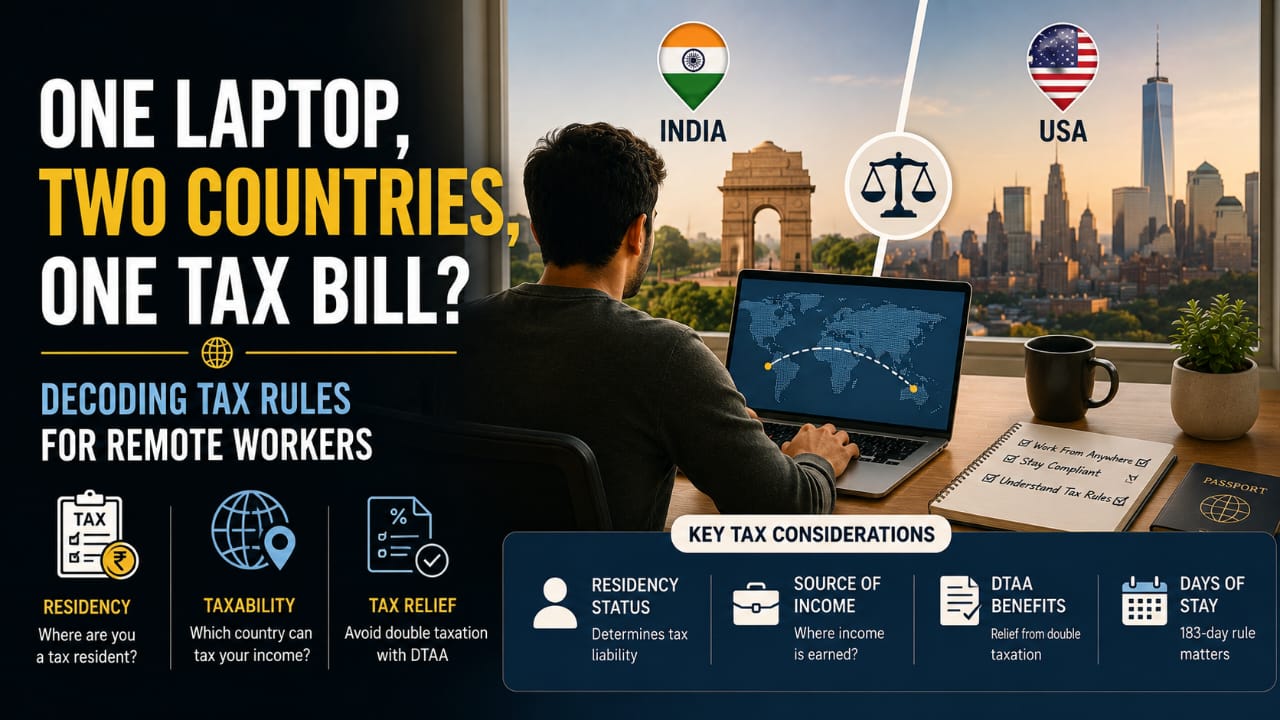
Suppose you are working for a technology company in California, and your office is in Bengaluru, Delhi or Kochi. Suppose, you work in a technology company headquartered in California and your office is in Bengaluru, Delhi or Kochi. You get paid in USD, your boss is in NY and your employer doesn’t have an office in India. The natural question is: Where do you have to submit income tax?
RESIDENTIAL STATUS: THE STARTING POINT OF TAX LIABILITY
Determining where an employer is liable to collect tax is no longer as easy as identifying where the employer is located. The contemporary international tax system is a blend of domestic tax laws, Double Taxation Avoidance Agreements and principles embodied by the Organisation for Economic Co-operation and Development and the United Nation. These concepts are crucial for understanding to protect remote workers from double taxation while maintaining tax compliance.
In India, the tax liability of an individual is mainly determined on the basis of his residential status and not citizenship or nationality of his employer under the provisions of the Income-tax Act 1961. The determination of whether a person is a Resident, Resident but Not Ordinarily Resident or Non-Resident for a financial year is made in accordance with sections 6 and 5 of the Act.
Therefore, an individual working and living outside India for a US employer would normally be considered to be residing and working in India and would be liable to pay tax in India on the salary earned, regardless of the location of the employer and the place where the salary is credited.
SOURCE-BASED TAXATION AND RESIDENCE-BASED TAXATION
There are two competing principles in international taxation – source principle and residence principle. Under the source-based taxation principles the income generated within its domestic territory can be taxed by the country. Residence-based taxation, on the other hand, permits a country to tax the worldwide income of its residents.
If an employee performs all of the employment services from India, the employment services will be performed physically in India. The salary from the Indian point of view is income earned in India and hence is taxable in India. The United States could also assert taxing jurisdiction under its own tax laws under circumstances where the employer is located in the United States, or the salary is paid by a US entity.
India has signed Double Taxation Avoidance Agreements with certain countries, including the USA, to avoid the double taxation of the same income. The India–US DTAA provides for the allocation of taxing rights between the two jurisdictions and typically provides relief to taxpayers in the form of tax credit/exemptions where both countries claim taxing rights.
WHEN REMOTE WORK IMPACTS THE EMPLOYER
The term permanent establishment comes into play. Remote employees may have other implications for the foreign employer, in addition to their own tax issues. Permanent Establishment (PE) is a fixed place of business where an enterprise conducts its business in another country. If the foreign company is deemed to have established a PE in India, it could be subject to the corporate taxes in India on the profits earned from the PE.
The OECD after COVID-19 pandemic issued international guidance that established the general rule that working from home would not lead to the establishment of a PE. But the Government has been considering the long-term or permanent option for working remotely on a case-by-case basis, too. As a result, multinationals are making themselves more aware of remote working policies to reduce the risk of the policy creating an unintended tax liability.
DIGITAL ECONOMY AND TAXATION REFORMS
As the digital economy has grown, traditional tax principles which have physical presence as a key element have been questioned. Nowadays, it is possible to earn money without borders and without the involvement of any material components. India has been one of the jurisdictions that have been pushing for tax on significant economic presence and digital business models.
While these steps have largely focussed on multinational digital businesses, they also demonstrate the international tax reform trend of capturing economic activity outside of offices. The changing landscape underscores the importance of understanding not just national tax laws but also international tax treaties and global changes in tax laws due to the OECD’s Base Erosion and Profit Shifting (BEPS) project for remote workers.
PRACTICAL CONSIDERATIONS FOR REMOTE WORKERS
The employees of foreign companies who work from home in India must seriously consider their tax liability before they conclude that they will tax only in the country where their employers are based.
The final tax liability can be influenced by various factors including the number of days spent in India, applicable DTAA, the withholding tax by the foreign employer, foreign tax credits and local reporting requirements. Correct documentation becomes crucial, with the need to maintain records such as employment contracts, salary records, tax residency certificates, and proof of taxes paid in other countries for treaty benefits claims and to avoid disputes. Where employees are often moving between countries or are providing services in various jurisdictions within the one financial year it is often necessary to seek professional tax advice.
THE WAY FORWARD
Greater clarity of international tax rules for cross-border employment is needed as the use of remote working rises. Governments need to keep up to date with domestic law to reflect digital working arrangements and to prevent compliance burdens on taxpayers or double taxation.
Internationally, better treaty coordination, streamlined tax credit systems, and new guidance on remote workers and PE can help offer clarity for workers and employers. As the nature of work becomes more and more mobile, a changing tax system is necessary to address the new economic landscape.
CONCLUSION
The tax liability does not necessarily pass from the employee to the employer’s country when working abroad for a foreign employer. In general, the tax law in India taxes income from employment on the basis of residence and the location where services are rendered. For cross-border remote work to continue expanding, the dynamics between the country of residence, the taxation of source income, the concept of Permanent Establishment and the digital economy are no longer the exclusive domain of multinational corporations. For professionals working in the international work landscape on the ground in India, it’s become a fact of working life.
“PRIME LEGAL is a National Award-winning law firm with over two decades of experience across diverse legal sectors. We are dedicated to setting the standard for legal excellence in civil, criminal, and family law.”
WRITTEN BY: SHEEN

