
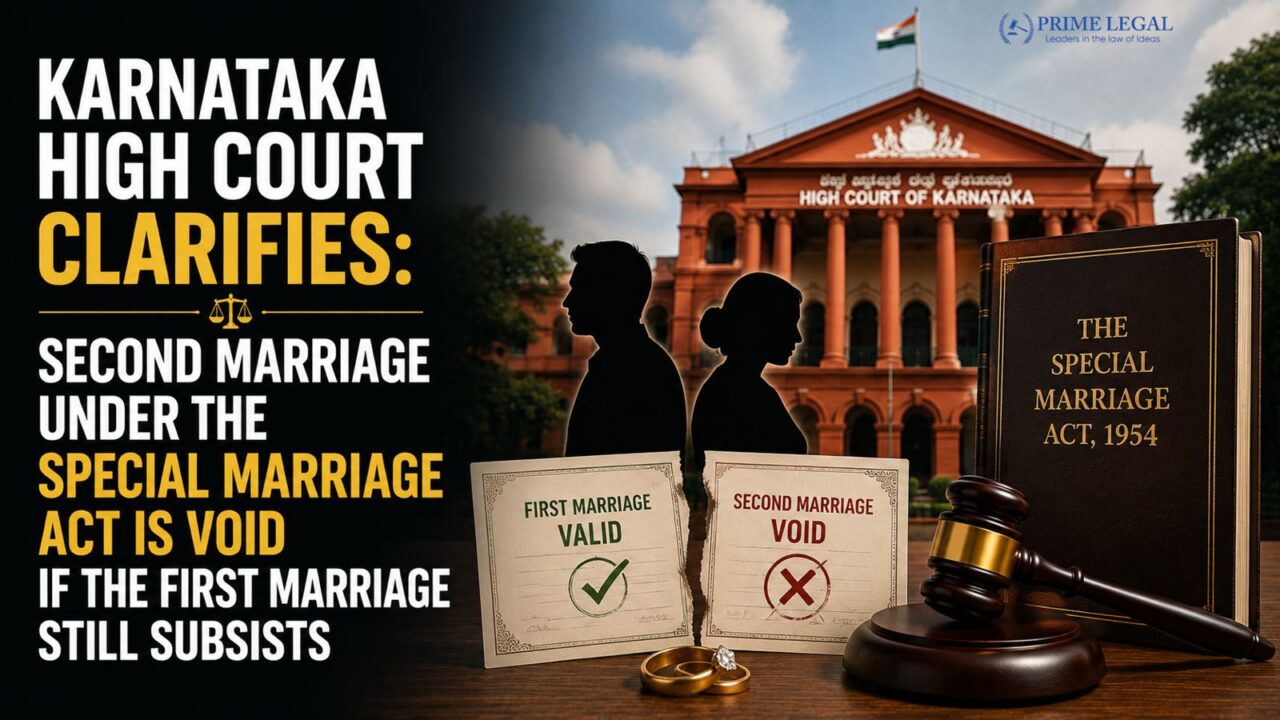
CASE NAME: A v. B & Ors.
CITATION: NC: 2026: KHC-D:9731
CASE NUMBER: Writ Petition No. 107250 of 2025 (GM-CPC)
COURT: High Court of Karnataka at Dharwad
DATE OF JUDGMENT: 15th July, 2026
QUORUM: Hon’ble Mr. Justice Sachin Shankar Magadum
FACTS
The present petition is filed in O.S. Suit No.246/2012 filed by brother of Defendant No.2 for partition and separate possession of suit schedule properties. Defendant No.2 died during pendency of the suit proceeding. 14th March, 2024. The Petitioner says she is the wife of the Defendant No.2 who died, who was married to her on 24th April, 2008 pursuant to the provisions of the Special Marriage Act, 1954. After the death of Defendant No.2, the Petitioner and her daughter were not informed or brought on record and Defendant Nos.2(a) to 2(d) were brought on as legal representatives.
The Petitioner then filed I.A. Nos.49 and 50 seeking to implead herself and her daughter to the proceedings, the same were allowed and were thereafter set aside by the High Court in a previous writ petition and the Court convened an enquiry to determine the status of the Petitioner and her daughter. In the course of the enquiry, the Trial Court rejected the Petitioner’s application and allowed her daughter to be brought on record, holding that the Petitioner’s marriage was void ab initio because Defendant No.2(a) was already married to the deceased.
ISSUES
- Whether the Trial Court erred in not accepting Petitioner’s application for impleadment as the legal representative of the deceased Defendant No. 2 but allowed the daughter of the said deceased to be brought on record.
LEGAL PROVISIONS
- Section 4(a), Special Marriage Act, 1954.
- Article 226 & 227, The Indian Constitution.
Case Laws Referred:
- MD Akhil Alam v. Tumpa Chakravarti, AIR 2026 JAR 12.
ARGUMENTS
PETITIONER
The learned counsel appeared for the Petitioner, submitted that the Petitioner had entered into marriage under the Special Marriage Act with the deceased Defendant No.2 and thus she has a right to represent his estate and oppose the proceedings. It was contended that the Trial Court erred in holding a trial on the validity of marriage and failed to afford her a hearing.
RESPONDENT
The counsel appearing for the Contesting Respondents supported the impugned order and contended that Petitioner herself admits she is the second wife of Defendant No.2 who is deceased. It was admitted that the first marriage was valid, it was argued that the alleged marriage under the Act was null and void on the basis of section 4 of the Act. So there is no legal status of Petitioner as wife and therefore as a legal representative for prosecution or defence of the proceedings.
ANALYSIS
The Court considered Section 4(a) of the Special Marriage Act in careful detail and specifically ruled that neither of the parties should have a spouse present at the time of the solemnization. The Court noted that the Petitioner’s own affidavit clearly admitted that she was the second wife and that Defendant No.2(a) did exist.
It firmly believed that when parties voluntarily enter into marriage under the secular law, they do so subject to all its conditions and one of those conditions is monogamy, which they could not abrogate by saying Mohammedan personal law applies. Marriage under the Act in derogation of this condition is null and void from the outset, and shall not make the persons who have been united husband and wife.
Moreover, the Petitioner was not the person with a legally recognised right to represent the estate, because the marriage was a void marriage. The Court however upheld the decision of the Trial Court granting permission to the daughter to be put on record and held that children born out of void marriages enjoy the status of statutory protection and are capable of asserting their legal rights in appropriate proceedings.
JUDGEMENT
Writ petition dismissed by High Court. The Court upheld the order dated I.A. No.50 in O.S. Consequently, No.246/2012 has held that impleadment of the proposed Defendant No.2(f) shall continue to remain undisturbed and directed the Trial Court to proceed with the suit in accordance with law.
CONCLUSION
It upholds the rule that the Special Marriage Act, which is highly substantive and secular, is binding on parties choosing to be governed by it and they are not entitled to enjoy an exemption based on personal law as well. If someone does not have a legally valid marital status under the Act, neither he or she nor any other person has the rights of a representative of a deceased.
Where a person does not have a legally valid marital status under the Act, he or she has no rights of a representative of a deceased, as Parliament intended in contemplation of the uniform statutory discipline.
“PRIME LEGAL is a National Award-winning law firm with over two decades of experience across diverse legal sectors. We are dedicated to setting the standard for legal excellence in civil, criminal, and family law.”
WRITTEN BY: SHEEN WANCHOO
Read the Judgement copy below:

