
INTRODUCTION:
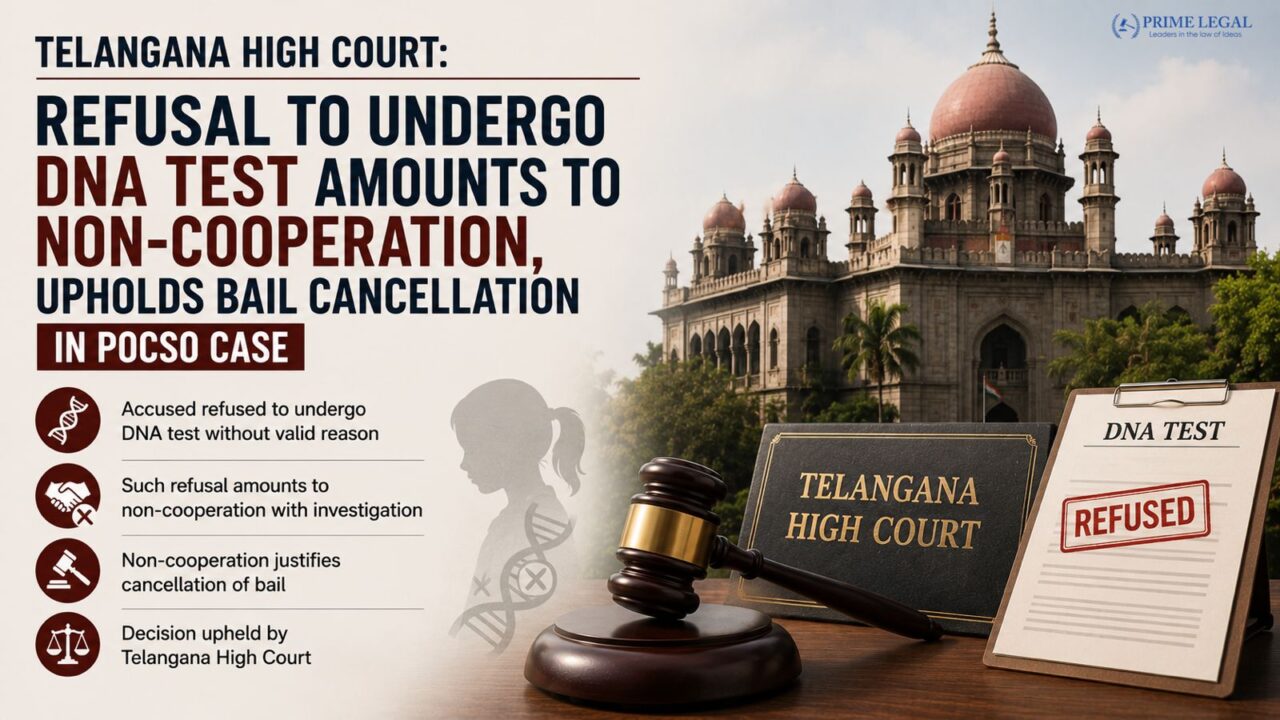
The Telangana High Court ruled in the case of Haseeb Ullah Khan v the State of Telangana that refusal to take DNA test in a case of sexual offence shall be treated as an act of non-cooperation which may lead to the cancellation of the bail of the accused. Justice K. Sujana stated that DNA profiling is recognized under Section 51 of the Bharatiya Nagarik Suraksha Sanhita, 2023 (BNSS).The Court has also mentioned that the provision does not violate right against self-incrimination provided under Article 20(3) of the Constitution of India.
BACKGROUND:
A Criminal Revision Case was filed by the prosecution seeking cancellation of the bail granted to the accused on the ground that he was not cooperating with the investigation. It was observed that the accused had received a notice from the Investigating Officer to appear for a DNA test but had failed to do so, taking a stance that such a test would amount to a violation of his right against self-incrimination. The accused relied on the judgment of Selvi V State of Karnataka where it was held that an accused must be protected against application of scientific techniques such as narco-analysis, polygraph examination and brain-mapping against their will. The court allowed the cancellation of bail on the ground that in cases involving sexual offences under the POCSO Act and the BNS, DNA profiling is a recognised investigative tool and it does not violate fundamental rights.
KEY POINTS:
- The Telangana High upheld cancellation of bail on the ground of refusal of the accused to undergo a DNA test in a sexual offence.
- The Court clarified that the refusal to comply with a lawful DNA test amounts to non-cooperation in investigation procedure.
- Section 51 of the BNSS particularly allows for DNA profiling in cases of a sexual offence investigation whenever considered necessary by a registered medical practitioner.
- The Court distinguished from the judgements in Selvi and R. Rajendran stating lack of factual nexus.
ANALYSIS:
The court has clarified that Section 51 of the Bharatiya Nagarik Suraksha Sanhita, 2023 provides that, in cases involving sexual offences, the medical examination of an accused may include collection of blood, blood stains, semen, swabs, sputum, sweat, hair samples, fingernail clippings, and other necessary tests, including DNA profiling, if the registered medical practitioner considers the same necessary. Thus, the Investigating Officer is empowered to request such examination, and it is for the registered medical practitioner to decide whether DNA profiling is necessary in the facts of the case.
In Selvi v. State of Karnataka the Supreme Court dealt with involuntary scientific techniques such as narco-analysis, polygraph examination and brain-mapping, and not with DNA profiling under Section 51 of the BNSS. The present case dealt with Section 3 read with Section 4 of the POCSO Act and Section 65 of the BNS, which are offences relating to sexual assault. Therefore, the request made by the Investigating Officer for the petitioner to undergo a DNA test is in accordance with law. Similarly, the decision in R. Rajendran v. Kamar Nisha was distinguished as there was no direct nexus with the offences alleged.
CONCLUSION:
The ruling of the Telangana High Court affirms that the right against self-incrimination cannot be used as a shield to obstruct legitimate procedures of investigation recognised by the law. The applicability of Section 51 of the BNSS Act was distinguished from previous rulings relating to involuntary scientific methods and establishing DNA profiling as a permissible method of evidence collection in cases of sexual offences. Further, it was observed that cooperation by the accused in the process of investigation is an important condition for bail as non-compliance might lead to cancellation of bail in cases of POCSO Act offences.
“PRIME LEGAL is a National Award-winning law firm with over two decades of experience across diverse legal sectors. We are dedicated to setting the standard for legal excellence in civil, criminal, and family law.”
WRITTEN BY: SOMSUTA PAUL.

