
CASE NAME: Vijayalakshmi R. v. C. L. Balaji
CITATION: 2026 INSC 731
CASE NUMBER: Civil Appeal arising out of SLP (C) No. 19770 of 2025
COURT: Supreme Court of India (Civil Appellate Jurisdiction)
DATE OF JUDGMENT: 21st July, 2026
QUORUM: Hon’ble Mr. Justice Sanjay Karol & Hon’ble Mr. Justice Augustine George Masih
FACTS
The Appellant-wife and Respondent-husband were married on 7th May, 2000 and had a son in 2006, who was included in the Settlement Petition on 29th August 2015 which dissolved their marriage by mutual consent and provided for the maintenance of the child. As per this agreement, in accordance with Clause 9, he had to pay 20% of his income every year. According to clause 10, if the amount of Rs.1 Crore was paid as a lump sum, he could stop paying any maintenance amount. On 9th March, 2022, the Appellant-wife filed an Execution Petition for execution of 20% of annual income obligation under Clause 9, on 28th July, 2017. The Family Court dismissed this petition on 3rd January, 2024 and the said order was affirmed by the Karnataka High Court on 7th March, 2025 on the ground that when the conditions under Clause 10 were satisfied, the obligation under Clause 9 was made legally inoperative.
ISSUES
- Whether Clause 9 of the Settlement Petition was a continuing obligation after the lump sum payments had been made or whether it was extinguished when the lump sum payments were made under Clauses 8 and 10.
- Whether the concurrent order of the Family Court and the High Court justified interference by the Supreme Court under Article 136 of the Constitution of India.
LEGAL PROVISIONS
- The Hindu Marriage Act, 1955 (Sections 13B and 28A).
- Family Courts Act, 1984: Section 19(1).
- Section 36 of the Code of Civil Procedure, 1908 read with Order XXI, R. 10.
- Article 136 and Article 142 of the Constitution of India.
- Article 136, Limitation Act, 1963.
Case Laws Referred:
- Kirti Malhotra v. M.K. Malhotra, 1995 Supp (3) SCC 522.
- Jayvardhan Singh Chapotkat v. Ajayveer Chapotkat, 2014 SCC Online Bom 465.
- Ramkishorelal and Another v. Kamal Narayan, 1962 SCC Online SC 113
- Radha Sundar Dutta v. Mohd. Jahadur Rahim and Others, 1958 SCC Online SC 38.
ARGUMENTS
APPELLANT
Clause 9 was an independent and continuing obligation to maintain and educate the son, the senior counsel representing the Appellant-wife contended. It was argued that if Clause 10 implied that it did away with Clause 9, then the latter would be redundant in accordance with the principles of construction.
The Appellant also contended that, the duty of father to support the son will remain even after the son attains majority, citing the previous case laws. The Appellant also asked the Court to use its power under Article 142 of the Constitution to establish a corpus of Rs. 6-6.5 crores for overseas education of the son.
RESPONDENT
The Respondent-husband’s senior counsel argued that Clauses 8, 9 and 10 were one, complete package, meant for a complete and final settlement. Both clauses 8 and 9 were drafted as a temporary measure to provide financial assistance until assets could be liquidated and the husband paid its debts. Rs. 1 Crore lump sum.
The Respondent highlighted that the wife’s silence for almost five years since the last payment was made in 2017 gave the Court the impression that she knew that the liability under Clause 9 had been discharged. Further, the husband, out of paternal concern, agreed to voluntarily drop the amount. He has paid 1 crore to his son for his foreign education, without accepting any liability for the crime.
ANALYSIS
The Supreme Court looked into the Settlement Petition and pointed out that the executing court cannot review and redecide rights when a decree is passed. The words of Clause 10, which stipulates that husband need not pay any further amount towards maintenance after paying Rs.1 crore.
However, the language of Clause 10 was found to be clear and unambiguous, which the Court should have used to work out what amount of maintenance the wife was entitled to receive. The obligation for Rs. 1Crore was completely fulfilled in terms of income linked.
The Court found that the three clauses were closely related to one another and formed a unified whole. Clause 8 set the total amount of capital; Clause 9 was a transitional support mechanism and Clause 10 was the point of discharge. The Court pointed out that the absence of the words “for all time” in Clause 10 would otherwise mean that the discharge was never actually granted.
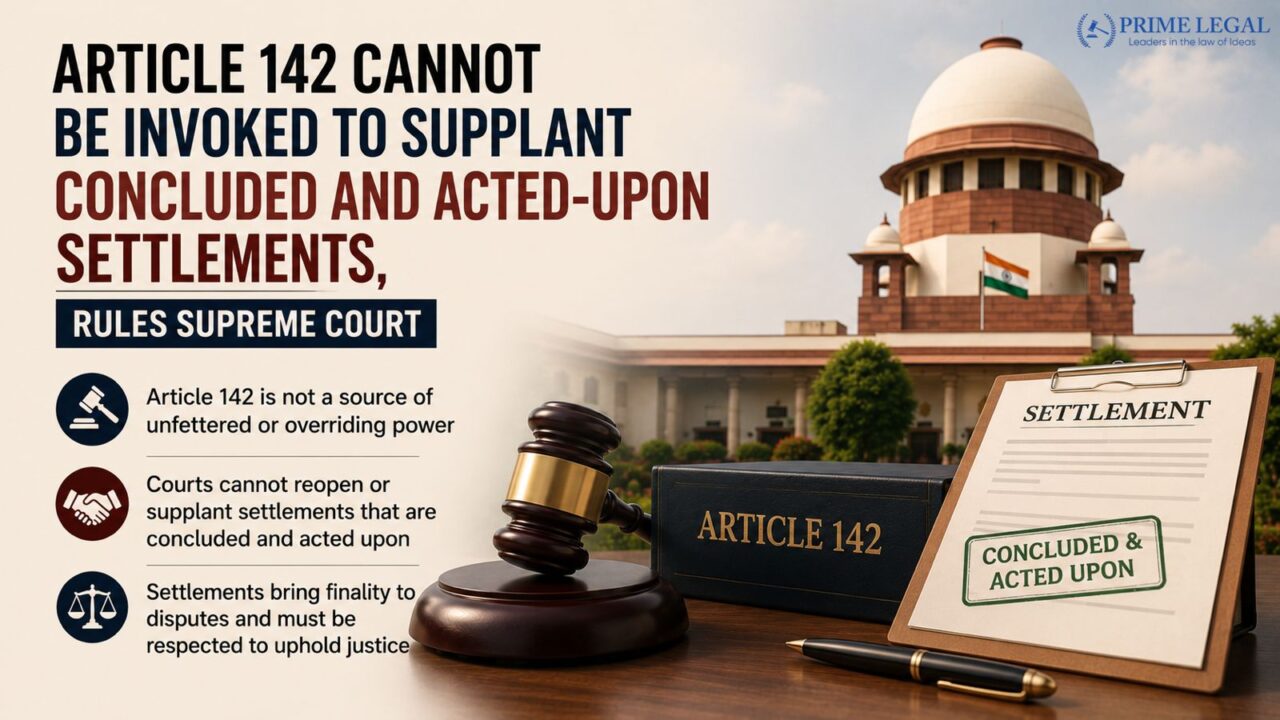
In addition, the Court found that the Appellant’s actions strengthened this interpretation. She did not demand the payment of the 20% annual income from 2017-2022 as she had done previously when seeking to recover payment for it, suggesting a mutual understanding that the payment had ceased. The Court, in addition, ruled that Article 142 of the Constitution cannot be used to reopen a binding and final consent settlement between two parties.
JUDGEMENT
The Supreme Court rejected the appeal, and upheld the concurrent decisions of the Family Court and the High Court. The Court clearly held that the Respondent-husband’s payment duties under Clause 9 had been fulfilled and would no longer be in effect once the payments were made under Clauses 8 and 10. The prayer for setting up a new body for the education of the son under Article 142 was rejected. The Court however formally recorded and accepted the Respondent-husband’s voluntary surrender of the money. While the proceedings were underway, he deposited Rs. 1 Crore, and had directed that it be used for the son’s higher education only.
CONCLUSION
The judgment upholds the notion that “matrimonial settlements should be treated in a holistic manner and not as individual clauses.” It restricts what can be done in execution proceedings, holding that the executing courts cannot alter or add to the specific provisions of a mutual consent decree. The judgment emphasizes that if a settlement contains a termination clause, it will automatically terminate obligations for interim periodic payments when they are satisfied.
“PRIME LEGAL is a National Award-winning law firm with over two decades of experience across diverse legal sectors. We are dedicated to setting the standard for legal excellence in civil, criminal, and family law.”
WRITTEN BY: SHEEN
Read the judgement copy below:
VIJAYALAKSHMI R. VERSUS C. L. BALAJI

