
INTRODUCTION
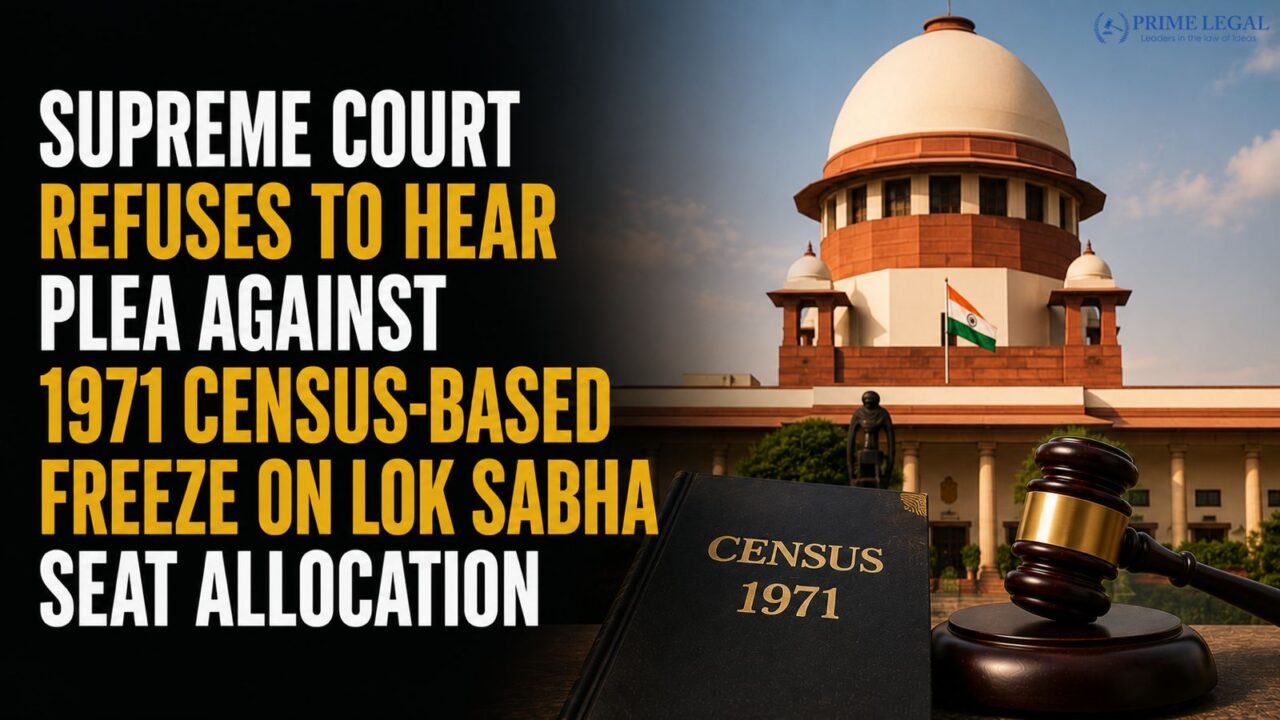
The Supreme Court of India decided not to consider a public interest litigation (PIL) challenging the constitutional validity of the 84th and 87th constitutional amendments in the case of Nishant Khatri v. Union of India. These amendments relate to the delimitation of Parliamentary and State Assembly constituencies. The Supreme Court bench, headed by Chief Justice of India Surya Kant, Justice Joymalya Bagchi and Justice V. Mohana, granted the petitioner’s plea to drop the petition. The bench had directed the petitioner to go for representation before the authorities instead.
BACKGROUND
The 84th Constitutional Amendment Act, 2001, put a freeze on reallocating the seats in Lok Sabha/State Assemblies based on the 1971 Census until the first Census after 2026. It, however, allowed for readjustment of territorial constituencies on the basis of the 1991 Census without changing the seats allotted to each State. The 87th Constitutional amendment Act of 2003 then ended the reference to the census of 1991, and introduced the census of 2001, which allowed for the delimitation of constituencies based on 2001 census data without altering the freeze on seats. Petitioner contended that the use of old census data amounted to denying equitable representation to almost 70% of the post-1971 Indians. The petitioner also pointed out that the value of the votes in the densely populated parliamentary seats has been affected with the growing population of the growing cities like Noida, Gurugram, Mohali etc., which has been growing at an exponential rate, but the seats have not increased in number.
KEY POINTS
- The Supreme Court has declined to hear a PIL challenging the continued use of the Census data of 1971 and 2001 for delimitation.
- Delimitation has no impact on the right to vote, said Chief Justice Surya Kant, who added that a person’s right to vote does not depend upon whether the village is part of a particular constituency or not.
- Justice Joymalya Bagchi explained that one can cast a vote from any constituency in which he is enrolled without consideration of domicile and the Chief Justice went on to add that a man could be a candidate to run elections.
- Justice Bagchi pointed out that the value of the vote is not “diluted” in comparison to the States, though it may be “diluted” in comparison to the overall population.
- Justice Bagchi added that the Constitution does not have an asymmetrical federalism or democracy approach between the States.
- The Court held that the issues raised were for the legislature/appropriate authorities to consider and the petitioner withdrew his plea.
ANALYSIS
The Supreme Court’s dismissal of the plea again reiterates that delimitation and constitutional amendment is a matter that must be addressed by the legislature and appropriate authorities. It highlights that core democratic participation is unaffected by constituency borders, and that the right to vote is not restricted by population changes. By emphasizing the level playing field among the states, the purpose of the constitutional system is to preserve a federal system of government, not an asymmetrical one. The petitioner raised valid concerns about the exponential growth of population in urban areas and the resulting weakening of vote value in those areas but the Court suggested that such laws should be changed as the will of the people’s representatives.
CONCLUSION
The Supreme Court had stuck to its earlier position that there is no need to intervene in the legislative standoff on delimitation of Lok Sabha constituencies on the basis of the Census data of 1971 and 2001. The order underscores the principle that any change in the existing system of political representation and reliance on census should be done through the parliament and not the courts.
“PRIME LEGAL is a National Award-winning law firm with over two decades of experience across diverse legal sectors. We are dedicated to setting the standard for legal excellence in civil, criminal, and family law.”
WRITTEN BY: SHEEN

