
INTRODUCTION:
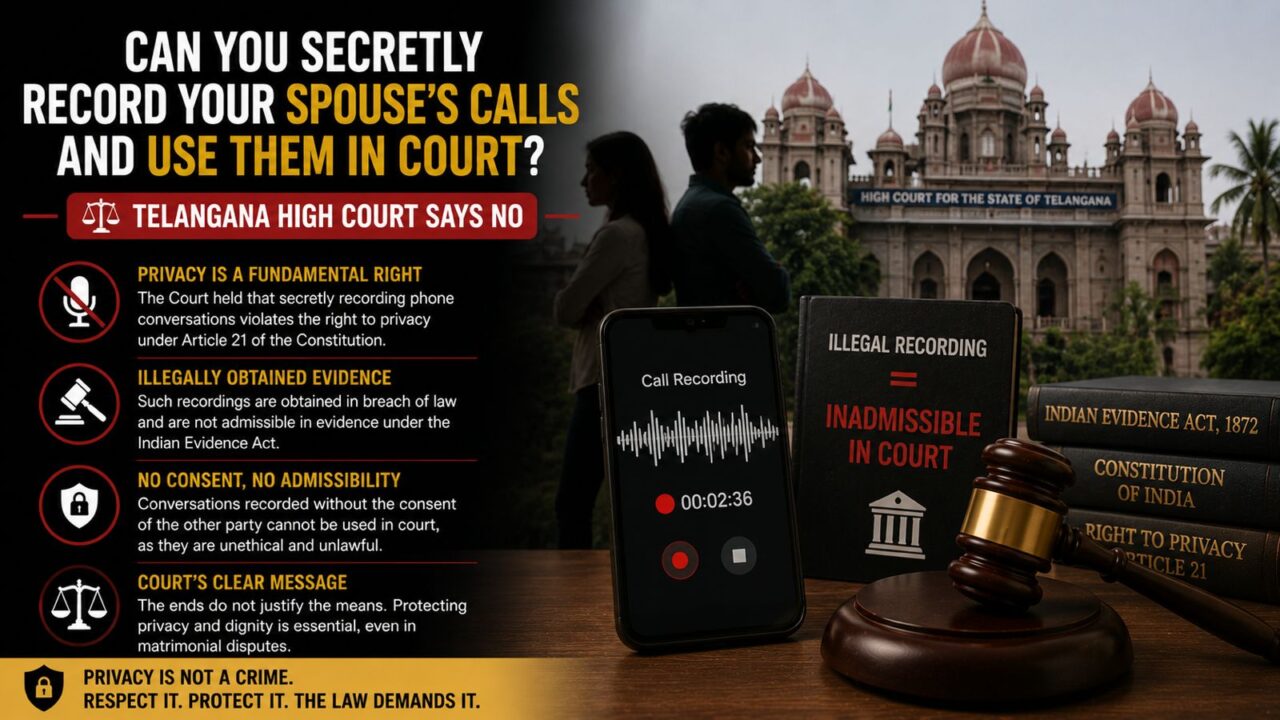
In a recent ruling upholding the right to privacy in marital relationships, the Telangana High Court stated that a spouse cannot record the private telephonic conversations of another spouse secretly and use such recordings as evidence in the court. The Court held that documents that are to be produced as electronic evidence should have a clear nexus with issues in the dispute and cannot be accepted merely because they were available in the electronic form.
BACKGROUND:
The matter came before the when a spouse attempted to use secretly recorded conversations of the other spouse in order to prove cruelty in Family Court proceedings. The trial court rejected such applications on the ground that the call recordings were not supported by the mandatory certificate required under Section 65-B of the Evidence Act and that there was no clarity about the existence of the original mobile phone.
The judgment from the Family Court led to an appeal being made in the Telangana High Court. The main issue considered by the High Court was whether secretly recorded private conversation of a spouse could be used as evidence in violation of the privacy clauses under the Constitution.
Rejecting the challenge, Justice Namavarapu Rajeshwar, upheld the trial court’s finding that the secretly recorded conversations were inadmissible, while commenting that secretly recording calls of a spouse violates right to privacy guaranteed under article 21 of the Indian Constitution.
KEY POINTS:
- The Telangana High Court held that secretly recording a spouse’s phone calls is in violation of the constitutional right to privacy.
- Documents that are to be produced as electronic evidence should have a clear nexus with issues in the dispute.
- Electronic proof unlawfully collected cannot be used in matrimonial disputes.
- The ruling establishes the right to privacy even in the relationships of a family.
ANALYSIS:
This judgment reestablishes the principles laid down by the Supreme Court in Justice K.S. Puttaswamy (Retd.) v. Union of India (2017) which recognized privacy as a fundamental right arising out of Article 21 of the Indian Constitution. It was recognized in the Puttaswamy judgement that definition of privacy helps in determining autonomy, keeping people’s information secure and safeguarding their interactions. The Telangana High Court based upon these principles to conclude that the privacy rights are independent of the matrimonial nature of a case.
It is to be noted here that the Supreme Court in 2025 in a matrimonial case of Vibhor Garg v Neha, held that secretly recording a spouse’s calls does not violate the fundamental Right to Privacy and may be admissible as evidence.
The Telangana HC while dealing with the specific facts of the present case held that the remaining documents that were to be introduced by the husband (appellant) included medical records, payment proofs, air tickets, photographs and money transfer records did not justify an allegation of cruelty. Moreover, the documents “appeared to relate to the cordial and successful marital life shared by the petitioner and the respondent”. Thus, a secret call recording in this case was a breach of privacy.
The ruling further underlines broader principles regarding electronic evidence as regulated by the Bharatiya Sakshya Adhiniyam, 2023, which states that the admissibility of electronic documentation depends on its legal validity. However, the acceptance of such evidence is tied with the legality of its collection processes as well.
The ruling has far-reaching impacts on protecting digital rights in family relationships. The court has strongly remarked that matrimonial relationships are based on trust rather than constant surveillance of a partner’s actions and that constitutional principles apply to relations in families. By putting dignity, autonomy, and privacy above unlawfully obtained evidence, Telangana High Court emphasized the significance of maintaining integrity in administering justice.
CONCLUSION:
The ruling of the Telangana High Court is of great importance in constitutional law, family law, and digital privacy. By rejecting the use of secretly recorded phone calls of spouses, the court affirmed the on-going importance of the privacy right even in marriage cases and asserted that privacy cannot be undermined by the methods of acquiring evidence.
“PRIME LEGAL is a National Award-winning law firm with over two decades of experience across diverse legal sectors. We are dedicated to setting the standard for legal excellence in civil, criminal, and family law.”
WRITTEN BY: SOMSUTA PAUL.

