
CASE NAME: Ajay Vijh vs. Indian Banks Association & Ors.
CITATION: 2026 INSC 670
CASE NUMBER: Civil Appeal arising out of SLP, No. 10787/2024
COURT: In the Supreme Court of India
DATE OF JUDGMENT: 7th July, 2026
QUORUM: Hon’ble Justice Pamidighantam Sri Narasimha & Hon’ble Justice Alok Aradhe
FACTS
The Appellant being an enrolled advocate was a panel counsel of Canara Bank since September 2010. The controversy was founded on a legal opinion provided by the Appellant on 8th August, 2015 with regard to the immovable property provided as security for a credit facility of Rs. 2.00 Crore. The Bank contended that the Appellant was negligent in failing to take note that a part of the said land had been alienated three years ago by sale deeds dated 31st October, 2012, involving the Bank’s risk of loss.
The Bank removed the Appellant from its panel for negligence in title verification without examining whether his explanation for the same is correct or not, on 31st January, 2019. The Bank thereafter forwarded the appellant’s name to the Indian Banks’ Association (IBA) leading to the appellant being added to the “Caution List” called “Third Party Entities Involved in Fraud” from 5th February, 2020 onwards.
The comments clearly read: “Given Wrong Legal Opinion and Negligence in Conducting Search and Bank Was Exposed to Loss and Financial Risk”. The Allahabad High Court dismissed the writ petition filed by the Appellant against this action, holding that IBA was not “State” under Article 12 of the Constitution, which led to the present appeal.
ISSUES
- Whether a writ petition challenging the inclusion of the Appellant’s name in IBA Caution List under Article 226 of the Constitution is maintainable.
- Whether the addition of an advocate’s name into the Caution List is an administrative action which is limited to the context of the contract or whether it will affect the advocate’s legal and constitutional rights.
- Whenever a complaint is made about professional misconduct or negligence of an advocate, does this matter lie squarely within the disciplinary jurisdiction of the Advocates Act, 1961, of the Bar Councils, or is it outside of that?
LEGAL PROVISIONS
- Article 12, Article 19(1)(g), and Article 226 of the Constitution of India.
- Section 35-A of the Banking Regulation Act, 1949.
- Sections 35, 36, 36B, 37, and 38 of the Advocates Act, 1961.
- RBI Circulars on Fraud Risk Management (2009, 2016, and 2024).
Case Laws referenced:
- Andi Mukta Sadguru Shree Muktajee Vandas Swami Suvarna Jayanti Mahotsav Smarak Trust v. V.R. Rudani.
- Bar of Indian Lawyers v. D.K. Gandhi PS National Institute of Communicable Diseases.
- Supreme Court Bar Association v. Union of India.
- Yash Developers v. Harihar Krupa Co-operative Housing Society Ltd.
ARGUMENTS
APPELLANT
The Appellant submitted that the legal opinion was properly based on a search certificate issued by the Sub-Registrar and an inspection of the relevant records and that the alleged sale transactions could not be discerned from the records available at that time. He argued that his name had been included on the Caution List without any prior warning or hearing, contrary to the procedural rules. He further contended that this act violated his fundamental right to practice his profession under Article 19(1)(g) of the Constitution by hugely impairing his reputation and resulting in his de-empanelment from other institutions. Finally, the appellant, supported by the Bar Council of India, submitted that allegations of professional negligence or misconduct squarely fall within the exclusive jurisdiction of the disciplinary authorities under the Advocates Act, 1961 and neither the Bank nor the IBA has jurisdiction to adjudicate upon the professional conduct of an advocate.
RESPONDENTS
The Respondents argued that IBA is not a statutory body or a “State” as defined under Article 12 of the Constitution and thus the writ petition is not maintainable. The respondents justified the inclusion of the name of the appellant in the Caution List on the basis of the regulatory framework and circulars issued by the RBI under Section 35-A of the Banking Regulation Act, 1949 in support of the merits. They contended that these circulars require the declaration of third-party entities and professionals, such as advocates, who spread false information or whose negligence exposes the banks to financial risk and encourages fraud.
ANALYSIS
The Supreme Court ruled that the High Court took a narrow perspective of Article 226. The Court pointed out that Article 226 also applies to the bodies which have public function even if they do not strictly speaking take up Article 12.
The IBA’s Caution List is a mechanism of adverse accreditation which has a direct impact on an advocate’s right to practice his/her profession as enshrined in Article 19(1)(g) of the Constitution, and has a nationwide industry-wide effect. The writ petition against the IBA is maintainable as the action has a public law aspect and also has a material impact on legal rights.
The Court considered the circulars issued by the RBI under Section 35-A of the Banking Regulation Act. It said the Caution List is a document “which is clearly designed for notifying banks of entities that are engaged in fraud”.
The mens rea and the intent to deceive are associated with fraud. The charges against the appellant were, on the contrary, a strict charge for professional negligence and a wrong legal opinion but were not for fraud, collusion or criminal misconduct. According to the Court, the introduction of a fraud prevention mechanism to ban an advocate for negligence is an unwarranted extension of the scope of the Caution List.
The Supreme Court highlighted that the legal profession is a unique one and the principle of self-regulation plays a significant role in the independence of the legal profession. The Advocates Act, 1961 gives a detailed and exclusive scheme for the adjudications of professional misconduct which has been given exclusively to State Bar Councils and the Bar Council of India (BCI). A bank cannot refuse to remain an advocate because they are unhappy with their performance; however, it would be wrong for the bank to take an action which would be a public blacklisting of the advocate without going through the statutory process of discipline because it would be a violation of the autonomy of the legal profession.
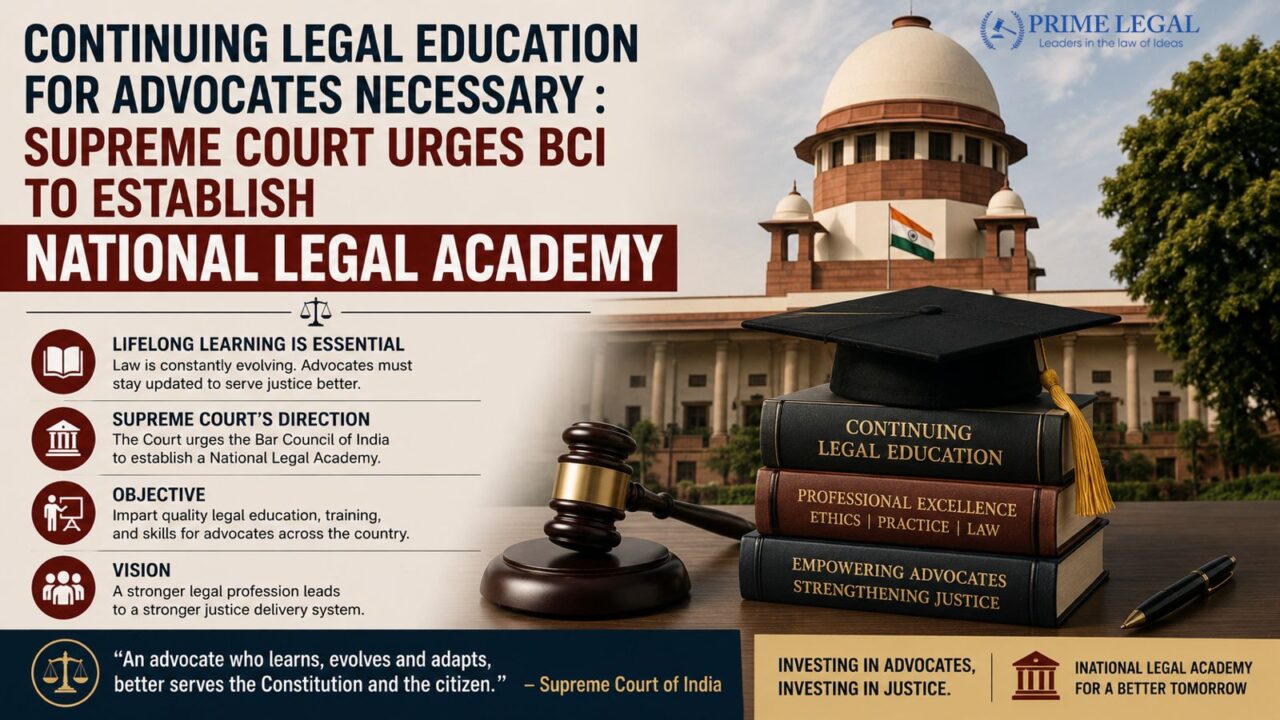
The Court observed that self-regulation is a privilege but has a responsibility attached to it of accountability. The Court expressed concern over delays and inefficiencies in the disciplinary process and directed the BCI to conduct a comprehensive performance audit of the disciplinary processes. The Court also said that lawyers also need continuous professional development and asked the BCI to formalize the Continuing Legal Education (CLE) and think about creating a full-time National Legal Academy (NLA) for lawyers on the lines of the National Judicial Academy.
JUDGEMENT
The Supreme Court allowed the appeal and set aside the judgment passed by the High Court of Judicature, Allahabad. The Court held that the listing of appellant’s name in the Caution List is unwarranted, uncalled for and without jurisdiction and ordered the respondents to delete his name from the Caution List immediately. The Bar Council of India was instructed to submit an affidavit containing an action plan on the performance audit, CLE and the NLA before the next call-up of the matter on 31st August, 2026.
CONCLUSION
This judgment is a significant one in protecting the independence of the legal profession, as it sets the precedent that any action of a disciplinary nature against an advocate can only be taken by the Bar Councils. It prohibits parallel disciplinary actions by third parties, like banks and banking associations. At the same time, the judgment puts a firm emphasis on the need for the Bar Council of India to update its regulatory regime using performance audits and compulsory continuing education so that the bar is held accountable, skilled and prepared to assist in the effective delivery of justice.
“PRIME LEGAL is a National Award-winning law firm with over two decades of experience across diverse legal sectors. We are dedicated to setting the standard for legal excellence in civil, criminal, and family law.”
WRITTEN BY: SHEEN.
Read the judgment copy below:

