
INTRODUCTION
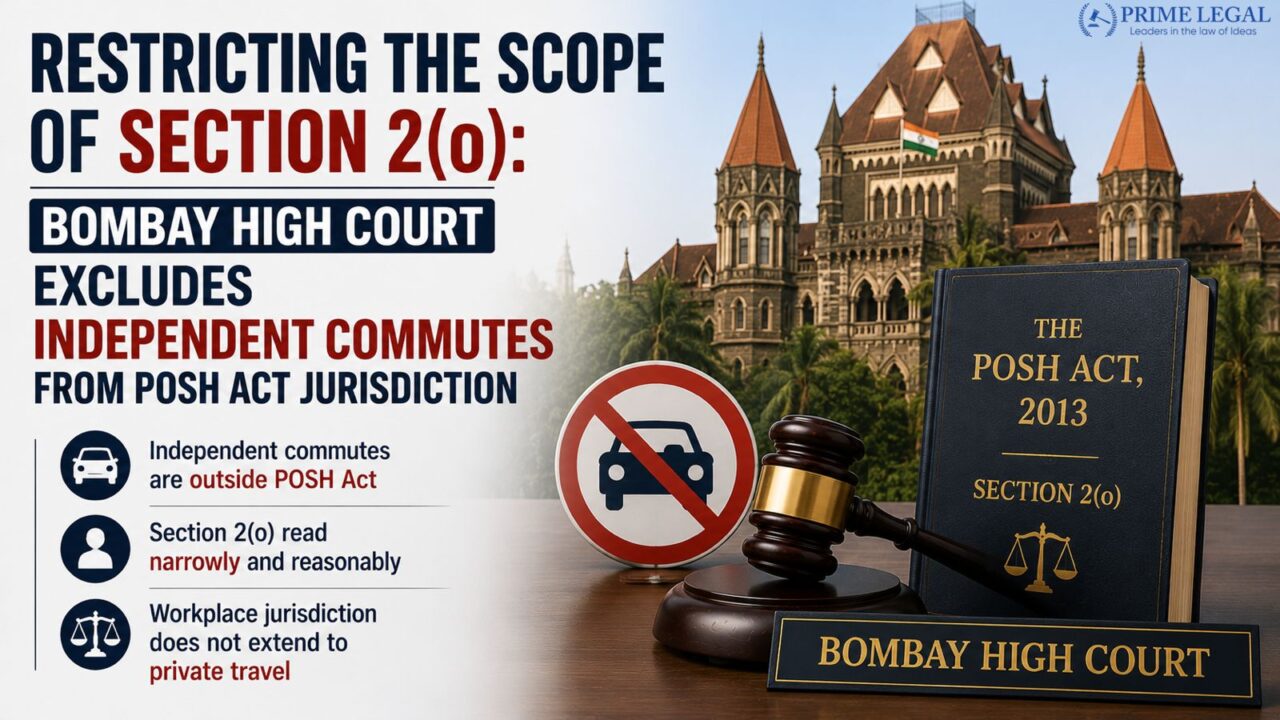
The Bombay High Court has made it clear what constitutes a workplace under the Sexual Harassment of Women at Workplace (Prevention, Prohibition and Redressal) Act, 2013 (POSH Act) by holding that an autorickshaw that is shared with others for commutes between one’s home and an office every day does not fall within the definition of a “workplace”. In a recent decision of the Division Bench of Justices Suman Shyam and Firdosh P. Pooniwalla, it upheld the appeal of a former employee of State Bank of India (SBI) and set aside the order of an Internal Complaints Committee (ICC) made against him, finding him guilty of sexual harassment. The Court explained that wherever there is a “means of transportation” made available to a person by his or her employer, the commuting to such workplace would be considered as having taken place at that time and therefore would fall within the jurisdictional purview of an ICC, but all other ordinary and usual means of transportation will never fall within the jurisdictional purview of an ICC under section 2(o) of the POSH Act.
BACKGROUND
On March 24, 2023, Siddhesh Pradeep Satpute (an employee of SBI) had an incident with a woman who was sharing a public autorickshaw with him from Kurla railway station to Bandra Kurla Complex. The woman accused him of engaging in unwanted physical conduct because the back seat was crowded. This led to an altercation, where she sprayed him with pepper spray, went to the police, and filed an FIR under Section 354-A of the IPC. After that incident, she made a complaint to her company’s internal complaints committee (ICC), which then forwarded the complaint to SBI’s ICC for investigation. After completing their inquiry, SBI’s ICC found Satpute guilty of sexual harassment and recommended disciplinary action. Satpute has challenged this finding by filing a writ petition in the Bombay High Court (Siddhesh Pradeep Satpute v. State Bank of India & Ors.) on the ground that the ICC did not have jurisdiction over the matter, as the public vehicle did not constitute a “workplace” according to the provisions of the POSH Act.
KEY POINTS
- The Court annulled the SBI ICC’s Order, holding that the Committee had no jurisdiction to investigate the Complaint since the event did not occur at a legally defined “workplace.”
- The Court stated in its examination of Section 2(o)(v) of the POSH Act that a workplace includes any place to which or to where a person goes in the course of their employment, “including transportation provided by the employer”.
- The Court interpreted the phrase “by” strictly under the statute to determine whether the place of transit was a workplace or not. The phrase “by” was not a mere ornament but required clear evidence that the transport will be provided or arranged by the employer to constitute a workplace according to the POSH Act.
- Because the autorickshaw used to transport the complainant was a public mode of transport and not one provided/arranged for by SBI or the complainant’s employer, it did not satisfy the requirement to constitute a workplace under the relevant legislation.
- With its decision, the Bench created an important procedural obligation that requires an ICC first to determine its jurisdiction by establishing whether there is a basis for responding to an allegation of harassment because the allegation is based upon occurring in a “workplace” before an ICC may be authorised to investigate the allegations.
- In doing so, the High Court explicitly stated that it did not investigate the merits or truth of the sexual harassment allegations and therefore, allows for the appropriate criminal or civil adjudications to address this issue.
RECENT DEVELOPMENTS
This decision establishes a critical legal precedent for ICC operation & corporate compliance throughout India. The Bombay High Court created clarity by clearly separating employer-mediated transport from independent transport when it addressed one of these grey areas with respect to how the POSH Act will be interpreted going forward. Legal professionals and HR are now reviewing their own policies to ensure ICCs determine jurisdictional validity before beginning any investigations. This decision also means that employees who have an incident while commuting to/from work on public transport cannot be disciplined through internal disciplinary processes and are entitled to make a criminal complaint (i.e., FIR) for incidents that occur on public properties.
CONCLUSION
In Siddhesh Pradeep Satpute v. State Bank of India & Ors., the Mumbai High Court has reiterated that while the extensive spirit of the POSH Act is noteworthy, it does not extend beyond what has been clearly legislated. Therefore, the Court has limited Section 2(o) only to transportation that is provided by the employer; therefore, internal corporate tribunals do not have jurisdiction over daily life. This decision also protects the employer from liability (in respect of independent events that occur while an employee uses public transit). Finally, it maintains the integrity of the legal due process, as those types of cases that fall outside an employer’s jurisdiction must be reported to the appropriate law enforcement agencies.
“PRIME LEGAL is a National Award-winning law firm with over two decades of experience across diverse legal sectors. We are dedicated to setting the standard for legal excellence in civil, criminal, and family law.”
WRITTEN BY: VINEET SEERVI

