
INTRODUCTION
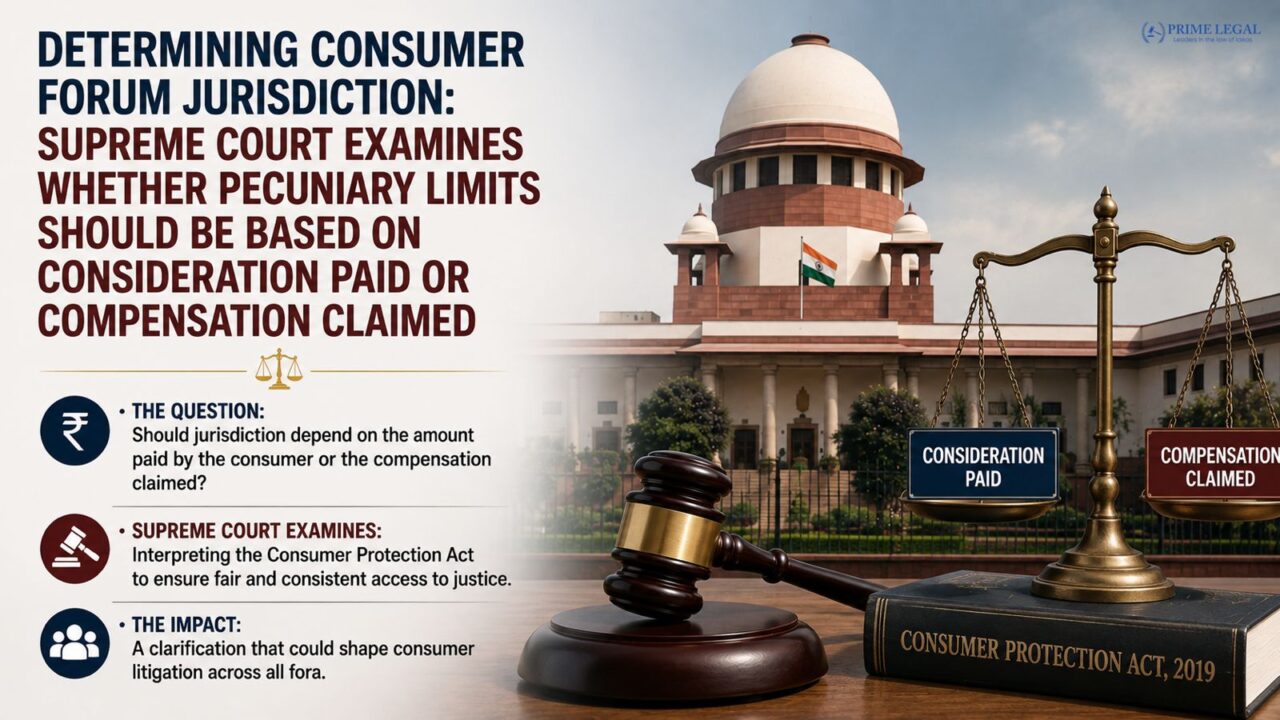
The Supreme Court has identified some discrepancies that can come up if the monetary jurisdiction of consumer courts is fixed according to the amount of money spent on the purchase of goods or services, and has asked for a reaction from the Union government. These remarks were made by a Bench comprising Justices K.V. Viswanathan and Arun Palli on 13 August 2026, during the hearing of a special leave petition relating to an insurance matter.
BACKGROUND
The pecuniary jurisdiction of the District, State and National Commissions under the now-defunct Consumer Protection Act, 1986 was determined on the basis of the total value of goods or services along with the amount of compensation sought. In contrast, the Consumer Protection Act, 2019 took a different stand wherein the determination of jurisdiction was based only on the value of the consideration for the goods or services. This case emanated from the decision of the National Consumer Disputes Redressal Commission on an insurance case between M/S Avon Elastomers (India) and Bajaj Allianz General Insurance Co. Ltd.
KEY POINTS
- Senior Advocate Gagan Gupta, for the petitioner, demonstrated how fixed deposit account holders in banks are consumers, although the account holders would not be able to approach the relevant commission on the matter due to the consideration element not being present since the amount paid is not paid for creating the FD account.
- In regard to subsidised medical services, where there are those who pay and those who do not, Mr. Gupta pointed out how the consideration only test could lead to different results although both were consumers.
- A further illustration concerned deficiencies limited to fixtures or fittings in a flat: absent a consideration breakup for those items, the entire value of the flat may have to be treated as the jurisdictional basis.
- The Court noted a car-purchase example: a buyer of a ₹2.5 crore car with a grievance limited to a defective windshield would have to approach the National Commission, while a buyer who had paid only a ₹40 lakh advance and faced delayed delivery would go to the District Commission – despite the latter dispute potentially involving a larger transaction.
- Advocate Jagdish Chandra Solanki, for a respondent, pointed out that complaints are not filed only by individuals who have paid consideration; under Sections 2(5) and 18 of the Consumer Protection Act, 2019, registered consumer associations, government authorities and the Central Consumer Protection Authority may also institute proceedings, where consideration paid would not arise at all.
- Additional Solicitor General Vikramjit Banerjee, for the Union, relied on the Court’s earlier ruling in Rutu Mihir Panchal v. Union of India (2025), upholding the constitutional validity of the pecuniary jurisdiction provisions; the Bench clarified it was not questioning legislative competence, but sought clarity on how the provisions would operate given the anomalies raised.
RECENT DEVELOPMENTS
The Court has directed the Union of India, through the concerned ministry, to file an affidavit within six weeks addressing the anomalies highlighted during the hearing, and also explaining the reasoning behind reducing the National Commission’s pecuniary jurisdiction from ₹10 crore, as originally fixed under the 2019 Act, to ₹2 crore, by a notification dated 30 December 2021. The Bench clarified that the illustrations discussed were only indicative, not exhaustive. The matter has been listed for further hearing on 8 October 2026.
CONCLUSION
The Court’s intervention signals a willingness to revisit how consumers form pecuniary jurisdiction nearly seven years after the 2019 Act departed from the compensation-inclusive formula used under the 1986 regime. While the Bench has noted that Parliament’s power to prescribe the jurisdictional basis is not in question, its request for an affidavit addressing concrete anomalies, and specifically the steep reduction in the National Commission’s threshold, suggests the outcome could meaningfully affect where consumers must file complaints, particularly in no-consideration or subsidised-service disputes that presently sit in an uncertain jurisdictional zone.
“PRIME LEGAL is a National Award-winning law firm with over two decades of experience across diverse legal sectors. We are dedicated to setting the standard for legal excellence in civil, criminal, and family law.”
WRITTEN BY: DRISHTITA BANIK

