
INTRODUCTION
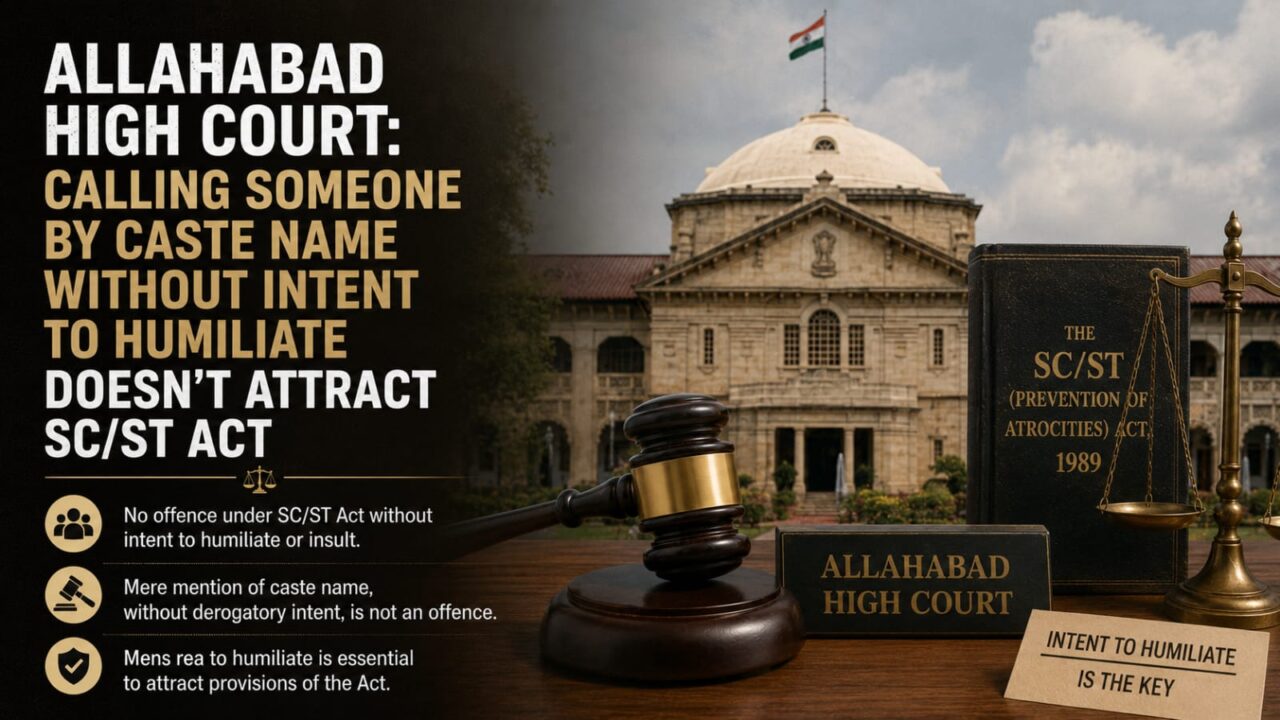
On 13 August 2026, the Allahabad High Court, in Vegraj Singh and Another v. State of U.P. and Another, 2026: AHC:171011, allowed a criminal appeal filed by two accused persons who had been summoned as additional accused under Section 358 of the Bharatiya Nagarik Suraksha Sanhita, corresponding to Section 319 CrPC, in a prosecution involving offences under the Scheduled Castes and Scheduled Tribes (Prevention of Atrocities) Act, 1989. A Single Judge Bench of Justice Santosh Rai set aside the summoning order dated 21 March 2025, holding that mere utterance of a caste-denoting word, without evidence of intent to insult or humiliate the victim on the ground of her caste, does not attract the SC/ST Act.
BACKGROUND
Case Crime No. 0290 of 2024 was registered at P.S. Izzatnagar, Bareilly, naming appellants Vegraj Singh and Daulat, along with the main accused Himmat Singh, under Sections 376(2)(n), 504 and 506 IPC and Sections 3(2)(5A), 3(2)(r) and 3(2)(s) of the SC/ST Act. Vegraj is the father, and Daulat the elder brother, of Himmat Singh. During investigation, statements of the victim and witnesses were recorded under Sections 161 and 164 CrPC.The Investigating Officer filed a charge-sheet only against Himmat Singh and exonerated the present appellants for want of material against them. However, during the Sessions trial (State of U.P. v. Himmat Singh, Sessions Trial No.1452 of 2024), the victim, deposing as PW-1, stated that the appellants had abused her using the word “Chamar” and had threatened her. On this basis, the Special Judge (S.C./S.T. Act), Bareilly, summoned the appellants as additional accused under Section 358 BNSS. The appellants challenged this order before the High Court.
KEY POINTS
Learned counsel for the appellants submitted that the victim’s earlier statements under Sections 161 and 164 CrPC did not attribute any specific casteist remark, abuse or intimidation to the appellants and that the summoning rested solely on the trial deposition of PW-1. It was contended that mere use of the word “Chamar” cannot, by itself, establish an intent to insult on the ground of caste and that the main allegations of rape and promise of marriage were directed solely against Himmat Singh. The State opposed the appeal stating that the victim had consistently named the appellants and that the assessment of the deposition of PW-1 by the trial court could not be discarded just because the Investigating Officer had earlier exonerated them and that questions of intent toThe Court held that no specific or distinct casteist role had been attributed to either appellant, either in the FIR or in the statements recorded under Sections 161 and 164 CrPC, and that mere use of a caste-denoting word does not, without more, satisfy Sections 3(1)(r) and 3(1)(s) of the SC/ST Act. Relying on Swaran Singh v. State, (2008) 8 SCC 435, the Court reiterated that words such as “Chamar” amount to an offence only when used with intent to humiliate a member of a Scheduled Caste, and must be read in their popular, social meaning rather than their etymological sense. The Court also invoked Gorige Pentaiah v. State of A.P., 2009 Cri LJ 350; Hitesh Verma v. State of Uttarakhand, (2020) 10 SCC 710; Shajan Skraria v. State of Kerala, 2024 SCC OnLine SC 2249; and Khuman Singh v. State of M.P., (2020) 18 SCC 763, all holding that the offence requires intentional insult on account of caste, and is not made out merely because the complainant belongs to a Scheduled Caste or Scheduled Tribe.
RECENT DEVELOPMENTS
The Court placed significant reliance on the Constitution Bench decision in Hardeep Singh v. State of Punjab, (2014) 3 SCC 92, describing the power under Section 319 CrPC as extraordinary and discretionary, exercisable only where the material is stronger than that required at the charge-framing stage, though short of what is needed for conviction.The Court applied this threshold and held that the appellants had been summoned in a casual manner without cogent material establishing complicity. It will also set the standard for future prosecutions under Section 319 CrPC or Section 358 BNSS, as a denial of family ties with the co-accused or a deposition on a single occasion referring to a caste-word can’t be considered as persuasive evidence of intentional casteist insult.
CONCLUSION
If the prosecution is to be based on the SC/ST Act, it is necessary to establish clear evidence of insult or humiliation that has been done for the purpose of insulting or humiliating a person on the basis of his caste and not the mere use of a caste associated word during an altercation. It also observes that the higher standard of proof required at the stage of framing is an additional evidence which is not required at the stage of invoking Section 319 CrPC, as now amended and renamed Section 358 BNSS.
“PRIME LEGAL is a National Award-winning law firm with over two decades of experience across diverse legal sectors. We are dedicated to setting the standard for legal excellence in civil, criminal, and family law.”
WRITTEN BY: GAURAV VIBHU RANJAN
Read the Judgement copy below:
Vegraj Singh And Another v. State of U.P. and Another

