
INTRODUCTION
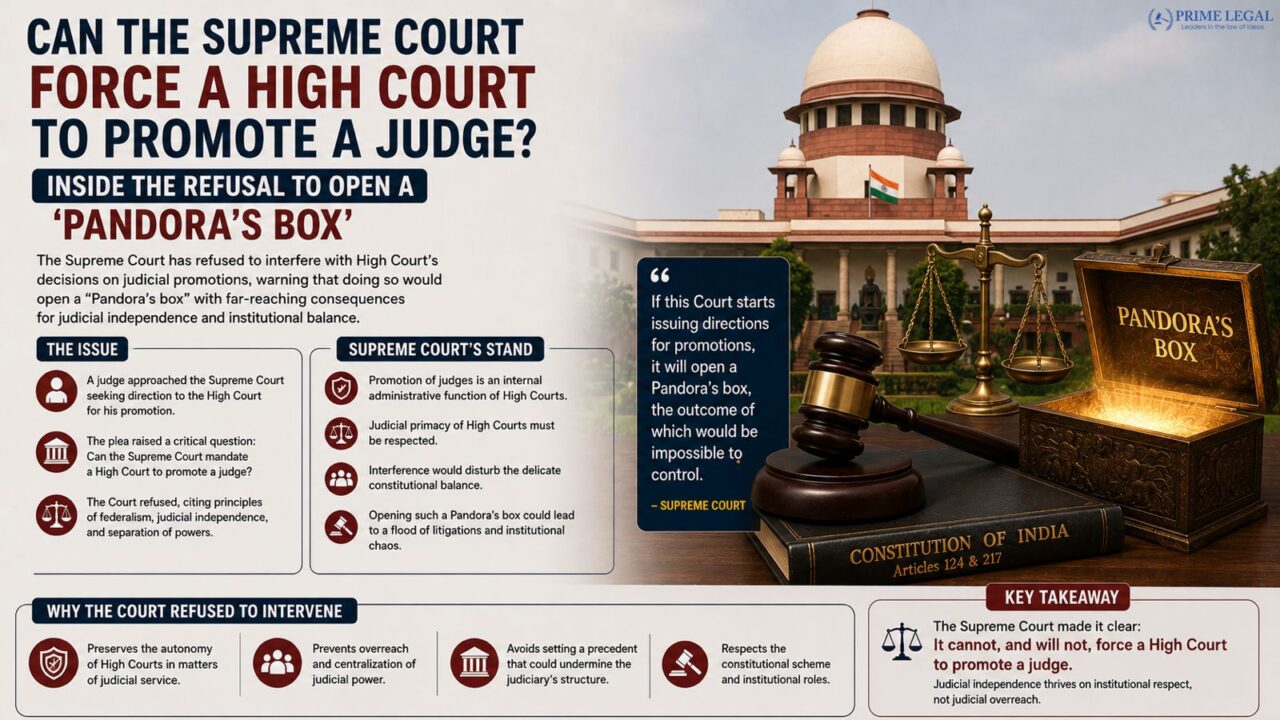
The Supreme Court of India in the case of Arvind Malhotra, Principal Judge, Family Court, Dharamshala, refused to entertain a writ petition filed by him challenging the order of the Collegium, headed by Justice B.V. Nagarathna, of the Himachal Pradesh High Court for recommending the judicial officers of the court for elevation. The Bench said that the collegium proceedings were matters of subjective satisfaction and also the proceedings were conducted under strict confidentiality and such deliberations are out of judicial purview. The Court noted that it was “not desirous to go into the reasons for the decisions of the Collegium of High Court and Supreme Court by asking questions into it, which may lead to an opening of a Pandora’s box”, and disposed of the petition, advising the petitioner, who has 10 years of service remaining, to “exercise patience and avail administrative remedies”. The question raised by the case is a fundamental one for the constitution: what is the limits of the collegium’s sequestered power and where does the right to a fair consideration begin?
BACKGROUND
- The Supreme Court had earlier received two district judges’ submissions requesting that the Collegium of the Himachal Pradesh High Court ignore their seniority and merit in nominating candidates for elevation. In September 2024, the Supreme Court permitted that petition and asked the High Court Chief Justice to re-think their names. The petitioner was later summoned for an interaction in September 2025 along with the documents. On 3 June 2026, the Supreme Court Collegium chaired by CJI Surya Kant recommended the names of three judicial officers Chirag Bhanu Singh, Bhupesh Sharma and Yogesh Jaswal for the appointment as judges in the Himachal Pradesh High Court which has only 12 judges against 17 strength including the Chief Justice of the Court. Malhotra went back to the Supreme Court with a fresh writ petition in the name of Article 32 of the Constitution, stating that the previous directions were not followed.
KEY POINTS
- The Bench ruled that there was no right to elevation as a High Court judge based on the basis of seniority. Subjective judgment of the collegium on the concept of ‘suitability’ and ‘merit’ as well as institutional requirements governs the appointments under Article 217 of Constitution and not the inter-se seniority of the district judges.
- Justice Bagchi pointed out that the Supreme Court Collegium’s recommendation was what was actionable and not the High Court Collegium’s. At that time the petitioner was not entitled to challenge the order of the Collegium in the High Court, in an interlocutory application.
- The Bench reiterated that the proceedings of a collegium are confidential. The Court had pointed out that such directions would make the proceedings akin to an RTI, which the Court did not approve of: “These are matters of secrecy. It cannot be like an RTI.”
- The Court said if there is any procedural defect it has not been proved, and the name of the petitioner had not been officially rejected, it may have been deferred. There was no adverse order and hence no cause of action, as per the principles laid down in the Second Judges Case (S.P. Gupta v. Union of India, AIR 1982 SC 149) and the Third Judges Case (In Re: Special Reference 1 of 1998, (1998) 7 SCC 739), which guards collegium primacy against external interference.
- The Bench warned that if it allowed the relief then there would be a deluge of similar applications from those who had been overlooked in the appointments. The petitioner was told to go back and file a reminder representation, so that he could continue to have his future cases heard without risking them.
RECENT DEVELOPMENTS
For years, the collegium system2019s opacity has been subject to scholarly critique. Such bypassing of one of the senior judicial officers without any reasoned, published order is a breach of rule of law in the very institution which is supposed to uphold it, as noted by Prof. (Dr.) M.P Singh and the jurists in the Journal of the Indian Law Institute. The First Judges Case (S.P. Gupta, 1982) had given more weight to the executive and the Second Judges Case (Third Judges Case) was seen as shifting the balancing point to the collegium, without resolving the issue of transparency in the collegium. The collegium has been ousted by Parliament2019 in the Supreme Court Advocates-on-Record Association v. Union of India (2015) 16 SCC 1 (the Fourth Judges Case) for violating judicial independence. This is the dilemma faced with in the present ruling: strong independence from the executive, but weak accountability. The high court at Shimla is functioning at a level of around 70% and appointments remain unfilled due to vacancies, while questions remain over fairness of the process.
CONCLUSION
In Arvind Malhotra v. High Court of Himachal Pradesh (W.P.(C) No. 779/2026), it is held that for all practical purposes the collegium’s appointment decisions are a self-contained space which is not subject to judicial scrutiny on merits. The Supreme Court’s hesitation to demand disclosure or reconsideration was a conscious constitutional decision taken in the Judges Cases to shield judicial appointments from outside influences. However, the judgment tacitly recognizes an unspoken dilemma: How to keep a system for preserving independence fair at some point. The only way to overcome the lack of transparency in the collegium process, till the day it is revisited by Parliament or a larger bench of the Constitutional Court, is to be patient and remind everyone about representation.
“PRIME LEGAL is a National Award-winning law firm with over two decades of experience across diverse legal sectors. We are dedicated to setting the standard for legal excellence in civil, criminal, and family law.”
WRITTEN BY: ARNAV NAIK

