
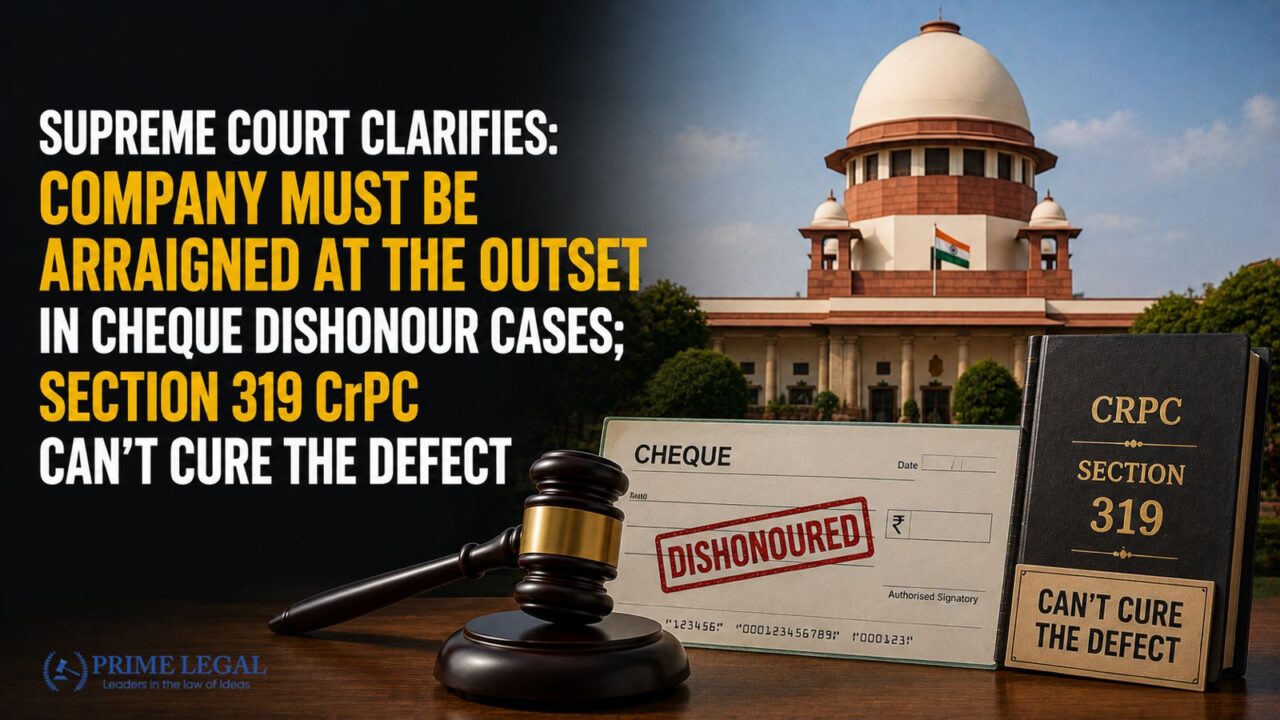
CASE NAME: Manjula Kapoor v. The State of Himachal Pradesh and Anr.
CASE NUMBER: Criminal Appeal No. ___ of 2026 (Arising out of SLP (Crl.) No. 8240 of 2016)
COURT: Supreme Court of India, Criminal Appellate Jurisdiction
DATE: 29 July, 2026
QUORUM: Hon’ble Manoj Misra, J. and Hon’ble Vijay Bishnoi, J.
FACTS
Respondent No. 2, Pankaj Sharma, filed a complaint against the Appellant, under Section 138 of the Negotiable Instruments Act, 1881, stating that there was a company which owed him Rs. 5,00,000 for services rendered, and that a cheque for that amount, signed by the appellant as the company’s authorised signatory, was dishonoured with the remark “payment stopped by drawer.” The complaint did not implead the company itself. A The appellant was issued with a summons, and the trial commenced. As regards the case under Section 313 CrPC, the appellant has made an application for quashing of the complaint under Section 482 CrPC along with Article 227 on the grounds that the complaint is not maintainable, considering that the company had not been impleaded as an accused, in line with Aneeta Hada v. Godfather Travels & Tours (P) Ltd. Although the High Court accepted this stance, it refused to quash the complaint and instead ordered the Trial Court to implead the company as an accused under Section 319 CrPC and conduct the trial afresh.
ISSUES
- Whether a complaint under Section 138 NI Act that fails to implead the company on whose account the cheque was drawn is maintainable against the signatory alone.
- Whether such a defect, once the limitation period under Section 142 NI Act has expired, can be cured by invoking Section 319 CrPC to implead the company mid-trial.
LEGAL PROVISIONS
- Sections 138, 141 and 142, Negotiable Instruments Act, 1881
- Section 319 and Section 482, Code of Criminal Procedure, 1973
- Article 227, Constitution of India
- Case Laws:
Aneeta Hada v. Godfather Travels & Tours (P) Ltd., (2012) 5 SCC 661;
State of Madras v. C.V. Parekh, (1970) 3 SCC 491;
- Harihara Krishnan v. J. Thomas, (2018) 13 SCC 663
ARGUMENTS
APPELLANT: It was submitted that a complaint against a director or authorised signatory, without impleading the company, is not maintainable per Aneeta Hada. Since Section 142 NI Act prescribes a limitation period for filing such complaints, a complaint suffering this fatal defect is non est in law, and its defect cannot be cured after limitation has expired by resorting to Section 319 CrPC.
RESPONDENT NO. 2: It was contended that inasmuch as the authorized signatory of the appellant had signed the cheque on behalf of the company, this was only a technical deficiency which could be rectified in accordance with Section 319 of CrPC; otherwise, it would lead to grave injustice to the accused.
ANALYSIS
The court reaffirmed, in line with the precedent set in Aneeta Hada, that the liability for an offence under Section 138 rests first on the account holder, which in the present case is the company, and that the vicarious liability created by Section 141 can only be attracted when the company itself has been arraigned as an accused. Given that Section 142 prescribes a period of one month from the date of occurrence of the cause of action, within which the complaint must be filed, and in view of the fact that the present complaint did not even name the company as an accused, the defect was inherent right from the beginning. The Court further held that Section 319 CrPC, by which an existing trial can be enlarged to include additional accused persons, cannot be resorted to in order to give a fresh lease of life to a complaint which had already lost its validity because of its being time barred following N. Harihara Krishnan, it made it clear that the only way out was to file a fresh complaint.
JUDGMENT
The Supreme Court upheld the appeal, struck down the order of the High Court, and set aside the complaint together with any resultant Section 138 proceedings initiated against the appellant.
CONCLUSION
In the event that a complaint filed under Section 138 NI Act does not name the company in whose favour the cheque was made, then that complaint is intrinsically flawed right from the start; there is no scope for using Section 319 CrPC for bringing the company on board, especially where the limitation period under Section 142 has expired.
“PRIME LEGAL is a National Award-winning law firm with over two decades of experience across diverse legal sectors. We are dedicated to setting the standard for legal excellence in civil, criminal, and family law.”
WRITTEN BY: DRISHTITA BANIK
Read the Judgement copy below:
MANJULA KAPOOR VERSUS THE STATE OF HIMACHAL PRADESH AND ANR

