
INTRODUCTION
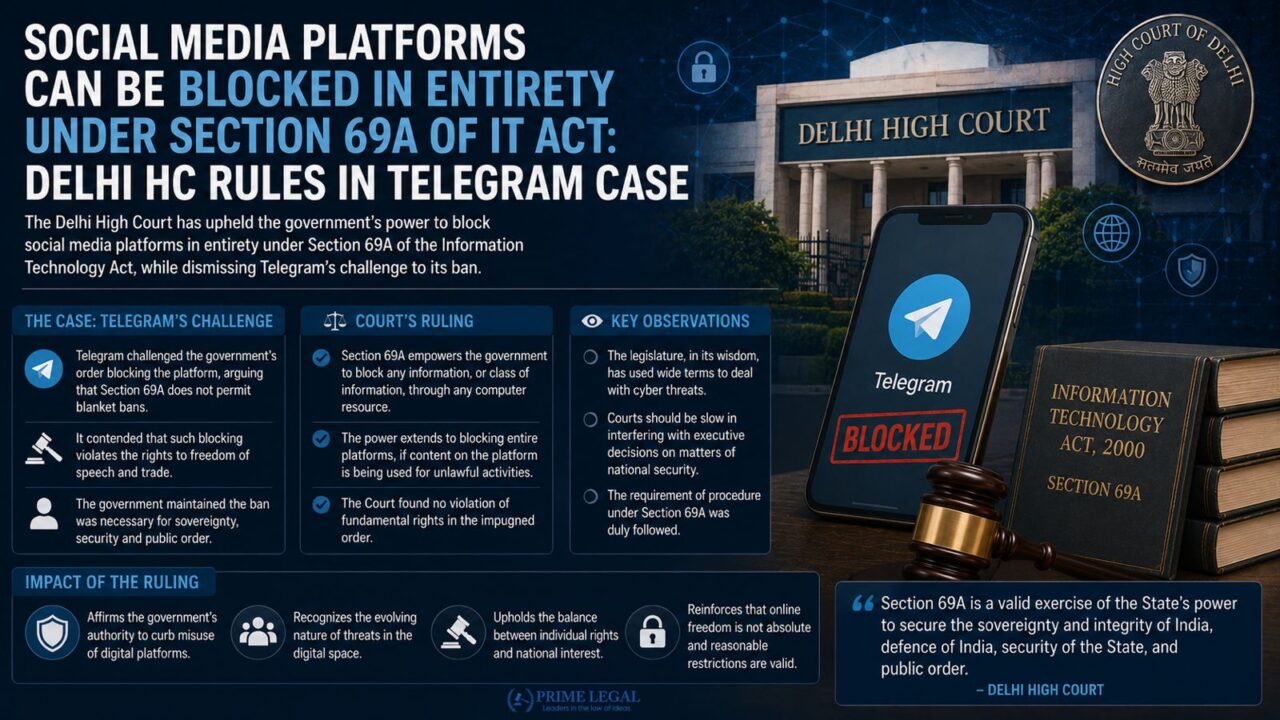
In a landmark and highly consequential ruling, the Delhi High Court has made an important decision indicating that it recognises the Central Government’s power under Section 69A of the Information Technology Act 2000. This decision clarifies that the Government COULD block access to entire social media or messaging platforms and not just individual pieces of content. This landmark decision was made by Justice Tejas Karia in Telegram FZ LLC & Anr. v. Union of India & Ors. (2026), when she dismissed a challenge to the Government of India’s interim order banning the Telegram Messaging App from being used in India. This decision creates sweeping changes to how digital platforms will be regulated in India and increase State authority regarding action against all online intermediaries.
BACKGROUND OF THE DISPUTE
The Ministry of Electronics and Information Technology (MeitY) blocked Telegram nationwide through the invocation of emergency powers until 22 June 2026 after receiving a recommendation from the National Testing Agency (NTA). The push for invoking this emergency power came from the widespread circulation of leaked question papers, along with fraudulent claims pertaining to the NEET-UG 2026 re-examination, as well as misleading information about the examination process.
According to officials, Telegram was frequently used as a safe Haven by cyber criminals and paper leak syndicates due to its unique architecture, including cloud-based infrastructure, ability to share large files, existence of automated bots and ability to edit messages, which allows bad actors to alter timestamps, making it difficult to enforce granular moderation.
After being denied access to their platform and their reasons presented in court hearings, Telegram approached the Delhi High Court and asserted that Section 69A of the IT Act only applies to blocking individual posts, URLs or messages; it cannot mean that a platform may be generally blocked in this manner, affecting legitimate users in India (totalling approximately 150M). Telegram also maintained that the legislative order was disproportionately large and that no rational analysis was given regarding its issuance.
KEY POINTS OF THE JUDGMENT
The High Court dismissed Telegram’s plea, delivering several critical observations on the scope of digital regulation:
- Broad Definition of Information: The most important finding made by the Court was how it viewed Section 69A in relation to the government being able to block any “information”, that is, something created, sent, received, stored or held on any computer resource. Justice Karia stated that Section 2(1)(v) of the IT Act defines “information” to explicitly include “codes”, “computer programs” and “software”. Thus, because an app or platform is comprised of software and code, the entire platform constitutes “information” and may be blocked accordingly.
- Failure of Entity Specific Actions: The court agreed with the government’s claim that targeted takedowns of content were generally impractical due to the existence of mirror channels, reserve networks and the speed at which audience migrations occur. Evidence demonstrated that attempts to remove targeted groups were repeatedly undermined due to the use of architectures that cannot generally distinguish between illegal and legal content at scale. design prevented the isolation of unlawful content from lawful content at scale.
- Proportionality and State of Emergency Powers- The High Court examined the proportionality test that was first articulated in earlier Supreme Court decisions and determined that there was a proper justification for the blanket ban applied throughout the platform. It determined that the restrictions were in effect only temporarily (during the time of the examination) and that, based on the circumstances of the situation, they were the least restrictive option available after repeated attempts to use something less restrictive failed.
- Procedural Compliance-The Court rejected any allegations of arbitrary action, noting that there was enough detail provided for the emergency blocking order, and it was also determined to be fully compliant with the requirements of the 2009 Blocking Rule.
IMPLICATIONS FOR DIGITAL PLATFORMS
This new decision creates a powerful precedent for the assignment of intermediary liability as well as State regulation of the Internet in India. The Delhi High Court has now legally defined an entire platform as “information”, which establishes platform-wide blocking as a legitimate state regulatory tool in circumstances where it can no longer control locally moderated information.
Legal experts, along with civil rights advocates, have expressed concerns that this would extend the application of Sec. 69A of the Act beyond the meaning intended by legislators, including the determination by the SC of India in the case of Shreya Singhal v. Union of India, to only permit granular blocking of materials. This determination puts platforms that have strong encryption, anonymity and decentralised network architecture at risk of being deemed non-compliant with the enforcement of their involvement in policing their networks.
CONCLUSION
The decision by the High Court of Delhi regarding the case with Telegram makes it possible for the Government of India to enforce laws about online usage through a far greater number of means than have previously existed. While establishing as being of primary importance the need to maintain public tranquillity and thwart widespread fraud, it also gives rise to very serious questions about how to balance national security with an intermediary’s safe harbours, and the rights of millions of innocent individuals using such platforms.
“PRIME LEGAL is a National Award-winning law firm with over two decades of experience across diverse legal sectors. We are dedicated to setting the standard for legal excellence in civil, criminal, and family law.”
WRITTEN BY: VINEET SEERVI

