
CASE NAME: Maniyar Iliyaz and Ors. v. P.Ayyappan and Ors.
CASE NUMBER: Civil Appeal No. 4665-4666/2025
COURT: Supreme Court of India
DATE: 19 June 2026
QUORUM: Hon’ble Justice P.S.Narasimha and Hon’ble Justice Atul S. Chandurkar
FACTS
One morning on the same day the appellant, Maniyar Iliyaz @ Shaik Riyaz, was taking his five year old son to a local school when the driver of the tanker, who was driving in the opposite direction, hit the child and damaged his waist and lower body. The boy died as a result of his injuries. The Court observed that at the place of accident there was no footpath and no pedestrian crossing which is a sad common feature in India. The appellant filed a claim petition in the Motor Accidents Claims Tribunal (MACT) claiming Rs. 16,79,500/- as compensation. 25,00,000/-. The MACT, by its award dated 30.05.2016, granted Rs. 7,82,000/- with interest @ 6% per annum from the date of the petition until the realisation. The appellant and Insurance Company appealed in the High Court. The High Court rejected the appellant’s appeal and on the Insurance Company’s appeal, lowered the compensation to Rs. 4,70,000/-. The appellant was aggrieved and went to the Supreme Court. In deciding the issue of compensation, the Court also considered the fundamental right to walk and the access to demarcated footpaths, which was a broader constitutional issue.
ISSUES
- Whether High Court erred in reducing compensation awarded by MACT to minor child who died in road accident.
- If the right to walk on demarcated footpaths is a fundamental right under the Constitution of India, including under Articles 19(1)(d) and 21?
- If the Motor Vehicles Act, 1988, properly acknowledges and safeguards the rights of pedestrians, or whether an independent legislation is needed.
- What are the correlative responsibilities of the State and local governments with respect to the right to walk, and what are the consequences of their failure to fulfil those responsibilities?
LEGAL PROVISIONS
- Constitution of India, Article 13
- Constitution of India, Article 19(1)
- Constitution of India, Article 21
- Constitution of India, Article 51A
- Motor Vehicles Act, 1988
- Motor Vehicles (Driving) Regulations, 2017
- Specific Relief Act, 1963, Section 38-40
- Minimum Wages Act, 1948
ARGUMENTS
PETITIONER:
The MACT was giving Rs. Even Rs. 7,82,000 was not enough and the High Court was seriously mistaken to further cut it down to Rs. 4,70,000/-. The principles of calculating compensation for the death of a minor child must be applied in accordance with this Court’s precedent in Karuna Parmar v Prakash Sinha (2025 INSC 1244) which has emphasized notional income, minimum wage, future prospects and the multiplier method. There was no foot path, no pedestrian crossing and this was a major contributing factor to the child’s death, it was a failure on the part of civic authorities.
RESPONDENT:
The High Court’s reduction of the award was justified as the MACT had overestimated the compensation. The notional income and the multiplier calculated by the MACT did not conform with the legal principles for notional income and multiplier in the case of deceased minors.
ANALYSIS
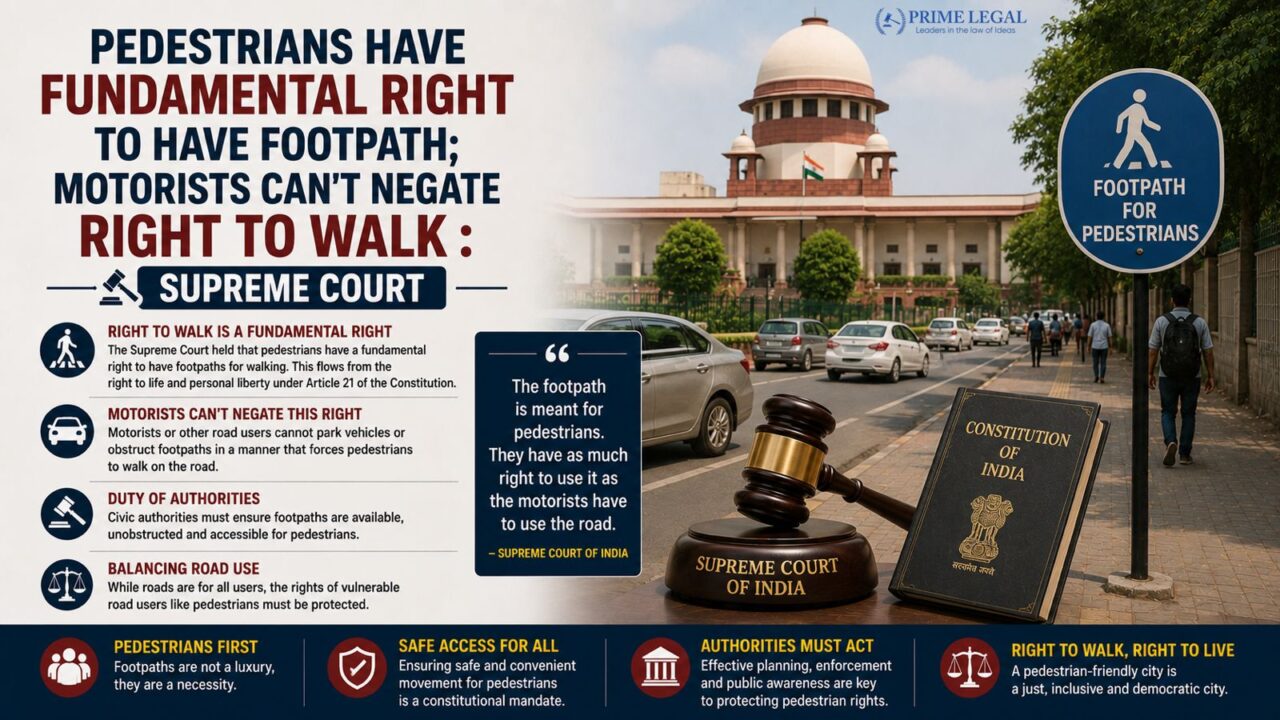
The Court has followed the compensation formula laid down in Karuna Parmar v. Prakash Sinha (2025 INSC 1244). If we take the minimum wage of a skilled worker in 2014 as Rs. A man earns Rs. per month. The annual income at Rs. 6,690/- is greater than the annual income at Rs. 2,290/- by 80,280/-. The future prospects added are 40% (Rs. after adding 40% for future prospects). The annual dependency loss worked out to be Rs. (1,12,392/-) after 50% deduction for personal expenses. 56,196/-. The loss of dependency was Rs. with the introduction of the multiplier of 18. 10,11,528/-. The Court also granted Rs. 96,800/- for loss of consortium, Rs. 18,150/- for loss of estate, and Rs. Rs. 18,150/- for funeral expenses. 11,44,628/-. In the constitutional issue, the Court held that the right to walk is a fundamental right under Article 19(1)(d) in conjunction with Article 19(1)(a), (b), (c) and Article 21. This right includes safe provision of demarcated footpaths, which have priority to the movement of motorised vehicles. The Court noted that the Motor Vehicles Act was vehicle-based law, placing a secondary focus on pedestrian concerns and it never served as a “charter of pedestrian rights.” A specific statutory obligation on protection of the right to walk, with duty bearers, remedies, a regulator and a mechanism to address constitutional issues was identified as a major constitutional gap. The Court also ruled that any denial of the right to walk would give the citizens constitutional and remedial rights against urban development authorities, municipal corporations, municipalities and panchayats apart from any remediation offered by the Motor Vehicles Act.
JUDGEMENT
The Supreme Court (Narasimha and Chandurkar JJ) allowed the appeal and increased the compensation to Rs. 11,44,628/-, to be paid within two months. The reduction by the High Court was found to be incorrect. The Court also made the following constitutional pronouncements: (a) the right to walk is a fundamental right under Articles 19(1)(d), 19(1)(a) to (c) and 21, which includes the right to demarcated footpaths which will have priority over motorised vehicles and (b) there is a correlative duty on the urban development authorities, municipal corporations, municipalities and panchayats to demarcate, construct and maintain footpaths, and (c) the violation of this right gives citizens the right to restitutionary and compensatory remedies apart from the Motor Vehicles Act. A copy of the judgment was sent to the Registries of all the Ministries of Road Transport and Highways, Housing and Urban Affairs, Rural Development and Law Commission of India. The case was re-numbered as a petition under Article 32 with cause title Re: Fundamental Right to Walk and Footpath.
CONCLUSION
The decision is a game-changer in the constitutional law of this country by explicitly declaring that the right to walk is a fundamental right, ahead of and over powering the right to move on wheels. The Court has established a precedent for a new rights-based pedestrian safety regime by identifying the duty bearers and remedies available to them. The call for a dedicated law to Parliament and the Law Commission indicates that having the judges declare the right is not enough – a new system of law, with a dedicated, full-time regulator is needed, to make it a reality.
“PRIME LEGAL is a National Award-winning law firm with over two decades of experience across diverse legal sectors. We are dedicated to setting the standard for legal excellence in civil, criminal, and family law.”
WRITTEN BY : ARNAV NAIK
Read the judgment copy below:
MANIYAR ILIYAZ SHAIK RIYAZ Vs P. AYYAPPAN

