
INTRODUCTION
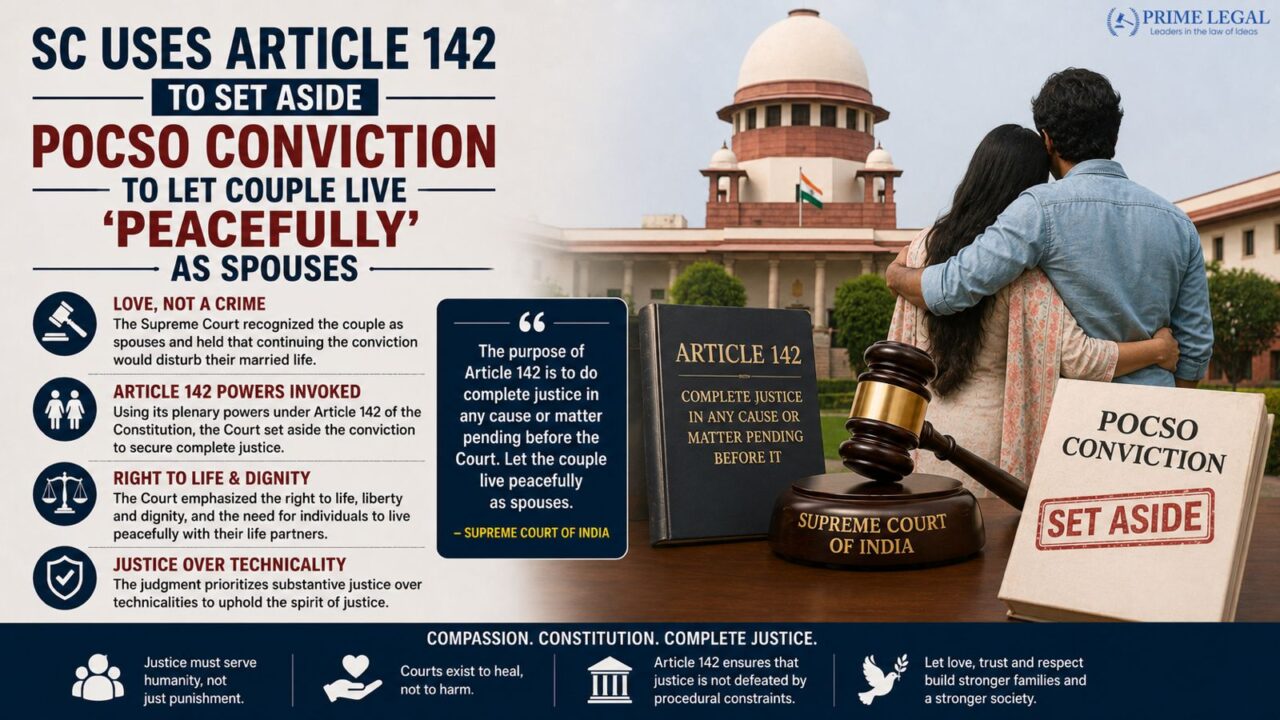
The Supreme Court of India in a decision that has won admiration and much criticism upheld the conviction and a ten-year prison term of a man convicted under the Protection of Children from Sexual Offences (POCSO) Act, noting that the woman, who had reached majority age, had decided to marry him. The two- Justice J.K. Maheshwari and Atul S. Chandurkar, issued the order on May 26, 2026, without bothering to examine the merits of the original conviction, and stated that the couple was free to live in peace in the society as husband and wife. The Court, however, made it clear that this order is not to be used as a precedent for any other purpose.
BACKGROUND
The case, Maruthupandi v. State represented by Inspector of Police & Anr. A special leave granted for an appeal, when a case has been decided incorrectly. No(s). This case (2782/2021) was initiated by the complainant who had filed a complaint alleging the accused had sexual intercourse with her on multiple occasions, after promising to marry her when she was minor. After complaining, Maruthupandi from Tamil Nadu was convicted under Section 5(1) with Section 6 of the POCSO Act and was sentenced to 10 years rigorous imprisonment by the Fast Track Mahila Court. Later the Madras High Court confirmed this conviction, which did not differ from the trial court’s decision.
But the story didn’t stop there, however, because it was destined to have a sequel. At the time of majority the victim got married to another man who later abandoned her when he found out she was married to someone else. Then, she tried to marry the appellant Maruthupandi. The couple moved the Madras High Court, arguing that his conviction should be set aside, because he had later been married to the other woman.The couple then filed a petition before the Madras High Court, seeking a setting aside of the conviction alleging that it was the result of the marriage of the other woman after the crime. They then appealed to the Supreme Court which resulted in the order and has now become the topic of a national debate on the extent of judicial power, the intent of child protection laws and the doctrine of complete justice. The Supreme Court allowed for the appeal and the appellant paid out Rs. A sum of Rs. He gave the victim 10,00,00/- to buy a future and family life which she accepted as received in full. In her statement on record, she also indicated that her intention was to have the litigation discontinued and she was not against overturning the conviction.
KEY POINTS
- It was made by the Division Bench of Justice J.K. Maheshwari and Justice Atul S. Chandurkar in Maruthupandi v. State of Tamil Nadu (SLP (Crl.)) case. No. 2782/2021]. Advocate on Record Rahul Shyam Bhandari appeared for the petitioner while AOR Sabarish Subramanian appeared for the respondents.
- The Constitutional Power that was invoked in this case was Article 142 which provides that the Supreme Court can make any such decree or order as it deems “just” or “fit” in any case or matter before it “for the purpose of doing ‘complete justice’ ”.
- The Court did not reopen the case for another trial, but acted in response to the entire sweep of the circumstances since that time: marriage, compensation, and the unequivocal desire to close the case. In an interesting procedural aspect of the order, the Court actually stated that it was not going to discuss the merits of the case.
- The acquittal was only granted due to the following events, that is, both parties reached full legal age prior to their marriage, they were compensated and the victim made statements in front of the Court. The State’s Position: The Government of Tamil Nadu told the Supreme Court that it did not agree with the conviction in the light of the peculiar facts, and also asked the Court to “not make a precedent” of its order.
- The Supreme Court subsequently took the State’s side, and made the “not make a precedent” part of its order. Bail and Surrender: The Supreme Court had no reason to ask the appellant to surrender, as the Madras High Court had cancelled his sentence in the same case in 2019, and also cancelled the bail bonds, thus terminating the criminal proceedings.
- The fact that the bench cleared the air and expressly has given it a direction that it would not be treated as a precedent for any other purpose, is also of legal significance in the context of POCSO jurisprudence.
RECENT DEVELOPMENTS
The order has rekindled the discussion that was started long ago in the legal profession of India about the application of Article 142 in the cases of POCSO offences. This is not the first time that courts have considered follow-up marriages and criminality convictions for child protection legislation. The High Courts have been approached on various earlier occasions to quash POCSO FIR which was lodged or conviction obtained and their findings have been different depending on the facts of the cases and the court. If the conviction of POCSO law can be thrown out because of a post-majority marriage, even an out-of-the-ordinary one, it has the potential of empowering the adults to start relationships with minors, with the hope of having them marry them when they reach majority age, thereby avoiding the application of the POCSO law. Before the Supreme Court, there has also been some uncertainty whether the victim consented without being under the pressure of the economy or the social system, which often in such circumstances affect consent. However, on the other side, a number of legal experts have supported the Court’s reasoning as amounting to an exercise of equitable jurisdiction since the continued incarceration of the husband would have had a direct impact on the victim herself who is the intended beneficiary of the protection afforded by the POCSO Act. The Court’s insistence on non-precedential status, they write, is sufficient to safeguard the larger child protection system from being watered down.
CONCLUSION
In Indian constitutional law, the balancing act encapsulated in the Maruthupandi judgment, in which both strictness and a strong deterrent of child protection laws is juxtaposed with flexibility in their enforcement, so that equity and sensitivity to human circumstance is preserved. The Supreme Court’s invocation of Article 142 was an intentional move to look at the real circumstances of the two individuals before it, in preference to the formalities of criminal law enforcement.
“PRIME LEGAL is a National Award-winning law firm with over two decades of experience across diverse legal sectors. We are dedicated to setting the standard for legal excellence in civil, criminal, and family law.”
WRITTEN BY: ARNAV NAIK

