
INTRODUCTION
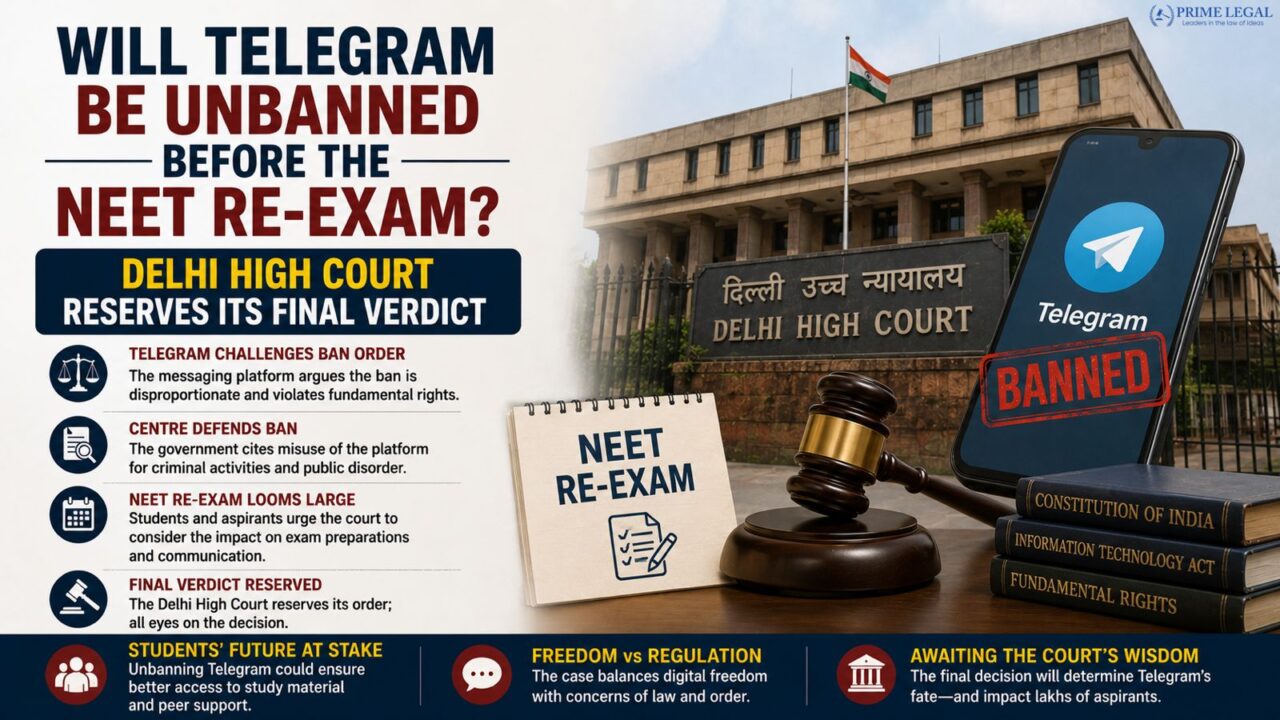
The Delhi High Court has yet to make its Final Decision regarding the appeal against the sudden suspension of the Telegram messaging app, which has left millions of students in jeopardy following an accusation of large-scale leaking of papers preceding the NEET-UG Exams. The ban on the telegram, which is implemented amidst allegations of widespread paper leaks ahead of the controversial NEET-UG exams, has sparked a severe legal and public debate. The Chief Justice of the Delhi High Court presided over a panel of judges to hear the case and has closed his deliberations concerning the supplemental temporary restoration of access to the Telegram App before the date of the re-exams for the NEET Examination, as the Court is attempting to determine whether the current status of the app will result in any damages to the educational system, as contrasted with the right to receive specific educational news through electronic media.
BACKGROUND
The controversy erupted when the Ministry of Electronics and Information Technology (MeitY) issued an emergency block order on Telegram. Controversy has raged around the order under Section 69A of the Information Technology Act. The Ministry’s blocking order was based on intelligence and NTA complaints regarding the use of Telegram by organised syndicates to distribute illegal NEET-UG examination materials, including leaked question papers and illegal study materials. The examination, which had been compromised, would be performed again, however, several student organisations, educators, and digital rights advocates filed a petition against the blocking order in the Delhi High Court, contending that Telegram acts as a primary archive of legitimate educational resources, free doubt-solving groups, and peer-to-peer academic support for underprivileged students who do not have access to costly coaching. The Petitioners assert that the blanket ban is a disproportionate response and that the innocent working candidates would be severely impacted one month before the re-examination.
KEY POINTS
The Key points of the case discussed are as follows:
- Proportionality Test: The petitioners have argued that the blanket ban placed by the Government was a violation of the Proportionality doctrine because the Government should have targeted specific malicious channels/users rather than shutting down an entire platform that serves millions as an important educational resource.
- Government’s Argument: The Union Government defended its position because of the encrypted nature of Telegram and its alleged lack of cooperation with the Government in tracing the origin of the leaked materials. They further argued that if the Ban was not to be lifted, it would render the NEET exam untrustworthy (and thus integrity would be compromised.
- Education vs. Exam Integrity: The Court acknowledged that there was a very delicate balance between preserving the integrity of a national-level medical entrance exam and preventing students from being cut off from access to their course materials and academic networks.
- Intermediary Liability: There was an extensive amount of debate relating to the obligations of platforms such as Telegram under the IT Rules, particularly concerning their obligation to remove illegal content on time and their obligation to assist law enforcement agencies.
- Alternative Remedies: The bench actively questioned the authorities on whether alternative, less restrictive technological measures were explored to curb the malpractice before resorting to a complete geographical block of the application.
RECENT DEVELOPMENTS
In closing arguments in court, the Government was questioned by the court regarding the possibility of restoring the app conditionally (with strong regulation by oversight committees) until re-examination. The NTA expressed serious concerns that the re-establishment of the app could result in another “leak mafia.” The petitioners produced hundreds of student affidavits attesting to being locked out of critical notes and academic discussions through the inability to access the app, which made their preparation more difficult. The bench reserved its judgment but indicated it would make a decision quickly, given that an examination is scheduled soon.
CONCLUSION
The imminent ruling from the Delhi High Court at the intersection of internet regulation, academic accessibility, and the indispensable need for appropriate assessment of knowledge. The outcome of this case will also create a precedent on how governmental agencies will govern the use of an intermediate platform (Telegram) in the future and during similar events regarding education. Thus, for example, the same outcome could result in (for the thousands of medical aspirants who are currently affected by this case) an increase to their ability to access their digital classrooms or otherwise cause them to continue their preparations under unprecedented restrictions due to a lack of digital technology.
“PRIME LEGAL is a National Award-winning law firm with over two decades of experience across diverse legal sectors. We are dedicated to setting the standard for legal excellence in civil, criminal, and family law.”
WRITTEN BY: VINEET SEERVI

