
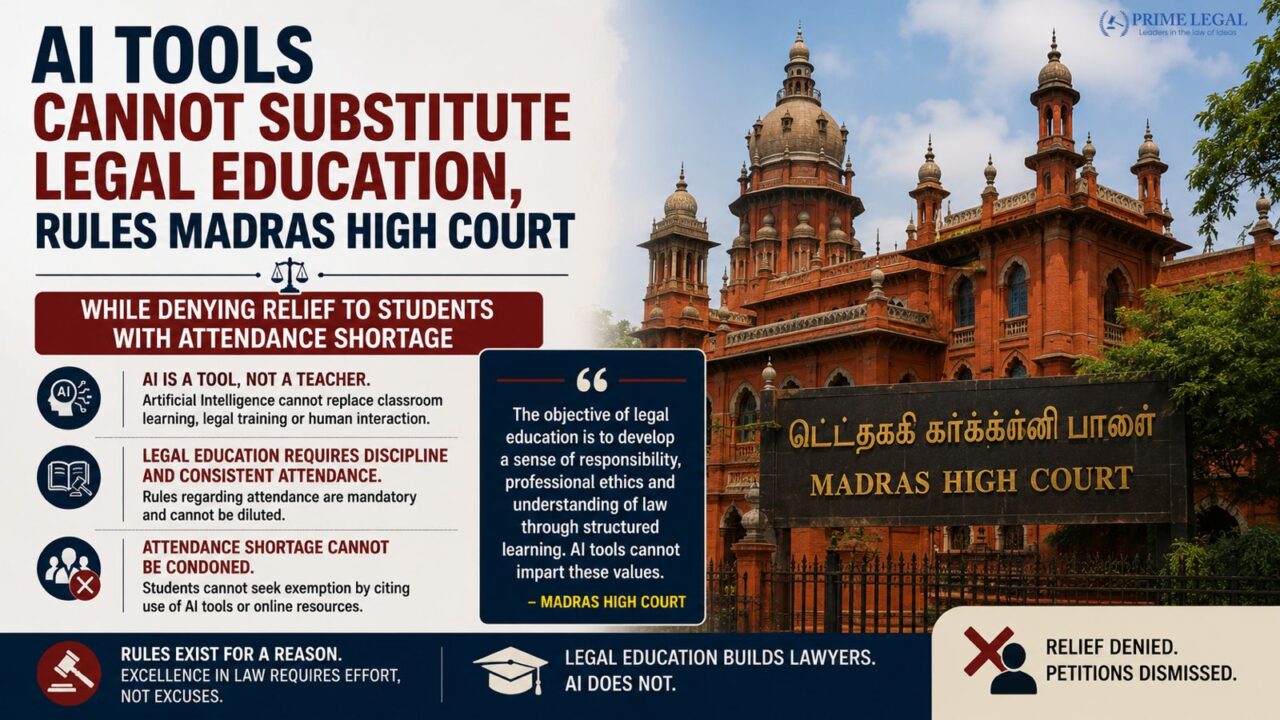
CASE NAME: Shakthi Shyam v. The Dean & Ors.
CASE NUMBER: W.A Nos. 49, 364 and 426 of 2026
COURT: Madras High Court
DATE: June 17, 2026
QUORUM: Justice SM Subramanium and Justice N Senthilkumar
FACTS:
Three law students B. Vadhanan (WA No. 49/2026), Shakthi Shyam R. Miruthula Shre, enrolled in the integrated BCA LLB (Hons) programme of Tamil Nadu Dr. Ambedkar Law University (TNDALU) and Government Law College, Coimbatore and A. Shrewaraj Kumar, enrolled in integrated LLB (Hons) programme at TNDALU and its associated Government Law College, Coimbatore, did not meet the minimum attendance standards set under Rule 12 of the Rules of Legal Education of the Bar Council of India (BCI). The attendance rates of their VII semester, VIII semester and IX semester were 46%, 41% and 37% respectively which is less than the required attendance of 65% – 70%. The University, as a result, denied them permission to sit for their end-semester examinations and sent them back to complete the academic year, thus cutting short their legal education by one year. The students had a grievance, and they had filed separate writ petitions before the Madras High Court (W.P. Nos.). 42641/2025, 46137/2025 and 43650/2025, each seeking permission to sit their semester examinations and the reconsideration of the decision to retake the year. The learned Single Judge partially allowed the writ petitions and directed the University to allow the students to attend the VIII semester, and also to make up attendance in the VII semester during vacations in flexible modes, and directed the BCI to reconsider Rules 10 and 12. The University and the authorities took up these appeals to a Division Bench of the University and its authorities. The appeals were taken up before the Division Bench of the University and its authorities in intra-court writ appeals.
ISSUES:
- Whether the learned Single Judge was right in granting relief to students who admittedly failed to comply with the mandatory minimum attendance requirement in Rule 12 of the BCI Rules of Legal Education.
- Whether courts are able to order universities to allow learners who fail to attend classes to sit for exams or provide alternative/flexible modes of attendance which deviate from the statutory provisions for course attendance.
- Whether allowing such relaxation is a breach of the right to equality of students who did register for the attendance requirement as per Article 14 of the Constitution.
- If or Not, Online classes or alternative forms of learning may be counted as class attendance for BCI’s attendance requirements.
LEGAL PROVISIONS
- BCI Rules of Legal Education Rule 12 requires a minimum attendance of 70% for law students; sets 5% attendance tolerable with sufficient cause; so the minimum effective attendance is 65%. There is no longer any room for relaxation.
- BCI Rules of Legal Education Rule 10: General conditions of legal education: Academic standards and institutional compliance.
- Article 14, Constitution of India – Equality before the law and equal protection of law; If there is any difference in treatment of similarly placed students, it has to be justified.
- Letters Patent (Madaras High Court) Clause 15 allows intra-court writ appeals against orders of a Single Judge to a Division Bench of the High Court.
ARGUMENTS
APPELLANTS (UNIVERSITY AUTHORITIES)
Rule 12 of the BCI Rules is categorical, mandatory and of law. The minimum attendance requirement of 65% (after maximum condonation) cannot be further relaxed. The Single Judge’s decision to allow attendance make-up in flexible modes is inconsistent with the clear provisions in the Rules and infringes upon the regulatory function of the BCI. Allowing students to pass as low as 37% will make an unfair division between those students who have worked hard to obtain the minimum attendance and those who have not.
RESPONDENTS
The Single Judge’s directions were made to protect the students’ career progression and were not intended to remove the attendance requirement altogether. The students were ready to make up for the difference in vacation. The University’s policy, which forced students to repeat an entire academic year was ill balanced and the Rules of the BCI, which were set out many decades ago, needed to be updated and revised in the face of new pedagogical methods including online learning modes.
LEGAL ANALYSIS
The Division Bench had to consider if it is appropriate for the court to disregard clearly expressed legislation. The Court ruled that the BCI Rules’ Rule 12 is clear and any amount greater than 65% is not condonable. The Single Judge’s directions, while good in intention, were essentially allowing students to circumvent an important statutory obligation that is not under the jurisdiction of the court. The Court noted that granting free exemption to students who have attended school between 37% and 46%, while imposing consequences on those who attended between 70% and 100%, would amount to unconstitutional differential treatment and would be in violation of Article 14. Legal education isn’t merely about what is taught in the classroom, it’s about discipline, punctuality and engagement that can only be developed through attendance in the classroom. The Court also rejected the idea that online classes or AI learning could replace class-based learning. It noticed that the ethical, moral and social aspects of legal education, debates and discussions, peer interaction and engagement, are intangible components of the physical classroom that are impossible to replace. Any systemic reform, such as revision of Rules 10 and 12 is in the exclusive jurisdiction of the BCI as a specialised regulatory body and the courts cannot order a revision or do it for the individual petitioners, where it is inconsistent with the existing rules.
JUDGMENT
All the three writ petitions were allowed by the Division Bench of the Madras High Court (S.M. Subramaniam and N. Senthilkumar JJ.) and the common order dated 17.12.2025 passed by the learned Single Judge was set aside. The Court said that the statutory attendance norms prescribed under Rule 12 of the BCI Rules are mandatory and binding and no court can grant relaxation, anything more than the outer limit of 65%, has been expressly laid down by the Rules. The decision to allow a student to attend classes in numerous flexible ways and for a student to appear in exams without meeting the statutory requirement for attendance was found to be legally unsustainable. There was no order as to costs.
CONCLUSION
This decision upholds the principle that “no court can diminish the strictures of a statute intended for professional education by seeking equitable relief”. The BCI’s attendance policies are meant to have a substantial effect, that is, they aim to build the discipline, social consciousness and professional demeanor needed to become good lawyers. The Court recognized the need for the Rules 10 and 12 to be improved, but rightly determined that it is not a matter for the judiciary but rather the BCI. This decision also provides an important balance; respecting the rights of students who are complying with the law while maintaining the integrity of legal education as a socially responsible profession.
“PRIME LEGAL is a National Award-winning law firm with over two decades of experience across diverse legal sectors. We are dedicated to setting the standard for legal excellence in civil, criminal, and family law.”
WRITTEN BY : ARNAV NAIK
Read the judgment copy below:

