
ABSTRACT
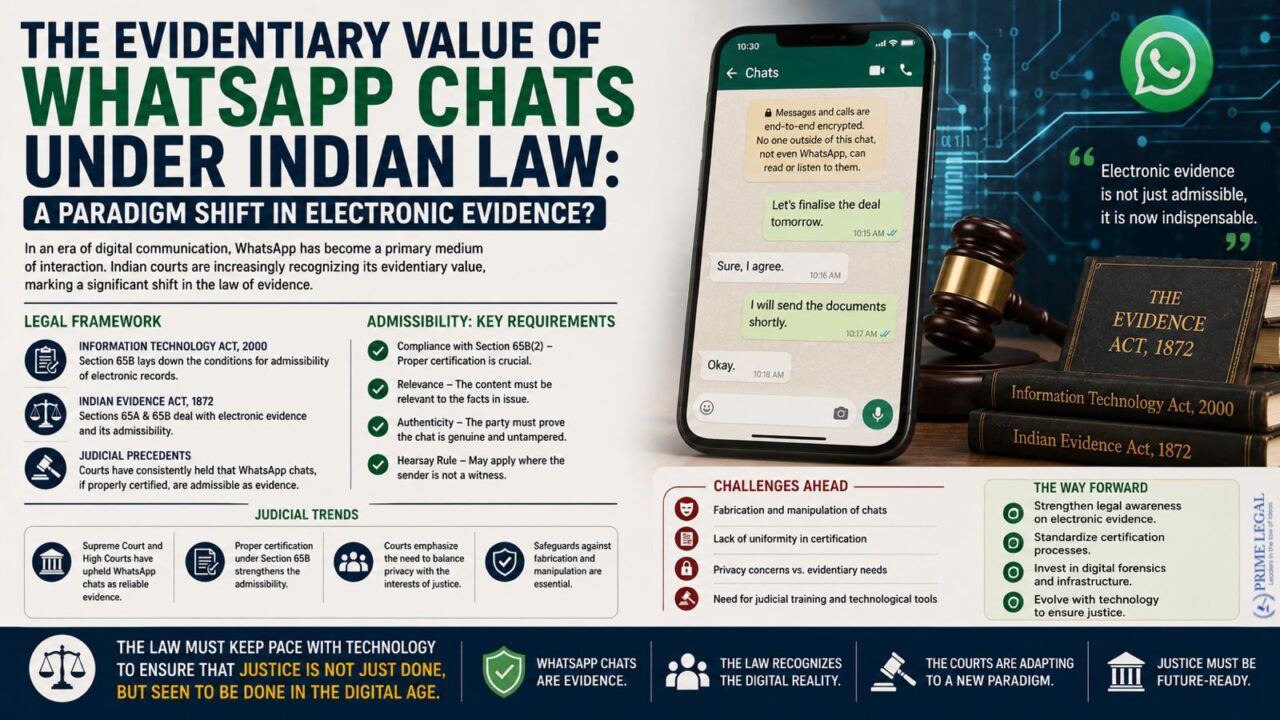
“Today, with instant messaging becoming the most popular form of communication both personally, professionally, and criminally, WhatsApp has become a primary method used by people within India to communicate. As such, WhatsApp chat messages are increasingly admissible forms of electronic evidence in a court of law. However, since they are a digital form of communication (i.e., they can be changed), establishing their value as evidence is a difficult task from a legal perspective. In this article, we will explore the admissibility and weight of WhatsApp chat messages from the perspective of the Indian legal system by discussing the evolution from the provisions established under Section 65B of The Indian Evidence Act, 1872, to those provided in Section 63 of The Bharatiya Sakshya Adhiniyam (BSA), 2023. We will cover judicial decisions that have set precedents regarding admissibility requirements, the certification requirement for admissibility, and discuss some of the challenges Courts find relating to end-to-end encryption, digital forgery, privacy concerns, and all other related issues facing Courts today.”
KEYWORDS: WhatsApp Chats, Electronic Evidence, Bharatiya Sakshya Adhiniyam 2023, Section 65B, Section 63, Digital Forensics, Data Integrity.
INTRODUCTION
In our contemporary digital reality, computer-mediated communication systems such as WhatsApp have dramatically changed the way people and businesses interact. WhatsApp has grown into an almost universally accessible medium for the exchange of synchronous (in real-time) and asynchronous (not in real-time) information. As a result, WhatsApp is now integrated into everyday life for over 2 billion people worldwide. Therefore, this shift has also permeated the Indian legal system, as most investigations and civil disputes now heavily rely on digital traces. WhatsApp messages, audio messages, and media files are submitted to the judiciary for establishing the terms of business contracts, proving mens rea in criminal trials, and proving cruelty in marriages.
However, the transition from traditional (paper) records to dynamic (electronic) records presents significant challenges concerning establishing the legitimate authenticity of the electronic record itself. Digital evidence can be manipulated, altered, and/or deleted easily and stealthily with little to no discernible trace physically. Therefore, Indian law has had to adjust and accommodate the establishment and determination of the authenticity, integrity, reliability, and accuracy of electronic records (including WhatsApp chats). In 2023, India passed a new evidence law and named it the Bharatiya Sakshya Adhiniyam, 2023, repealing the Indian Evidence Act,1872, thereby creating necessary changes to the body of law governing electronic evidence and certification of that evidence (including WhatsApp).
BHARATIYA SAKSHYA ADHINIYAM (BSA), 2023
The Legal Framework governing the “Admissibility of electronic records” in India has traditionally been outlined as per the provisions of the Indian Evidence Act, 1872, namely, Section 65B and read in conjunction with the Information Technology Act, 2000. As such, electronic records were classified as a different type of secondary evidence. To have a WhatsApp chat accepted as valid evidence, it had to be duly certified according to the provisions of Section 65B (4) – this required confirmation that both the computer and/or device being used had functioned correctly and that the information being provided would have been produced accurately.
The BSA provides a comprehensive consolidation and modernisation of prior electronic evidence rules to reflect the current state of the art in digital forensic examination. Section 63 of the BSA specifically deals with the admissibility of electronic records. The BSA establishes new paths to electronic records being considered primary evidence, so long as they meet specific qualifying criteria while preserving several critical procedural protections. Notably, Section 63(4) requires an electronic record to have undergone a dual certification process requiring signatures from both the device custodian and a qualified technical expert and includes stringent technical requirements such as the creation of secure hash values (e.g., SHA-256 or MD5) for the sole purpose of validating the digital authenticity of the exported electronic record so that no edits have taken place after the exportation of the record and prior to the record being offered into evidence at trial.
KEY JUDICIAL PRECEDENT
The Indian judiciary has continuously clarified the rules in relation to electronic evidence through landmark rulings. The rules relating to electronic evidence have been continually explained through landmark case law decided by the Indian judiciary. In the case of Anvar P.V. v. P.K. Basheer (2014) 10 SCC 473, the Supreme Court established the basic principle that an electronic record as secondary evidence cannot be admitted to the Court of Law unless the requirements prescribed under Section 65B(4) of the Evidence Act are fully complied with; this was done to ensure that the manipulation and alteration of digital evidence and data do not occur in a Court of Law.
The Supreme Court, in the later case of Arjun Panditrao Khotkar v. Kailash Kushanrao Gorantyal (2020), reiterated that the Certificate is now a prerequisite for all electronic records that are allowed to be used as evidence in any Court. However, in this case, the Supreme Court viewed the pressing need for practicality. It allowed for the relaxation of this precondition when a party has made all reasonable efforts to obtain the Certificate from the proper authority but has failed due to circumstances beyond its control.
In regard to WhatsApp chats, courts have consistently ruled that simply having printouts or screenshots of chat discussions does not establish enough proof on its own. As found in numerous high court decisions, unless there is an express admission by the other party as to the content of a chat conversation, the party who is relying on the WhatsApp conversation will need to present sufficient evidence that proves the authenticity of the WhatsApp chat room and, if contested, will need to have followed the appropriate statutory requirements and also provide primary digital forensics (i.e., original mobile phone being brought into the court for examination).
THE MANDATE OF CERTIFICATION AND CONDITIONS FOR ADMISSIBILITY
To have meaning as an evidence item, WhatsApp conversations must comply with strict procedure-related rules. You cannot simply present a transcript of your WhatsApp conversations without that transcript being produced in accordance with the law. Some of the requirements or conditions under the evidence law need to be met, which include the following:
- Lawful Custody: The WhatsApp evidence (e.g. Chats, Documents, etc.) must have come from a device that is legally owned (true owner of the device) and/or possessed by the person who created the WhatsApp conversation.
- Regular Use: The phone or computer from which the WhatsApp chat was taken must have been regularly used to store and/or process information and must have fully functioned at all times during the date and time when the chat was created and/or downloaded.
- Dual Certification: Section 63(4) of the BSA requires that the producer of the evidence provide a valid certificate, in the form provided in the Schedule, to be able to positively say that the record is technically sound and that the act of presenting digital evidence is a highly formalised process and not simply a casual one.
- Proper Chain of Custody: The law requires that the chain of custody for evidence be documented in order to eliminate the possibility of tampering occurring between the time when the evidence was seized from the device and when the evidence is introduced at trial.
Interestingly, strict compliance with the procedural rules set out in Section 63 of the BSA has always been required in the courts, whereas in quasi-judicial forums, tribunals or departmental inquiries, a more practical approach is taken. Not only are there considerable relaxations to the strict technical means of proof required during these proceedings, but proof must be shown with the least restrictive means. The Authority does have an affirmative obligation to ensure the electronic evidence is reliable by, at a minimum, examining the relevant device and permitting the opposing parties to cross-examine the relevant party.
CHALLENGES: TAMPERING, PRIVACY, AND ENCRYPTION
Although WhatsApp is governed by strict laws, it poses a number of practical difficulties for law enforcement and lawyers conducting investigations.
First, WhatsApp encrypts all messages using end-to-end encryption. Only the sender and recipient will have access to their message content, and because of this, investigators cannot directly contact WhatsApp to obtain access to stored chat records. Instead, they need to obtain chat records from either physical device acquisition, local back-ups, or through use of companion devices that are linked to the user’s WhatsApp account.
Second, the ease with which the digital media associated with digital communication can be manipulated creates significant ongoing concern. For example, anyone with access to basic photo editing software can fabricate a screenshot of a chat, and third-party applications are readily available to help create fake chats. Because of this issue of authentication, courts will typically require that parties verify a message’s hash value. In addition, metadata plays an essential role in establishing an event’s timeline. Even if a user deletes a message, the underlying metadata, including the timestamp for backup, connected IP address, and device log, can still provide a timeline of an event, and will require sophisticated forensic tools to obtain. The third concern relates to the right to privacy. Forcing someone who is accused of committing a crime or forcing a witness to unlock their devices so that investigators may retrieve WhatsApp chat logs could constitute a violation of an individual’s constitutional right not to be compelled to testify against oneself, and to a lesser extent, an individual’s right to privacy from unreasonable searches and seizures. Courts frequently confront situations where they must weigh the need for critical digital evidence against the constitutional rights of citizens not to be subjected to unreasonable invasion of privacy or searches and seizures.
CONCLUSION
There was once an uncertainty surrounding WhatsApp chat messages and whether or not they would be considered evidence in India. The introduction of the Bharatiya Sakshya Adhiniyam, 2023, has changed this situation, and now WhatsApp chat messages are treated as evidence with stringent rules governing their use. The move from the old Indian Evidence Act to the Bharatiya Sakshya Adhiniyam is a huge step forward in acknowledging how we communicate today using new technologies, also taking into account data integrity, hash values and certification by experts as part of establishing the reliability of this type of evidence. When used correctly and correctly assessed, a WhatsApp chat message can be powerful enough to impact the outcome of a legal matter. However, this type of evidence can only be used depending on the various conditions related to its use established by Courts, being the principal custodian for assessing digital evidence (to ensure no accidents occur by way of using a digital record that has been forged or not certified). Digital technology continues to develop rapidly with the introduction of deep fakes and messages that self-destruct; therefore, those parties that implement the current laws will need to continue working towards moving those same laws so as not to impede the ability to continue to maintain the integrity (i.e. confidence that you can believe in) of digital evidence moving forward.
“PRIME LEGAL is a National Award-winning law firm with over two decades of experience across diverse legal sectors. We are dedicated to setting the standard for legal excellence in civil, criminal, and family law.”
WRITTEN BY: VINEET SEERVI

