
INTRODUCTION
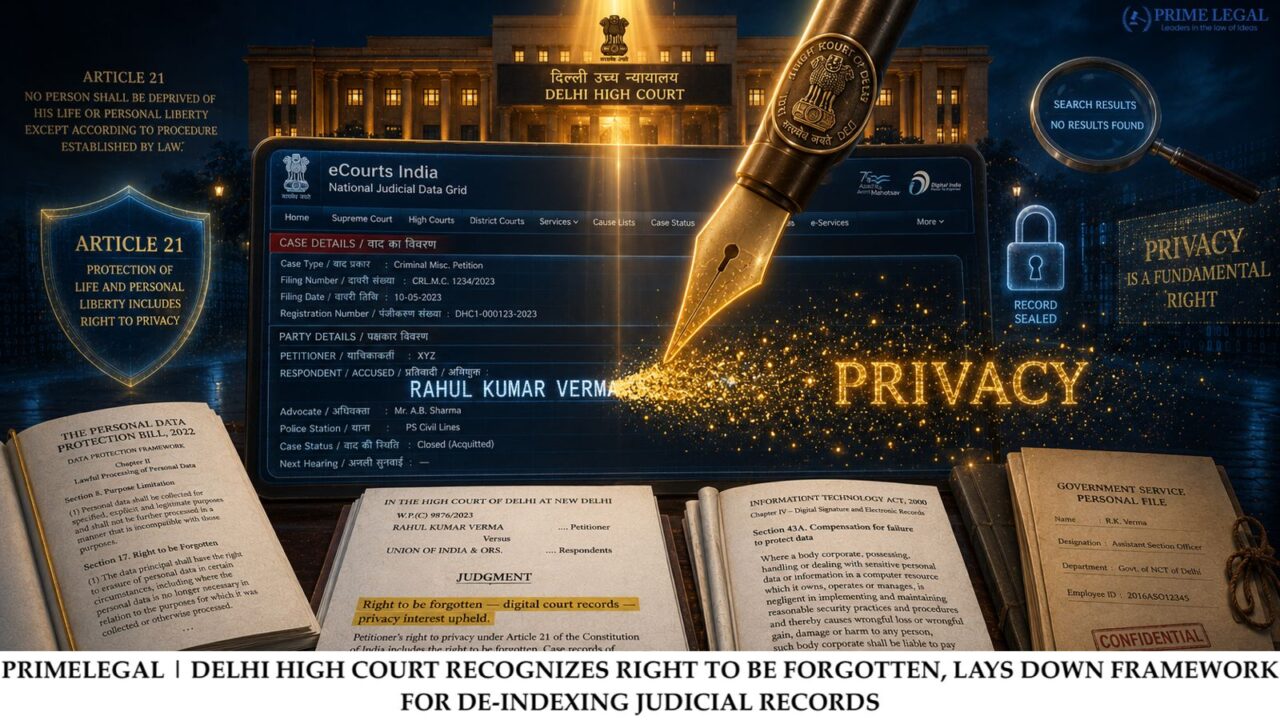
The Delhi High Court has passed a groundbreaking verdict on privacy that has treated the right to be forgotten as part of the right to privacy under Article 21 of the Constitution. Hon’ble Justice Sachin Datta said in a batch of petitions led by Laksh Vir Singh Yadav that it had to go by the name of “In appropriate circumstances”, if there is a disproportionate harm to “privacy, dignity, repute” of a citizen to continue the accessibility of his online presence in judicial record then a request can be granted to “mask” such information and “de-index” it.
The decision is important to the jurisprudence of privacy since it takes the debate out of the realm of theoretical ‘privacy principle’ and into the realm of how online court files should be treated. It makes clear that there will not be continuous search ability through the website of the accused person in cases where he was acquitted, discharged or otherwise clear of the competent court over matters.
BACKGROUND
The lead Petitioner Laksh Vir Singh Yadav had asked to have the criminal judgment and his name removed and de-listed for search engines continued to present the case in a manner that affects his employment opportunities and social standing. In time, there grew into a collection of over 30 joined petitions which encompassed more general issues of whether it were “frequent” for the records of cases to be “ever to be continuously open for search?” in a world of digital information.
Petitioners have included those who were acquitted, discharged, involved in matrimonial disputes and were mentioned by names in the judicial records. The Internet Freedom Foundation in a briefing to the court warned that a right to be forgotten could be used to “shorten or even eliminate access to public records” and be instrumental in blocking information for others. In fact, a Delhi High Court plea filed in 2026 was rejected before this judgment on the basis that there was no policy that allowed for redaction or masking of the information
KEY POINTS
- The Court found that this right to be forgotten relates to Article 21 and to the interests or rights to privacy, dignity and informational self-determination.
- It distinguished between “de-indexing” and “masking”. De-indexing does not delete a judgment from the name based search results, masking hides personal identifiers in the public version of the record but does not delete the judgment.
De‑indexing: The removal or exclusion of a specific URL or web‑page from the searchable index of a search engine, so that it no longer appears in search results for relevant queries. De‑indexing affects the visibility of information on the internet; it does not delete the underlying data, merely prevents it from being discoverable via search engines.
Masking: The alteration or obfuscation of personal data within a record (e.g., replacing a name with “XXXXX” or showing only the last four digits of a PAN) while retaining the underlying data for internal processing.
- Only personal information is what the Court ruled could be hidden. Judgments shall be open to general public access and shall give the reasons for the judgment, findings and conclusions thereunder.
- The decision will create a level of change to the memorably skewed view of an acquittal becoming forever consumed by allegation digitally. The Court held that “continuing harm to employment, reputation and dignity can occur after a person has been legally cleared even though the identification of such a person continues through their websites, which are therefore visible perpetually”.
- The framework cannot be applied in any automatic manner. In certain situations, particularly with offences against women or children, those would be considered public breaches of trust, or matters of serious public interest, and relief may be refused partly or completely.
- Search engines and legal databases are expected to be de-indexed once a court grants masking.
RECENT DEVELOPMENTS
The ruling has already been commented on as “a significant milestone in India’s privacy jurisprudence”, as it provides an entity for courts to better process requests concerning online judicial records. It also takes into account a long-debated criticism that digital databases and search engines facilitate the perpetuation of past conflicts forever after even after the laws are changed.
The order comes as India’s Digital Personal Data Protection Act, 2023, is in its process of getting operational and the Act has limited grounds for any relief on the issue of erasure. That’s particularly crucial especially for courts, search engines and legal platforms as a current interim constitutional guidance. The decision should have an impact on the actions of platforms like those for search engines and legal databases when handling requests for removal or masking in the future.
CONCLUSION
Laksh Vir Singh Yadav vs. Union of India W.P.(C) 1021/2016 & Connected Matters is a landmark verdict that has provided a constitutional interface and contour for the right to be forgotten in India. The Delhi High Court’s decision marked an attempt to “reach a balance between privacy and open justice”, which does not imply ‘forever on the list cordoned off for punishment online’, it said.
The ruling does not rewrite history or remove it entirely, but it does restrict how quickly the history can be bequeathed to weaponization via search engines and online databases. That is what the court has attempted to do: not make the Internet’s memory too morbid in purpose.
“PRIME LEGAL is a National Award-winning law firm with over two decades of experience across diverse legal sectors. We are dedicated to setting the standard for legal excellence in civil, criminal, and family law & Privacy Law.”
WRITTEN BY: ARNAV NAIK

