
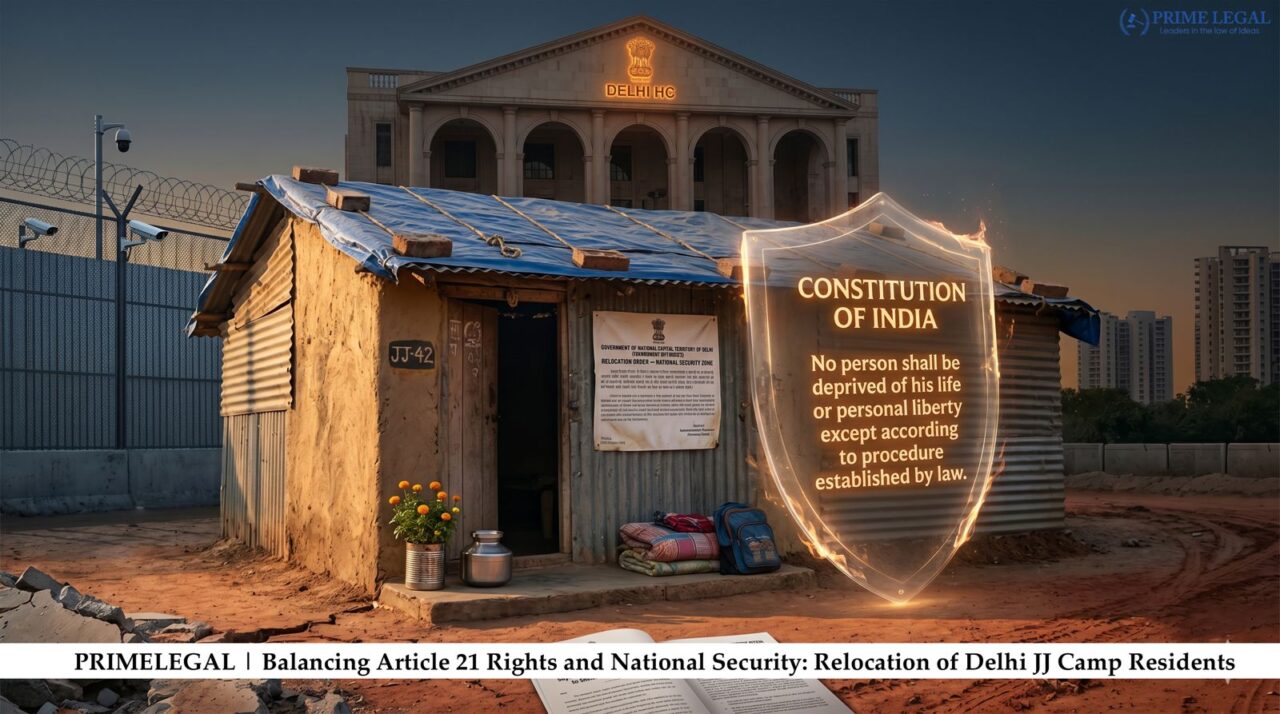
CASE NAME: Mrs. Khushnuma Khan and Others v. Union of India and Others
CASE NUMBER: W.P.(C) 17239/2025 & W.P.(C) 2943/2026
COURT: High Court of Delhi
DATE: 11 May 2026
QUORUM: Hon’ble Mr. Justice Purushaindra Kumar Kaurav
FACTS
Petitioners take residence in three “jhuggi jhopri bastis” located on property owned by the Government of India through the Land and Development Office and consist of the Bhai Ram Camp, the DID Camp and the Masjid Camp. The Respondents issued notices of eviction to the Petitioners in October 2025, instructing them to vacate their homes with no alternative housing available to them before actual eviction. After various legal challenges and intervention in the judicial process, the Authorities finally approved the relocation of the Petitioners to alternate housing in Savda Ghevra, Delhi, and issued notices of allotment of flats to the Petitioners in February 2026. The authorities took action to carry out the evictions to permit the clearing of unauthorised occupants from an extremely sensitive and strategic section of land adjacent to an operational Air Force Station for the purpose of enhancing the physical infrastructure necessary for the defence of this area.
ISSUES
- Whether the eviction and moving of the applicants from the present location to a different location violates their Fundamental Right (right to live, have a roof over their head (home), and be able to make a living (work), as provided under Article 21 of the COI.
- Whether the eviction procedures that are being used actually violate the Supreme Court’s order in the Re: Directions in the matter of demolition of structures 2024 SCC OnLine SC 3291 as well as the Delhi Slum and JJ (Slum and Juxtaposed) Rehabilitation Policy, 2015 (DUSIB Policy), with respect to providing in-situ rehabilitation.
LEGAL PROVISIONS
- Article 21 of the COI – Right to live, along with a right to earn and secure housing.
- Article 226 of the COI- High Courts can issue writs in their discretion.
- Section 2(f) of the Delhi Urban Shelter Improvement Board Act, 2010- Defines “jhuggi”.
- Delhi Slum and JJ Rehabilitation Policy, 2015 (DUSIB Policy) – Guidelines for in-situ rehabilitation and relocation.
ARGUMENTS
APPELLANT
Petitioners argued that their families have lived in their current camp locations for generations. They claimed that moving to Savda Ghevra, which is a very long distance from their schools and workplaces, would severely impair their ability to sustain themselves and would also violate their right to live within the definition of Article 21 of the Constitution of India. Moreover, they argued the evictions would violate the DUSIB Policy that requires provision of in situ rehabilitation within 5 km of the site, as well as the due process requirements set forth by the Supreme Court in the Re: Directions case.
RESPONDENTS
According to the submissions made by the Respondents, the Petitioners have been found to meet the requirements for rehabilitation and are entitled to receive a flat that includes basic amenities, such as an efficient sewerage system, water supply, and a well-planned and maintained park. It was further stated that there are no viable alternatives for the Petitioners to be provided with in-situ rehabilitation within 5 km from their original camp locations. Furthermore, the Respondents pointed out that the reason for the evictions from the camps is a matter of national security because of the proximity of the camps to a protected zone surrounding a sensitive Air Force Station. It was also noted that the burden on the Petitioners to make their contributions to the cost of rehabilitation has been mitigated significantly by the Union Government’s (MoHUA) payment of the beneficiary contributions.
ANALYSIS
The Right to Shelter and Livelihood have a direct link to the Right to Life under Article 21 of the Constitution; however, adequate alternate accommodation guarantees these rights only if all necessary amenities (e.g., education, transport) are provided by the State at the new site.
The Supreme Court’s decision in Re: Directions does not apply to unauthorised constructions on the public domain regarding the violation of due process. The petitioners meet the definition of “unauthorised occupants of jhuggis” and are thus eligible for rehabilitation under the DUSIB Act. Although there were some deviations from the DUSIB Protocol (e.g., DDA and L&DO conducted the survey instead of DUSIB), the Court found that the lack of compliance with this protocol created no prejudice to the petitioners, as ultimately all are eligible for rehabilitation.
The Court found that the DUSIB Policy expressly permits relocation beyond the five km limit outlined in the policy in cases of extreme hardship. Two exceptional circumstances that warranted this decision were: (i) there were no alternate sites available close by; and (ii) there were considerations about National Security. The Court reiterated that under Supreme Court precedent, the courts should not intervene in any executive policy decision regarding national security.
JUDGMENT
The Court has ordered the respondents to comply with the DUSIB Protocol by providing education, transport and sanitation services for all the residents who will be living at the alternate accommodation, while providing access to the alternate accommodation in the way set out in the Protocol. The respondents had bound themselves to the undertaking, to include the contributions to the beneficiaries within the undertaking. The petitioners who have not yet accepted the allotment letters from DUSIB/Rescribed Land were ordered to get the allotment letters following verification of their documents and to leave the present camps, within fifteen (15) days of receipt of the letters; otherwise, the respondents have the right to commence eviction proceedings.
CONCLUSION
The High Court ruled that, while the fundamental rights of slum-dwellers include the right to a shelter; there is no right to an automatic prohibition against being evicted from public land under conditions where the government is unable to provide adequate and suitable alternate housing as an appropriate means of mitigating the financial difficulties of evicted persons; where matters of national security are jeopardised, can be reasonably met by the State’s total supply of alternate accommodation and where complying with infrequent relocation programs that are less than in situ can be effectively and legally executed.
“PRIME LEGAL is a National Award-winning law firm with over two decades of experience across diverse legal sectors. We are dedicated to setting the standard for legal excellence in civil, criminal, and family law.”
WRITTEN BY: VINEET SEERVI
Read the full Judgement here: Khushnuma Khan v. Union of India

