
INTRODUCTION
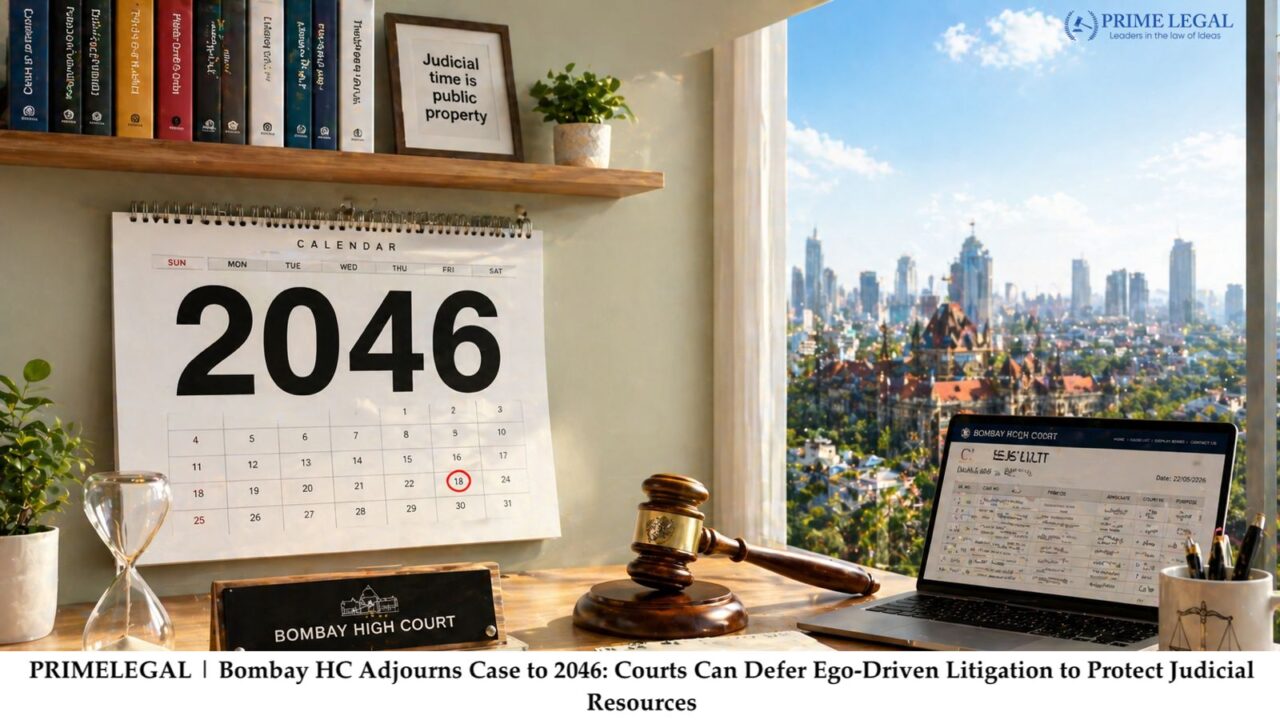
The Bombay High Court has recently made an unprecedented move by adjourning a long-pending property dispute to 2046, which effectively defers the next hearing of the matter by two decades. The court has described this case as an “Ego-driven” dispute between estranged members of a family over a property, with none of the parties showcasing genuine intention of resolving their issues or availing alternative dispute resolution mechanisms. This decade-long dispute has consumed considerable amounts of judicial resources and the court’s time due to multiple hearings over the years.
The Single Judge Bench of Justice Priya Anand passed the extraordinary adjournment order under the Section 151 of the Code of Civil Procedure, 1908, as the intent of such litigation was solely to harass and financially exhaust the other party, as opposed to the enforcement of any legitimate right. This order has drawn attention to the extent of discretionary powers of the higher judiciary, such as in this case, to exercise such powers to preserve the sanctity of the judicial system, along with the protection of judicial resources from abuse.
BACKGROUND
The dispute began in 2016 when the plaintiff, who lives in Pune, filed a civil suit against his younger brother for partition of a jointly owned flat worth around ₹45 lakhs. At first glance, it looked like a routine partition matter, but over time it became unnecessarily complicated. Both the parties constantly filed multiple counter-suits, injunction applications, contempt petitions, and repeatedly sought adjournments. It appeared that neither of the sides was genuinely interested in the resolution of the dispute.
The case has been listed more than 120 times, taking up a very significant amount of the court’s time and has resulted in large records. The court also referred the matter to mediation twice under the Mediation and Conciliation Rules, but these attempts failed because both parties did not cooperate. In fact, the mediators specifically noted that the parties were acting in bad faith and were using the sessions to understand each other’s legal strategies rather than to settle the dispute. The situation reached a tipping point when the defendant’s lawyer asked for yet another adjournment, this time because the defendant was going abroad on a vacation. Thus, the court closely observed the conduct of the parties before delivering its landmark ruling.
KEY POINTS
- The Court held that Section 151 of the Code of Civil Procedure, 1908, vests in every civil court inherent powers to issue such orders as may be necessary to meet the ends of justice or to prevent abuse of the process of the court, and that a long-term adjournment to a distant date constitutes a legitimate exercise of such power when litigation is found to be manifestly vexatious.
- Justice Priya Anand observed that judicial time is a constitutional resource belonging to all litigants. Thus, allowing a few parties without good faith to take up the court’s time constitutes an infringement of the right of access to justice guaranteed to other citizens under Article 21 of the Constitution of India.
- The Court upheld the principle that the judicial process shall not be used to derail the public interest however the Court declined to dismiss the suit as there was a legitimate cause of action.
- Both parties have been directed to mandatorily appear before a court-appointed Lok Adalat once every two years during the adjournment period, with the matter to be relisted for final hearing in January 2046 if all mediation attempts fail in the interim period.
- Costs of ₹2 lakhs have been imposed on each party, to be deposited in the High Court Legal Services Committee’s fund within thirty days, as a punitive measure for the waste of judicial resources caused by their conduct.
- The Court noted with concern the growing trend of family property disputes being converted into instruments of personal vengeance. It also called upon the Bar Council of Maharashtra and Goa to sensitise advocates to their duty under the Bar Council of India Rules not to assist in the filing or continuation of vexatious proceedings.
RECENT DEVELOPMENTS
In this particular case of Ramesh Subramaniam v. Sunil Subramaniam (2026:BOM:17843), the Court took an unusually strong stance by directing that the matter be listed only in January 2046 and flagged the case before the Case Management Committee as an example of litigation abuse. It also recommended that an anonymised version of the order be shared across the Maharashtra District Judiciary to guide courts in using their inherent powers in similar situations.
The decision has sparked mixed reactions within the legal community. While some academics and practitioners see it as consistent with the Supreme Court’s approach in Ramrameshwari Devi v. Nirmala Devi (2011) 8 SCC 249 in curbing vexatious litigation, others – especially within the Mumbai Bar – have cautioned that such strict measures could unintentionally affect genuine litigants who are unable to settle their disputes through alternative mechanisms.
CONCLUSION
This order of the Bombay high court displays a bold judicial position that the judicial system does not serve as a mechanism to fulfil personal vendettas. Additionally, by invoking its inherent powers instead of dismissal of the suit, it has retained the balance between a plaintiff’s right to litigate a genuine grievance, while preventing the abuse of the judicial process.
Whether this decision shall empower and serve as a model for other courts to adopt such similar measures or invite legislative measures to provide remedies in such vexatious cases remains uncertain.
“PRIME LEGAL is a National Award-winning law firm with over two decades of experience across diverse legal sectors. We are dedicated to setting the standard for legal excellence in civil, criminal, and family law.”
WRITTEN BY: KRITIKA KIRAN GOLE

