
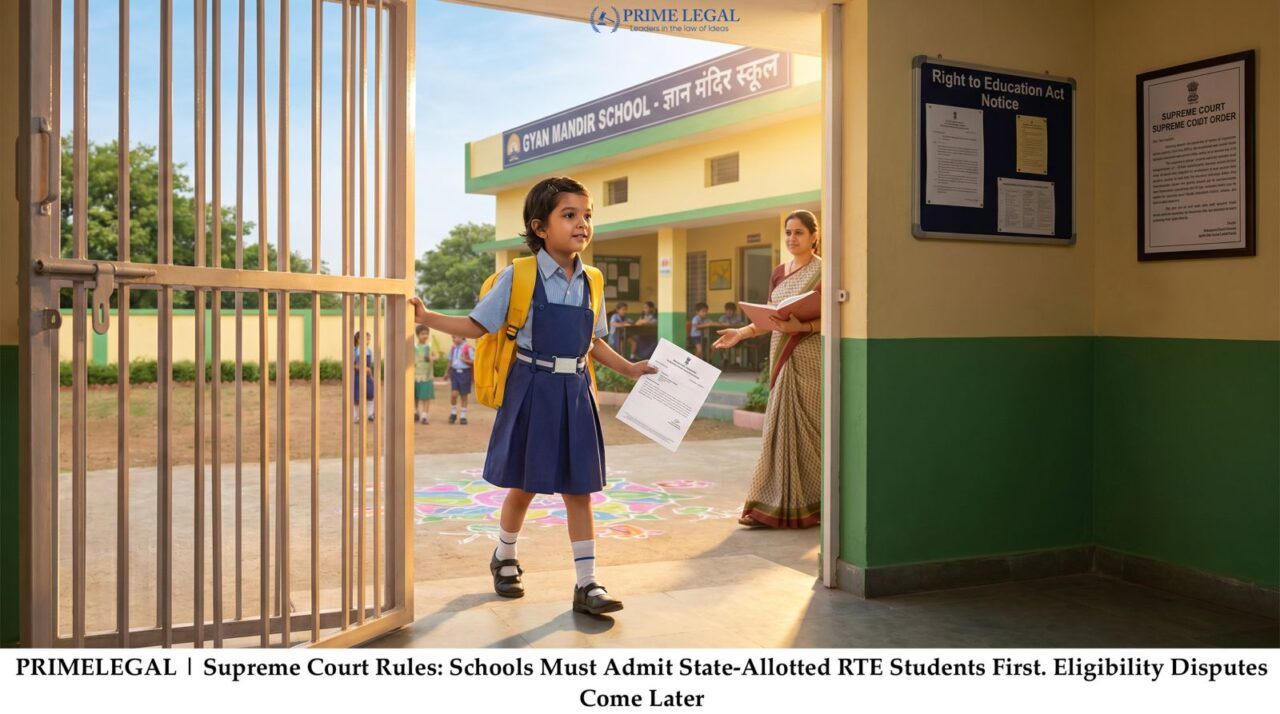
CASE NAME: Lucknow Public School, Eldico & Anr. vs. State of Uttar Pradesh & Ors. (2026 INSC 422)
CASE NUMBER: Special Leave Petition (C) Diary No. 60657 of 2024
COURT: Supreme Court of India
DATE: 28 April, 2026
QUORUM: Hon’ble MR. Justice Pamidighantam Sri Narasimha and Hon’ble Mr. Justice Alok Aradhe
FACTS
The case arose from an issue regarding admission of a student under the Right of Children to Free and Compulsory Education Act, 2009 (RTE Act) for the academic year 2024-2025 in the state of Uttar Pradesh. The respondent applied for admission to a pre-primary class under the Uttar Pradesh Right of Children to Free and Compulsory Education Rules, 2011. Once selected, the student’s name was included in the list sent to the petitioner school.
The school stated that it was uncertain regarding her eligibility and neither granted her permission to attend classes nor gave admission. The student later filed a writ petition before the High Court seeking a remedy.
The High Court allowed the petition, stating that once the allotment process was completed and the list is forwarded to the school, the school is mandated to grant admission to the student. The petitioner challenged this decision before the Supreme Court by filing a Special Leave Petition (SLP).
ISSUES
- Whether a school may refuse admission to a student allotted by the State under the RTE Act on the grounds of ineligibility.
- Whether a school has authority to not comply with the State-mandated admission process.
LEGAL PROVISIONS
- Article 21A of the Indian Constitution – Right to Education.
- Section 12 of the Right to Children to Free and Compulsory Education Act, 2009.
- Rule 8 of the Uttar Pradesh Right of Children to Free and Compulsory Education Rules, 2011.
- Case Law: Dinesh Biwaji Ashtikar v. State of Maharashtra & Ors. 2026 INSC 56
ARGUMENTS
PETITIONER (SCHOOL):
The petitioner argued that there is some uncertainty about the student’s eligibility, and therefore, her admission could not be granted. The school justified their refusal by stating that the selection required further verification.
RESPONDENTS (STATE AND STUDENT):
The respondents claimed that once the State had allotted the student to the school, it was under the obligation to admit her. It argued that the school had no authority to refuse her admission and that this action went against the RTE Act.
The mandate of the Rule 8 of the Uttar Pradesh Right of Children to Free and Compulsory Education Rules, 2011 is clear. Once the government assesses an application for admission under the 2009 Act, the school shall proceed and be bound by other provisions as laid from time to time.
ANALYSIS
The Court reviewed the RTE Act and the U.P. RTE Rules, particularly Rule 8, which requires the admission process to be transparent and in accordance with the State-prescribed procedure. The role of the school is only to implement the State’s allotment list once it’s sent.
Schools denying admissions would amount to a violation of Article 21A and would weaken the guarantee of education. It also held that any kind of delay in the admission stage would impact a child’s access to education.
The referred to Dinesh Biwaji Ashtikar v. State of Maharashtra & Ors. (2026 INSC 56) to emphasise that active participation of the State, local authorities, schools, parents and teachers is central to effective implementation of the RTE Act. Neighbourhood schools, especially, are important for promoting inclusion of children from disadvantaged sections.
JUDGEMENT
On the 28th of April, 2026, the Supreme Court dismissed the Special Leave Petition by the school and upheld the decision of the High Court. It held that the school was obligated to grant admission to the student. Any grievance regarding the selection process cannot be used as a ground to deny or delay admissions, but can also be raised before competent authority.
CONCLUSION
The decision by the Supreme Court sustains the mandatory character of admissions under the RTE Act and affirms its enforceability under Article 21A of the Indian Constitution. It requires schools to follow state-directed admissions without any delay, strengthening the implementation of the RTE Act. This judgement highlights the role of neighbourhood schools in achieving equality and social inclusion and clarifies that a child’s right to education will always override institutional concerns.
“PRIME LEGAL is a National Award-winning law firm with over two decades of experience across diverse legal sectors. We are dedicated to setting the standard for legal excellence in civil, criminal, and family law.”
WRITTEN BY: SAMANA
Read the judgement copy here:
LUCKNOW PUBLIC SCHOOL, ELDICO AND ANR. VERSUS THE STATE OF UTTAR PRADESH & ORS.

