
INTRODUCTION
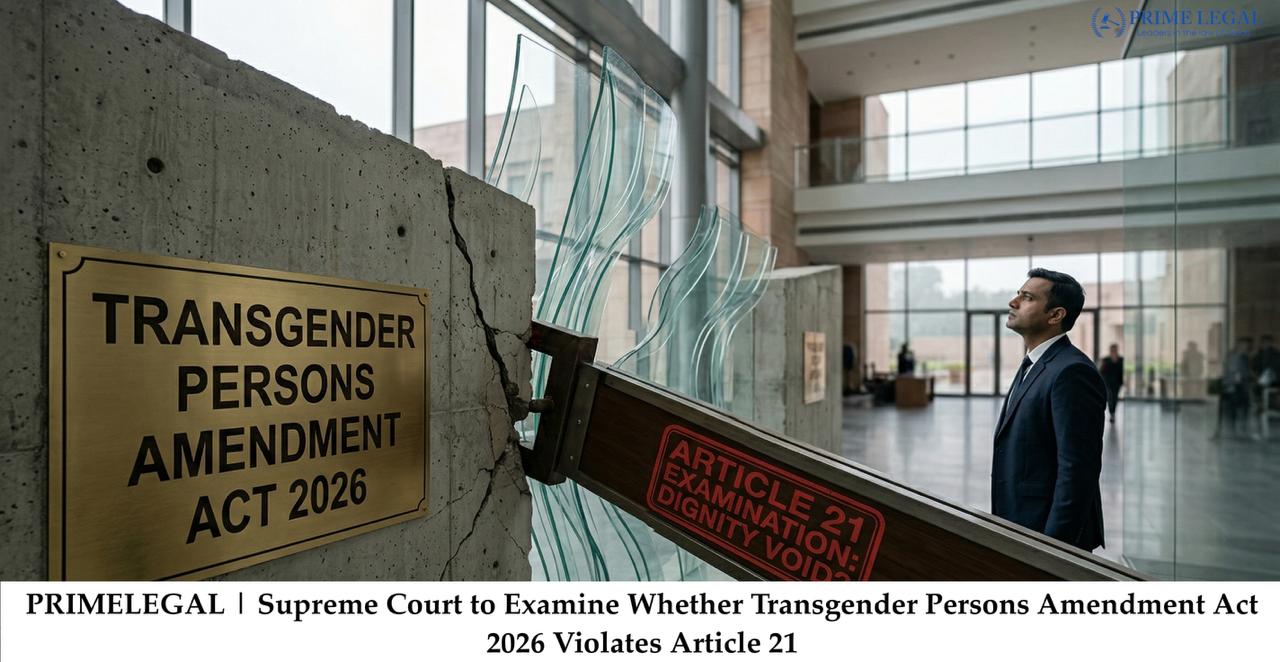
The honourable Supreme Court of India (SCI) is approached with the constitutionality of the new Transgender Persons (Protection of Rights) Amendment Act, 2026, alleging that the said legislation violates right to life and personal liberty guaranteed under Article 21 of the Constitution. The petitioners contend that the Act strips off transgender persons of their right to self identify their gender. Thus, raising a question of constitutional significance: Whether the State can define or redefine by way of a legislation who a person is overriding the persons’ lived experience and perceived gender?
BACKGROUND
The honourable SCI in the landmark judgement of National Legal Services Authority v. Union of India (2014) 5 SCC 438 recognised transgender persons as the ‘third gender’ and affirmed their right to self determination of gender identity as part of dignity and autonomy under Article 21 of the Constitution.
The 2026 Amendment Act, which got the Presidential assent on 30th March 2026, alters the legal framework that was laid down in the Transgender Persons (Protection of Rights) Act, 2019 which allowed such persons to declare their gender through self attestation without medical or surgical intervention.
The Court was approached by way of writ petition under Article 32 by Laxmi Narayan Tripathi and Zainab Javid Patel on the grounds that the amendment violates fundamental rights under Articles 14, 15, 19 and 21. The petitioners also argue that the amendment also violates the right to privacy declared in K. S. Puttaswamy v. Union of India (2017) 10 SCC 1.
KEY POINTS
- Removal of self determination
Removing self determination of gender identity severely contradicts the established constitutional principles under NALSA and Puttaswamy judgements, thus infringing right to life and personal liberty.
- Substitution of ‘transgender person’ under section 2(k)
The definition was amended to replace ‘self identification’ with medically or surgically verifiable conditions. The definition has limited his scope by excluding people who do not fall under the enumerated socio-cultural categories.
- Medical Board Certification
The new Act mandates the Magistrate to issue a certificate upon the medical board’s recommendation, which was previously rejected by SC in another case.
- National transgender registry
Section 4A of the Act mandates to maintain a national transgender registry which is argued by the petitioners to be violative of constitutional and international human rights.
- Privacy concerns
The state surveillance system alleged to be created by mandating the medical institutions to disclose the gender identification procedures to the authorities are serious threats to privacy rights.
- Criminalisation
The Act also seeks to penalise people for ‘impersonation’. This was vaguely defined and risks misuse against the community.
- Retrospective impact
The Act’s exclusion of ‘self perceived identities’ may be affected on people who were recognised legally under the old law’s provisions.
- Doctrine of Non retrogression
The Parliament cannot dilute the rights guaranteed under Part III of the Constitution.
RECENT DEVELOPMENTS
The Act was passed despite heavy opposition in the Parliament. Experts and rights groups called for a broader consultation with the transgender community before passing the Bill.
The SCI has taken the matter for consideration in Lakshmi Narayan Tripathi and another v. Union of India and another (Diary No. 20054/2026), where the Court shall examine various constitutional questions raised before it.
The Court might grant an interim relief to preserve the status quo pending adjudication.
CONCLUSION
The Apex Court is once again at the spotlight of a constitutional debate between privacy, dignity and limitations of legislative powers. While the Parliament has effectively invalidated the rights conferred to the transgender community by the SCI in landmark judgements and that of under Article 21, the case’s outcome will reveal if the rights declared under the NALSA and the Puttaswamy judgements will be curtailed forever or will the SCI act as the defender of the fundamental rights.
“PRIME LEGAL is a National Award-winning law firm with over two decades of experience across diverse legal sectors. We are dedicated to setting the standard for legal excellence in civil, criminal, and family law.”
WRITTEN BY: AARSHITHA UNNIKRISHNAN

