
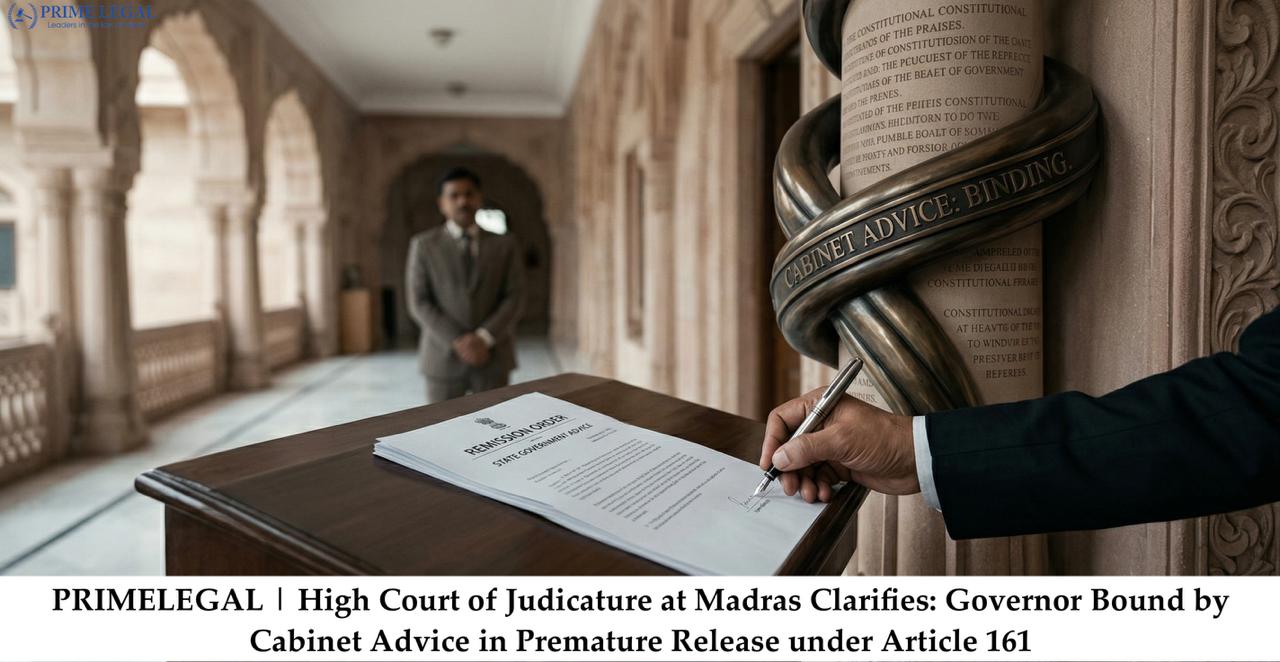
CASE NAME: Eswaran v. State (Premature Release Batch)
CASE NUMBER: W.P. No. 31478 of 2024 & batch
COURT: High Court of Judicature at Madras
DATE: 02 April, 2026
QUORUM: Hon’ble A.D. Jagadish Chandira, J.; Hon’ble G.K. Ilanthiraiyan, J.; Hon’ble Sunder Mohan, J.
FACTS
The High Court of Judicature Madras was approached under Article 226 of the Constitution against the arbitrary actions of the Tamil Nadu Governor. Multiple writ petitions were filed by convicts and their kin when the Governor rejected the premature release of life convicts which was earlier approved by the Government of Tamil Nadu by way of G.O. (Ms.) No. 430 (2023) and G.O. (Ms.) No. 488 (2021). However, the Governor acted on his own discrediting and declined to follow the Cabinet’s advice.
While hearing the matter the Division Bench noted a disparity between earlier decisions in Veera Bharathi v. State and Murugan @ Thirumalai Murugan v. State which dealt with the discretionary power of Governors under Article 161. The matter was thus referred to a Full Bench for its consideration to resolve the said inconsistency.
ISSUE
- Whether the Governor is bound by the decision of the Council of Ministers under Article 161 of the Constitution relating to matters of remission and premature release?
- Under which all circumstances, if any, can the Governor depart from the Council’s advice and exercise discretion?
LEGAL PROVISIONS
- Article 161 – Power of the Governor to grant pardons, reprieves, remissions, and premature release of convicts sentenced under state laws.
- Article 163 – General obligation of the Governor to act on the aid and advice of the Council of Ministers.
- Article 142 – Supreme Court’s power to do complete justice
ARGUMENTS
PETITIONERS:
Even though the petitioners drew the attention of the Court to Articles 14 and 21 the core challenge revolved around the scope of Article 161. Relying on Maru Ram, Perarivalan, and Raj Kumar @ Bittu, the petitioners contended that the Governor is bound by the aid and advice of the Council of Ministers while exercising the power under Article 161 of the Constitution. And they further argued that any such deviations by the Governor will undermine the constitutional scheme of responsible government.
RESPONDENTS:
The respondents (State) held that the legal position that Governor is bound by the advice of the Cabinet and that he (Governor) cannot exercise independent discretion by relying on precedents such as Perarivalan, Maru Ram and Samsher Singh.
However, they contended that M.P. Special Police Establishment v. The state of M.P is misplaced as it dealt with statutory powers under section 197 CrPC (section 218 BNSS) and not constitutional powers under Article 161. The Division Bench ruling ruling in murugan @ Thirumalai Murugan was, thus, per incurium.
ANALYSIS
The Court conducted a detailed constitutional examination on the two apparent conflicting precedents. The Court, thus, reiterated that India follows a parliamentary form of government and the Governor is the formal head of the State who is bound by the aid and advice of the Council of Ministers.
The apparent conflict between Veera Bharathi v. State (which followed Perarivalan) and Murugan @ Thirumalai Murugan v. State (which relied on M.P. Special Police Establishment v. State of M.P.) was reconciled by analysing the conceptual scope of each ruling. It was held that M.P. Special Police Establishment discussed the statutory power under section 197 CrPC (Section 218 BNSS) and not with regards to constitutional powers under Article 161.
The Court also observed that the Honourable Supreme Court had clarified and distinguished M.P. Special Police Establishment (particularly at paragraph 29) in A.G. Perarivalan v. State of Tamil Nadu, thus, there existed no real conflict between the two Supreme Court decisions. The apparent conflict resulted from the fallacious application by the Division Bench in Murugan @ Thirumalai Murugan.
The Court further drew attention towards the ruling of the Constitutional Bench in In Re: Assent, Withholding or Reservation of Bills by the Governor and the President of India (2026), which backed the reasoning given in the Perarivalan case and reiterated the constitutional restriction placed by the Cabinet’s advice on the Governor’s power. Thus, reinforcing the legal position that the Governor cannot act independently.
In the event of arbitrary, irrational or non-consideration of relevant factors the Court clarified that the remedy lies in judicial review. Drawing emphasis from Epuru Sudhakar v. Government of A.P the Court held that scrutiny is within the domain of judiciary and not of the Governor to take independent discretionary actions.
Finally, the Court declared Murugan @ Thirumalai Murugan as per incurium to the extent it allowed Governor’s discretion under Article 161 of the Constitution.
JUDGEMENT
The Court held that
- The Governor is bound by the aid and advice of the Cabinet under Article 161.
- The Governor cannot exercise discretionary powers in contrast to such advice under any circumstances.
- The ruling in Murugan @ Thirumalai Murugan is per incurium to that extent.
CONCLUSION
The honourable Court reaffirmed that the Governor’s role under Article 161 of the Constitution is not discretionary and is constitutionally constrained by the advice of the Cabinet. By relying on Perarivalan, Raj Kumar @ Bittu, and In Re: Assent (2026), removed discrepancies and conflicts between past rulings and settled the constitutional position on the limits of gubernatorial discretion in matters of remission and premature release.
The Court also held that in the event of challenges to administrative decisions the remedy lies in judicial review.
“PRIME LEGAL is a National Award-winning law firm with over two decades of experience across diverse legal sectors. We are dedicated to setting the standard for legal excellence in civil, criminal, and family law and Constitutional matters.”
WRITTEN BY: AARSHITHA UNNIKRISHNAN
read the judgement copy here

