
ABSTRACT
The purpose of this article is to analyse the Supreme Court’s ongoing constitutional challenge to India’s blood donation policies, which prohibit transgender individuals, MSM, and FSW from participating as blood donors. This article will also discuss the legal history of Thangjam Santa Singh v. Union of India, in which petitioners have challenged Clauses 12 and 51 (of India’s 2017 Blood Donor Selection and Blood Donor Referral Guidelines) based on a violation of Articles 14, 15, and 21 of the Constitution. This article provides an in-depth examination of the Government of India’s defence of these policies using epidemiological data and the expert witness reports, while also discussing the alternative arguments made by the petitioners relying upon their assertion that an individualised risk assessment should occur and that an evolution in medical testing capabilities has occurred since the guidelines were instituted. This legal dispute is placed within the framework of growing LGBTQ+ rights in India and raises important questions surrounding the interaction of public health policy and discrimination.
KEYWORDS: Blood Donation, Transgender Rights, MSM, Sex Workers, Transfusion-Transmitted Infections, Articles 14, 15 and 21, National Blood Transfusion Council, NACO, Supreme Court of India
INTRODUCTION
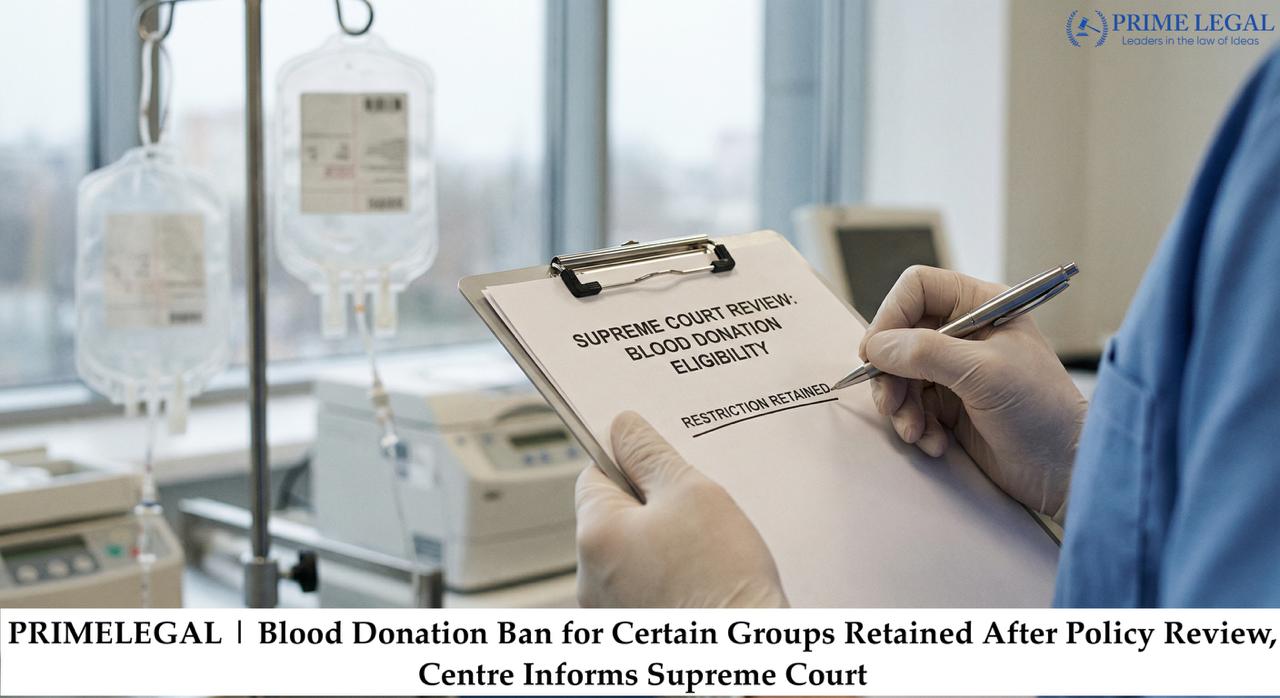
On 13 March 2026, the Supreme Court of India was told something that many had hoped would change after years of legal battle. The ban on blood donation by transgender persons, gays, and female sex workers would stay. The Centre, appearing before a bench of Chief Justice Surya Kant, Justice Joymalya Bagchi, and Justice Vipul Pancholi, informed the court that an expert committee constituted at the court’s own direction had reviewed the existing policy and concluded that no change was warranted at this stage.
This matter before the Supreme Court is not a single petition but a batch of three related writ petitions being heard together. The first and lead petition is by Thangjam Santa Singh, a transgender rights activist from Manipur, filed in 2021. The second is by Sharif D. Rangnekar, a gay author, filed and tagged to the lead matter in August 2024. The third is by Harish Iyer, a prominent LGBTQ+ activist, raising the same constitutional challenge. There is no fresh petition in 2026. The March 13 hearing was simply a continuation of this existing batch. The petitions challenge the constitutional validity of two clauses in the Guidelines for Blood Donor Selection and Blood Donor Referral, 2017. These guidelines, issued by the National Blood Transfusion Council (NBTC) and the National AIDS Control Organisation (NACO) under the Ministry of Health and Family Welfare, classify transgender persons, gays, and female sex workers as groups “at risk” for HIV and other Transfusion-Transmitted Infections. The result is a permanent deferral, effectively a lifetime ban on blood donation.
BACKGROUND: THE 2017 GUIDELINES AND THE PETITION
The restrictions were formalised and made official through the Guidelines for Blood Donor Selection and Blood Donor Referral, 2017. Clause 12 of these guidelines identifies transgender persons, MSM, and FSW as among those “at risk” for transmissible infections. Clause 51 goes further and mandates their “permanent deferral” from donating blood, meaning there is no path, no waiting period, and no individual assessment that can make them eligible.
Santa Khurai, as Thangjam Santa Singh is known, challenged these two clauses in a PIL admitted by the Supreme Court on 5 March 2021. The PIL argued that the exclusion is arbitrary, unscientific, and discriminatory because it is based entirely on gender identity and sexual orientation rather than actual risk behaviour. The petition contends that the guidelines violate Article 14, Article 15, and Article 21 of the Constitution of India. The petition raised a practical objection as well, that during the second wave of COVID-19, when the demand for blood and plasma was at a peak, transgender persons, gay men, and sex workers were unable to donate blood to their own family members in need.
THE CENTRE’S DEFENCE: DATA, EXPERTS, AND RECIPIENT RIGHTS
The Union government’s position, presented before the bench through Additional Solicitor General Aishwarya Bhati, rests on three main pillars: epidemiological data, expert committee endorsement, and the primacy of the blood recipient’s right to safe transfusion.
On data, the government cited the Annual Report of the Department of Health and Family Welfare 2020-2021, which states that HIV prevalence among transgender persons, MSM, and FSW is 6 to 13 times higher than adult HIV prevalence in the general population.
Following a Supreme Court direction in May 2025 to reconsider the policy, the government set up a fresh expert committee comprising specialists from government bodies, NGOs, and medical societies. In August 2025, the committee submitted its report, which the Centre placed on record. The committee found that the 2017 guidelines are “firmly rooted in national and international research” and that any relaxation could “pose a serious risk to the safety and integrity of the national blood supply.”
The government also raised the issue of testing limitations. Most blood banks in India do not use Nucleic Acid Testing technology. Even where NAT is available, a window period of 10 to 33 days exists during which an infection may not be detectable. Because of this window period, blood from an infected donor could still pass through screening as clean. The government argues that the suggestion to replace the permanent ban with a temporary deferral period is therefore unworkable, given the realities of testing infrastructure across India.
The affidavit calls the blood transfusion system a “major public health responsibility” and invokes Article 47 of the Constitution, On this basis, the government urged the court to defer to the judgment of medical experts and not interfere in what it characterised as a technical public health matter.
Chief Justice Surya Kant, while hearing the matter, appeared to lean cautiously toward the government’s position. The court reportedly indicated that even a one percent chance of infection was too much of a risk when it came to blood transfusion safety, and expressed reluctance to override a policy backed by expert opinion.
THE PETITIONERS’ COUNTER: BEHAVIOUR, NOT IDENTITY
Senior Advocate Jayna Kothari, appearing for the petitioners, made a pointed argument before the court. She asked the bench to consider a fundamental question: why is a heterosexual person who engages in unprotected sex not asked about it before donating blood, while an entire community is barred by identity alone? The actual risk, she argued, lies in specific behaviours , unprotected sex, multiple partners , and not in being transgender, gay, or a sex worker.
Kothari also pushed back on the government’s testing argument. She pointed out that all donated blood is already mandatorily tested for HIV, Hepatitis B, Hepatitis C, and other TTIs before it is used. She argued that if the government’s concern is truly about inadequate testing infrastructure, the answer is to improve that infrastructure, not to permanently exclude whole communities. As advocates Anindita Pujari and Jayna Kothari together argued, if these tests are unavailable or unreliable, that inadequacy itself puts recipients at risk regardless of which community the donor belongs to.
The petitioners want the court to replace the current system of identity-based permanent deferral with individual risk assessment. Under this proposed system, every prospective donor would be evaluated based on their actual recent behaviour, whether they have had unprotected sex, whether they have had multiple partners in a recent period, and other specific risk factors, regardless of their gender identity or sexual orientation.
Kothari also raised a procedural concern: while the expert committee report has been placed on record by the government, the actual reasoning of the committee, why it concluded no change was needed, has not been disclosed to the petitioners. Without that reasoning being available, the petitioners argue, it is impossible to challenge the committee’s findings meaningfully.
THE LARGER PICTURE: RIGHTS, STIGMA, AND INDIA’S IP JURISPRUDENCE
Although the honourable court has termed the petitions as “luxury litigation,”
This case does not exist in a vacuum. The Supreme Court’s own decisions, from recognising transgender identity in NALSA (2014) to decriminalising homosexuality in Navtej Singh Johar (2018), reflect a judiciary that has been willing to protect the dignity of marginalised communities against state overreach. The Transgender Persons (Protection of Rights) Act, 2019, goes so far as to explicitly prohibit discrimination in healthcare against transgender persons.
However, this policy treats an entire community as a source of contagion, not based on their individual medical history or behaviour, but based on their identity. If the concern is safety, the solution should be rigorous, universally applied testing and individual risk screening, not blanket exclusion.
CONCLUSION
The Supreme Court’s handling of Thangjam Santa Singh v. Union of India will be a defining moment for how India balances public health policy against constitutional rights. The Centre’s position, that the ban is data-driven, expert-backed, and necessary to protect blood recipients, is not without logic. Blood safety is a genuine and serious concern. But the petitioners’ argument, that identity-based permanent exclusion is a blunt and discriminatory instrument when behaviour-based individual assessment is both scientifically viable and constitutionally required, is equally compelling.
The bench has signalled caution. But the case is still alive, and the arguments from both sides deserve a full and reasoned adjudication. For millions of transgender persons, gay men, and sex workers in India, the answer matters, not just as a matter of law, but as a matter of being seen as equal citizens.
“PRIME LEGAL is a National Award-winning law firm with over two decades of experience across diverse legal sectors. We are dedicated to setting the standard for legal excellence in civil, criminal, and family law.”
WRITTEN BY: KISLAY RAJ

