
INTRODUCTION
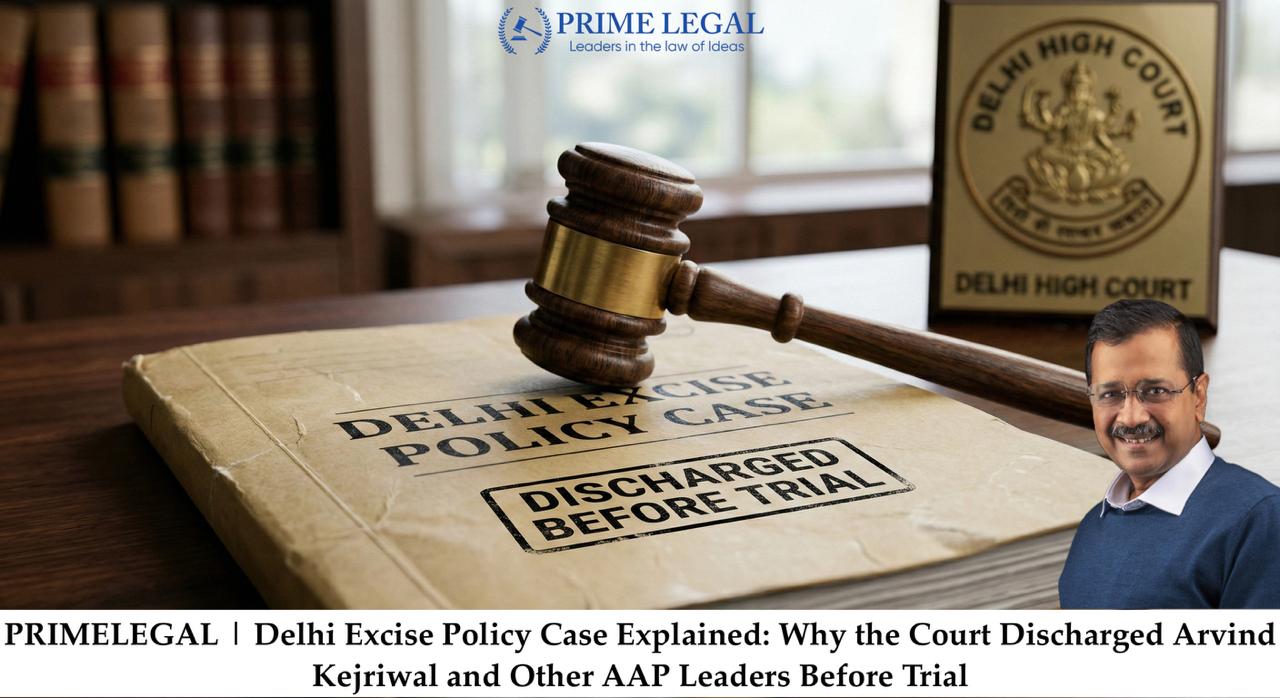
Recently, former Chief Minister of Delhi Arvind Kejriwal, along with Manish Sisodia and 21 other accused from the Aam Aadmi Party (AAP), were discharged by the Special Judge at the Rouse Avenue Court in New Delhi in the excise policy case. This was being investigated by the Central Bureau of Investigation (CBI).
BACKGROUND
The present case pertains to the alleged corruption in the framing and implementation of the excise policy, formulated and implemented by the then AAP government in Delhi on 17 November 2021 to reform the liquor trade and boost revenue. It was later withdrawn on 31 July 2022 due to allegations of corruption. In the present matter, CBI filed a First Information Report (FIR) on 17 August 2022. Kejriwal was arrested by the ED over money laundering allegations that arose from the excise policy case on 21 March 2024. He was later taken into custody by the CBI and was released from Tihar Jail on 13 September 2024, after the bail was granted by the Supreme Court in both cases.
KEY POINTS
- In the year 2022, CBI registered its case under legal sections that cover criminal conspiracy, cheating, and disappearance of evidence, as well as the Prevention of Corruption Act, 1988. The agency alleged that a total of Rs. 100 crore was paid by a “south lobby” to influence the now scrapped liquor policy.
- The Enforcement Directorate pursued a separate case under the Prevention of Money Laundering Act, wherein the probe was against the alleged hawala transfers and shell companies linked to the main case.
- During arguments, the CBI maintained that the evidence of criminal conspiracy must be viewed in its entirety and that the sufficiency of evidence should be tested during the trials. They highlighted that there was adequate material to frame charges against all the accused.
- The counsel on behalf of the AAP members, however, maintained that there was no incriminating material linked to Arvind Kejriwal to the alleged wrongdoing and raised the question as to why his name appeared only in a later supplementary chargesheet.
- The Delhi Court refused to take cognizance of the CBI chargesheet and stated that it has several lacunae, which were not supported by evidence. It was ruled that there was no overarching conspiracy or criminal intent behind the excise policy and that the CBI had attempted to construct a narrative of conspiracy based on conjecture, rather than evidence.
- It is crucial to highlight that Arvind Kejriwal and other party members were discharged altogether and not acquitted, meaning that the court did not find substances enough in the allegations for a trial. Discharge refers to the termination of proceedings before framing of charges due to insufficient evidence to establish a prima facie case.
- The Court underlined that, based on the evidence on record, the policy was an outcome of a deliberative exercise, and to compel an accused to face the rigors of a criminal trial in the absence of any legally admissible evidence would be unjust.
RECENT DEVELOPMENT
The Court recommended a departmental inquiry against the CBI officials handling the case to ensure accountability of the investigative system. The CBI has issued a statement pertaining to the immediate appeal in the Delhi High Court against the Trial Court’s statement.
CONCLUSION
To conclude, while the matter may continue in appellant forums, the present case highlights the core stance of the judiciary that criminal prosecution must rely on credible and legally admissible evidence and not mere conjecture. It reinforces judicial scrutiny over investigative agencies and that a criminal trial cannot be imposed in the absence of substantive material.
“PRIME LEGAL is a National Award-winning law firm with over two decades of experience across diverse legal sectors. We are dedicated to setting the standard for legal excellence in civil, criminal, and family law.”
WRITTEN BY: STUTI ANVI

