
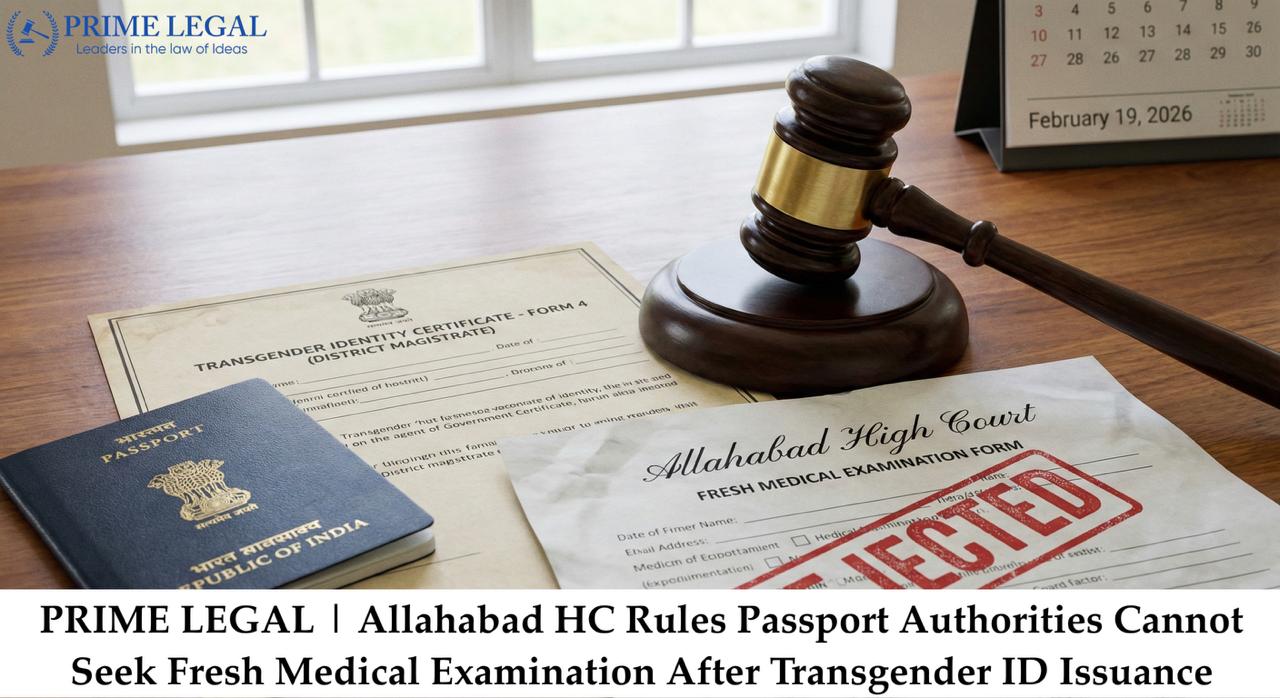
CASE NAME: Khush R Goel v. Union of India & 3 Others
CASE NUMBER: Writ – C No. 5154 of 2026
COURT: High Court of Judicature, Allahabad
DATE: 10 February 2026
QUORUM: Hon’ble Atul Sreedharan, Hon’ble Siddharth Nandan
FACTS:
The petitioner, Khush R Goel was born a female but later on came out to be a transgender person. In line with The Transgender Persons (Protection of Rights) Act including details on sections 5 & 6 2019, the petitioner applied to the District Magistrate and was granted the certificate of identity of a transgender person. Upon reaching the age of majority, the petitioner underwent gender affirmation surgery and subsequently made an application under Section 7 of the Act with Rule 6 of the Transgender Persons (Protection of Rights) Rules, 2020 for issuance of revised certificate for change of gender. The District Magistrate issued an identity card and certificate under form-4 stating the petitioner’s gender as ‘male’. Clause 5 of the certificate explicitly stated that it granted the owner the right to change the name and gender in all official documents. Despite this, the petitioner was directed by an order dated 23.06.2025 by the passport office to undergo fresh medical examination from a panel clinic and further unaddressed these issues pertaining to name and gender correction in the birth certificate before disposing of passport application. Aggrieved by these directions the petitioner moved the High Court for quashing such impugned order.
ISSUES:
- Whether the passport authorities were justified in demanding fresh medical examinations in spite of the issue of certificates under the law of Transgender Persons (Protection of Rights) Act, 2019.
- Whether correction of birth certificate has been or is compulsory before issue of passport
- Whether the impugned order violated the special act’s statutory protections.
LEGAL PROVISIONS:
- Sections 5 and 6 of the Transgender Persons (Protection of Rights) Act, 2019
Relied on by the petitioner to prove that the statutory procedure for getting to be recognized as a transgender person had been duly followed.
Recognised by the Court to establish a legal mechanism of issuance of identity certificate by the District Magistrate.
- Section 7 of the Act read with Rule 6 of the Transgender Persons (Protection of Rights) Rules, 2020
Invoked by the petitioner establishing lawful change of gender after surgery, issue of revised certificate indicating ‘male’
Interpreted by the Court as giving finality to the certificate given by the District Magistrate following the satisfaction of medical documents.
- Clause 5 of Form-4 Certificate
Provides that the certificate granted allows the holder to change name and gender in all official documents.
Relied upon by the petitioner to argue that the passport is under “official documents”.
The court accepted this position and stated that a passport is a sovereign document and as such it would fall within Annexure-1 to Schedule 2 of the Rules.
- Statement of Objects and Reasons (clause F) .
Means the legislative intent to avoid discrimination against and ensure the dignity and the equal rights of transgender persons.
The Court took this into consideration when interpreting the scope statutory protection.
ARGUMENTS
PETITIONER:
The petitioner submitted that the entire procedure of the statute contained in the said Special Act had been strictly complied with. The identity card and revised certificate issued by the District Magistrate clearly mentioned the gender as ‘male’. Clause 5 authorised change in all official documents including passport. Therefore, the demand for fresh medical examination and insistence on correction of birth certificate were against the Act and amounted to violation of statutory rights. The impugned order was arbitrary and subject to quashing.
RESPONDENT:
The respondents argued that the requirements in the power of the passport authorities were reasonable and procedural in nature. It was argued that the petitioner needed to correct name and gender first on the birth certificate to make corresponding changes in the passport. The need for medical examination was then defended as one of administrative compliance.
ANALYSIS:
The Court looked into the scheme and object of the Transgender Persons (Protection of Rights) Act, 2019, and it was enacted with an intention to secure the dignity, identity, and protection for the transgender persons who were politically socially excluded in the past. Sections 5, 6 and 7 set up a full statutory framework for the recognition and change of gender. On the certifications of the District Magistrate who upon being satisfied about the medical certification makes a new certificate claiming the change of gender, the matter is given statutory finality.
The Court held that Clause 5 clearly authorises change in all official documents, which necessarily includes passport. The fact that a passport is included in Annexure-1 to Schedule 2 of the Rules also favors this interpretation. Consequently, the additional requirements of the passport authorities were not legally founded and failed to be in line with the Special Act.
JUDGMENT:
The High Court held that the impugned order dated 23.06.2025 was inconsistent with the provisions of the Transgender Persons (Protection of Rights) Act, 2019 along with the certificate issued of the said Act. It ordered that no additional documents were needed to be provided by the petitioner demonstrating proof of their identity or gender. The passport authorities were asked to process and issue the passport on the basis of identity card and certificate issued by the District Magistrate. The writ petition was accordingly disposed of.
CONCLUSION:
The said judgment maintains the statutory finality of identity and gender certification under Transgender Persons (Protection of Rights) Act, 2019. It underlines that even after the prescribed procedure has been duly followed and the certification obtained, the authority cannot seek any further condition not visioned in the statute. The decision gives added strength to protect the dignity, identity and the non-discrimination of transgender persons and at the same time ensures the faithful implementation of the legislative intent.
“PRIME LEGAL is a full-service law firm that has won a National Award and has more than 20 years of experience in an array of sectors and practice areas. Prime legal falls into the category of best law firm, best lawyer, best family lawyer, best divorce lawyer, best divorce law firm, best criminal lawyer, best criminal law firm, best consumer lawyer, best civil lawyer.”
WRITTEN BY: TANUSH RAJ
Click here to read the judgment.

