
INTRODUCTION
A trademark is the commercial signature by which a business distinguishes its goods or services from those of others, and registering it under the Trade Marks Act, 1999 (“the Act”) converts an unregistered claim of reputation into a bundle of enforceable statutory rights, including the exclusive right to use the mark and a lower evidentiary threshold in infringement proceedings than is available under the common law remedy of passing off. The journey from conceiving a mark to holding a registration certificate is, however, neither automatic nor purely administrative. It runs through statutory grounds of refusal designed to keep the register free of generic or deceptive marks, an international classification scheme that determines the scope of protection, an examination conducted by the Trade Marks Registry, and a public opposition window that allows any third party to contest registration before it is finalised. This article traces that procedural pathway and situates each stage within the substantive jurisprudence that shapes it.
THE STATUTORY FRAMEWORK
Trademark law in India is governed principally by the Trade Marks Act, 1999, which replaced the earlier Trade and Merchandise Marks Act, 1958, and came into force in September 2003, aligning Indian law with obligations under the TRIPS Agreement. Procedure is prescribed by the Trade Marks Rules, 2017, which consolidated dozens of earlier forms into eight and introduced measures such as expedited examination and video-conferencing hearings. India’s accession to the Madrid Protocol in 2013, given effect through Chapter IVA of the Act, additionally allows Indian applicants to seek international registration through a single application filed with the Trade Marks Registry, and permits foreign applicants to designate India for protection through the World Intellectual Property Organization.
WHO MAY APPLY AND ABSOLUTE GROUNDS FOR REFUSAL
Section 18 permits any person claiming to be the proprietor of a mark, whether already in use or merely proposed to be used, to apply for registration in the manner prescribed by the Rules. The mark itself must satisfy the definition in Section 2(1)(zb): it must be capable of being represented graphically and of distinguishing the applicant’s goods or services from those of others. Section 9 provides for the absolute grounds for the Registrar to reject registration outright, such as marks which have no distinctive character; marks which are merely descriptive of the kind, quality or geographical origin of the goods; marks which have become customary in the trade; and marks which are likely to deceive the public. The early decision of the Supreme Court in Registrar of Trade Marks v. Ashok Chandra Rakhit Ltd., AIR 1955 SC 558, is still instructive on this point: on examining the Registrar’s power to require a disclaimer over the common, religiously significant word “Shree”, the Court held that a disclaimer is made to prevent a proprietor from securing an unwarranted monopoly over words that are generic or otherwise incapable of exclusive ownership, without extinguishing whatever common law rights the proprietor.
RELATIVE GROUNDS AND THE TEST FOR DECEPTIVE SIMILARITY
Even a distinctive mark can be refused under Section 11 if it is identical or deceptively similar to an earlier mark registered or applied for in respect of identical or similar goods or services, where such similarity is likely to cause confusion among the public. The Supreme Court’s judgment in Cadila Health Care Ltd. v. Cadila Pharmaceuticals Ltd., (2001) 5 SCC 73, though delivered in a passing-off suit between two pharmaceutical companies over the marks “Falcigo” and “Falcitab,” laid down a multi-factor test for assessing deceptive similarity, weighing the nature of the marks, the class of purchasers, the mode of purchase, and, notably, urging a stricter standard where medicinal products are concerned given the risk to public health from mistaken purchases; the Trade Marks Registry routinely draws on this test while examining Section 11 objections. A different but related concern arose in Nandhini Deluxe v. Karnataka Co-operative Milk Producers Federation Ltd., (2018) 9 SCC 183, where the Supreme Court permitted the phonetically similar marks “NANDHINI” and “NANDINI” to coexist because the goods for which registration was sought, though nominally falling in overlapping classes, were visually and commercially distinct from the earlier proprietor’s actual dairy business; the judgment cautions the Registry against treating classification alone as conclusive and against allowing a proprietor to claim a blanket monopoly over an entire class where its actual use is confined to a narrow segment of it.
CLASSIFICATION OF GOODS AND SERVICES
Every application must specify the class or classes of goods or services for which registration is sought, in accordance with the Fourth Schedule to the Trade Marks Rules, 2017, which adopts the International (Nice) Classification of forty-five classes, of which the first thirty-four cover goods and the remaining eleven cover services. Since the 2010 amendment to the Act, a single application may cover multiple classes, though the prescribed fee is charged per class rather than per application. Precise classification is not a mere formality: as Nandhini Deluxe illustrates, the boundaries of a class can determine whether two marks are treated as competing for the same commercial space or as occupying entirely separate ones.
FILING AND EXAMINATION OF THE APPLICATION
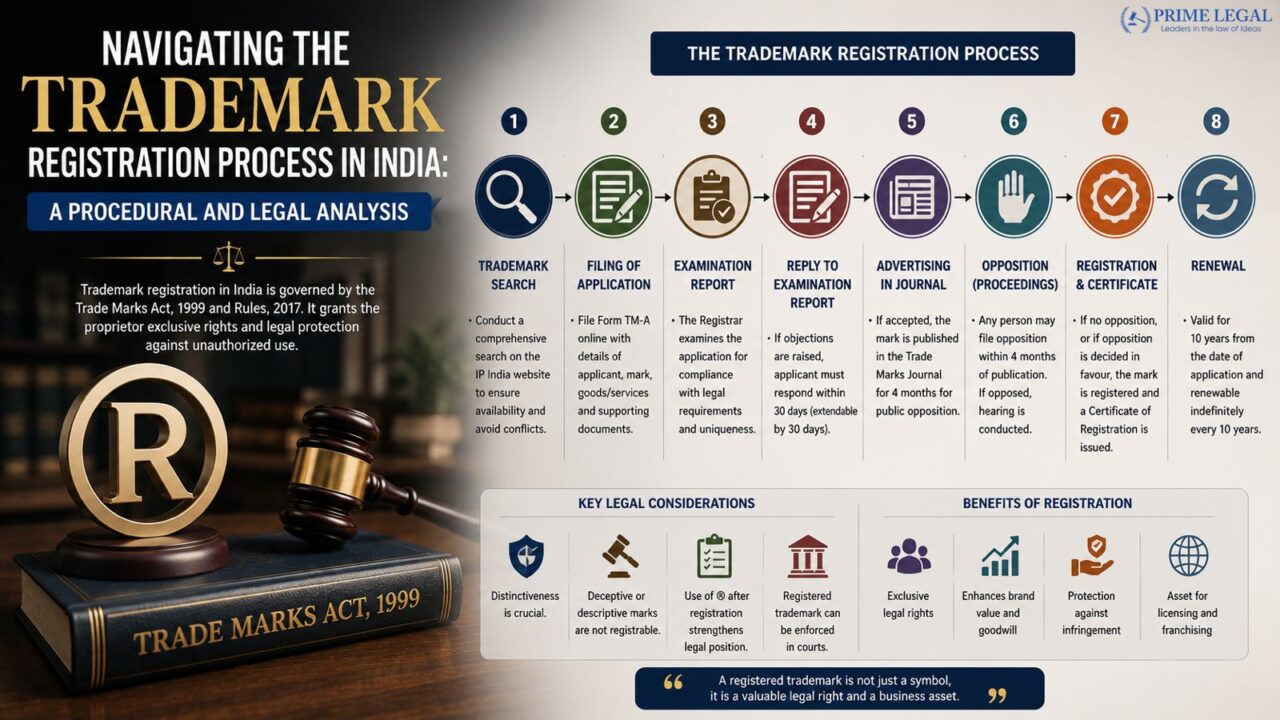
Applications are filed in Form TM-A, largely through the Registry’s e-filing portal, which offers a reduced government fee for individuals, start-ups, and small enterprises. Under Section 18(4) read with Rule 33, the Registrar conducts a search against existing and pending marks and issues an examination report raising any objections under Sections 9 or 11, or any procedural deficiency in the application. The applicant is ordinarily given one month, extendable at the Registrar’s discretion, to respond in writing or to request a hearing; if the objections are not satisfactorily overcome, the application is refused, and if they are, the mark proceeds to publication.
PUBLICATION AND OPPOSITION
Once an application is accepted, Section 20 requires it to be advertised in the Trade Marks Journal. Section 21 then opens a window during which any person, whether or not they hold a competing mark, may file a notice of opposition; the Trade Marks Rules, 2017, fixed this at four months from the date of publication and removed the earlier facility to seek a one-month extension, making the period strict and non-extendable. Opposed applications proceed through an exchange of a counter-statement by the applicant, evidence in support of the opposition, evidence in reply, and written submissions or a hearing before the Registrar decides the matter. Where no opposition is filed within the period, the Registry proceeds directly to registration.
WELL-KNOWN MARKS AND THE TERRITORIALITY PRINCIPLE
The Act separately protects “well-known marks,” defined in Section 2(1)(zg), by extending relative grounds of refusal under Sections 11(2) and 11(6) to 11(10) even to dissimilar goods or services, and by allowing the Registrar to formally declare a mark well-known under Rule 124 on a proprietor’s application. How much weight a mark’s foreign reputation carries in India was tested in Toyota Jidosha Kabushiki Kaisha v. Prius Auto Industries Ltd., (2018) 2 SCC 1, where the Supreme Court, considering Toyota’s claim over the mark “Prius” against a domestic auto-parts manufacturer, held that Indian law follows the territoriality doctrine rather than the universality doctrine: a mark’s renown abroad does not automatically translate into protectable goodwill in India, and a claimant must produce evidence of actual reputation and recognition among the relevant Indian public.
The decision has implications for registration policy as well, as foreign proprietors intending to avail themselves of the protection afforded by well-known marks in India will not be able to rely on the mark being well known abroad; they will need to establish an evidentiary record in India.
REGISTRATION, RENEWAL, AND POST-REGISTRATION CHALLENGES
After the opposition period has ended (either because the opposition was waived, or because it was successfully challenged in favor of the applicant), the Registrar must register the mark and grant a certificate of registration, which takes effect on the date when the application was filed. Registration has a validity of 10 years and can be renewed for further 10 year periods thereafter indefinitely by paying the prescribed fee, with a grace period and restoration provision provided for marks that have lapsed due to oversight. However, the registered mark is not protected from further attack as Section 47 provides for its removal from the Register due to continuous non-use for five years and Section 57 provides for its rectification on other grounds, both of which are currently heard by the High Courts after the Intellectual Property Appellate Board was abolished under the Tribunals Reforms Act, 2021.
PRACTICAL CHALLENGES IN THE REGISTRATION PROCESS
Though the Rules have been simplified in 2017, there are still delays in the examination and opposition phases, confusion over the application of Section 9 and 11 and problems in drafting an accurate specification of goods/services, especially for small companies who lack knowledge of the Nice Classification. A thorough public search before filing remains the most effective safeguard against a Section 11 objection or a subsequent opposition, yet it is a step many first-time applicants overlook, often discovering conflicting marks only after an examination report or opposition notice has already been issued.
WAY FORWARD
Continued digitisation of the Registry’s search and examination functions, sustained adherence to the statutory timelines the 2017 Rules introduced, and greater applicant awareness, whether through professional guidance or Registry outreach, of the importance of an accurate specification and a pre-filing search would collectively narrow the gap between the Act’s procedural design and its practical administration. Equally, the shift of rectification and cancellation proceedings to the High Courts after the Intellectual Property Appellate Board’s abolition calls for close monitoring to ensure that specialised trademark disputes do not lose the domain expertise the Board once provided.
CONCLUSION
The path to a registered trademark in India is procedurally structured but substantively demanding at every stage, from selecting a mark distinctive enough to clear Section 9, as Ashok Chandra Rakhit illustrates, to navigating the confusion analysis under Section 11 that Cadila and Nandhini Deluxe have shaped, to establishing, where relevant, a genuinely Indian reputation under the territoriality principle affirmed in Toyota. For applicants and their counsel, careful classification, a diligent pre-filing search, and vigilance through the publication and opposition windows remain the surest means of converting a proposed mark into a durable and defensible registration.
“PRIME LEGAL is a National Award-winning law firm with over two decades of experience across diverse legal sectors. We are dedicated to setting the standard for legal excellence in civil, criminal, and family law.”
WRITTEN BY: GAURAV VIBHU RANJAN

