
ABSTRACT
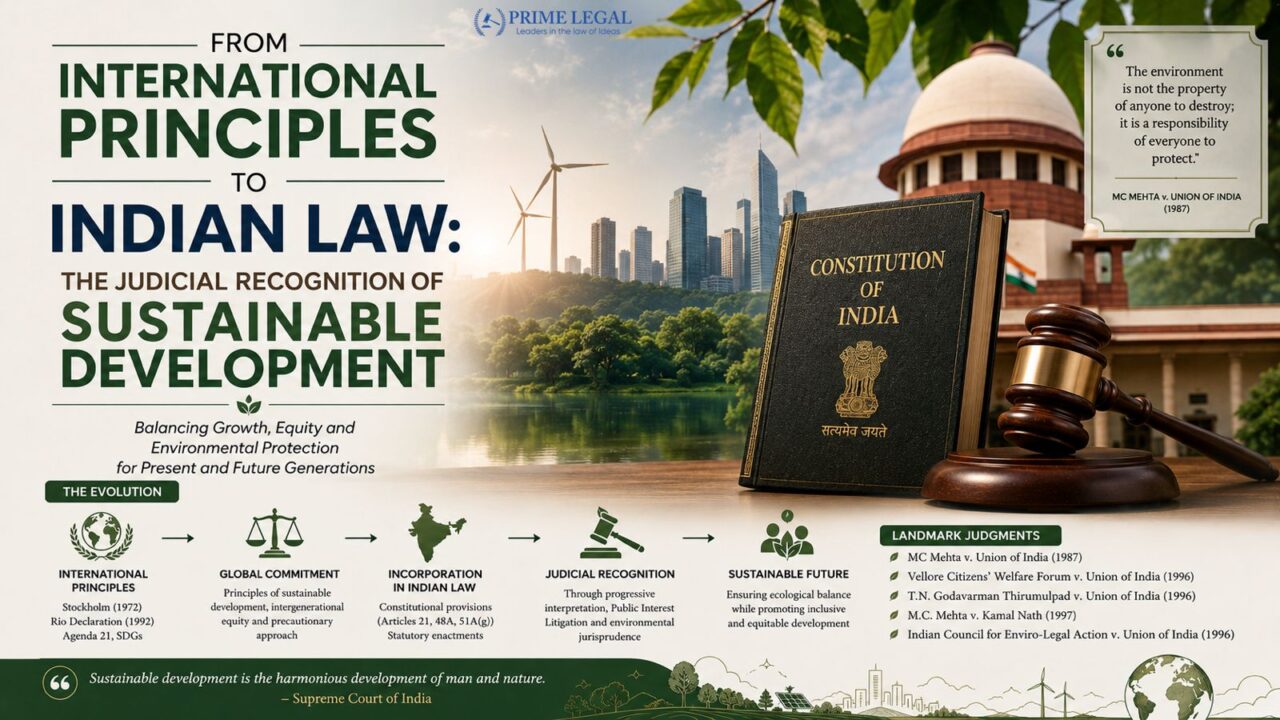
Sustainable development began as a diplomatic compromise between environmental protection and economic growth, articulated in international instruments with no binding force in domestic law. Indian courts, confronted with industrial pollution and ecological degradation but no explicit constitutional text on the subject, imported the concept through Article 21 and built it into enforceable doctrine. This article traces that journey from the Stockholm and Rio Declarations to the Supreme Court’s incorporation of the precautionary principle, the polluter pays principle, and intergenerational equity and asks what remains unresolved in the doctrine three decades on.
KEYWORDS
Sustainable development, Article 21, precautionary principle, polluter pays principle, intergenerational equity, environmental jurisprudence, Vellore Citizens Welfare Forum
INTRODUCTION
“Sustainable development” is not a term the Indian Constitution uses. It appears nowhere in Part III, Part IV, or the Ninth Schedule. Yet it is now treated by Indian courts as part of the substantive content of the right to life under Article 21, cited routinely in industrial licensing disputes, mining clearances, and coastal zone litigation. That gap between a concept absent from the constitutional text and a doctrine central to constitutional adjudication is the subject of this piece. Understanding how it was filled says as much about the method of Indian constitutional interpretation as it does about environmental law itself.
THE INTERNATIONAL ORIGINS
The term traces to the 1972 Stockholm Declaration on the Human Environment, which was the first major international instrument to frame environmental protection as compatible with, rather than opposed to, development. It gained its canonical definition fifteen years later in the Brundtland Report, “Our Common Future” (1987), which described sustainable development as development that meets the needs of the present without compromising the ability of future generations to meet their own needs. That formulation deliberately avoided specifying how competing claims between present and future needs should be weighed, which is precisely why it survived into so many later instruments.
The 1992 Rio Declaration on Environment and Development operationalised the concept further, setting out twenty-seven principles including the precautionary approach (Principle 15) and the polluter pays principle (Principle 16). Neither Stockholm nor Rio created binding obligations enforceable in domestic courts; they were statements of intent adopted at diplomatic conferences, not treaties India had ratified with domestic legislative follow-through. The question, then, is how principles with no domestic legal status became operative rules of Indian environmental adjudication.
THE ROUTE INTO INDIAN LAW
The answer lies in the Supreme Court’s approach to unincorporated international law and its expansive reading of Article 21. Courts had already established, well before the environmental cases, that international conventions not inconsistent with fundamental rights could be read into the content of those rights in the absence of domestic legislation – the sexual harassment guidelines issued in Vishaka v. State of Rajasthan are the most cited example of this method, though that case followed the environmental jurisprudence chronologically.
In the environmental context, the foundational case is Vellore Citizens Welfare Forum v. Union of India (1996), concerning pollution from tanneries in Tamil Nadu. The Court held that sustainable development, along with the precautionary principle and the polluter pays principle, had become part of customary international law and could therefore be applied even without domestic statutory backing. The judgment did not merely gesture at the concept; it gave the precautionary principle operative content placing the burden on industry to show that a proposed action is environmentally benign, reversing the ordinary evidentiary position, and directing the constitution of an authority to assess and recover compensation from polluters.
This was built on M.C. Mehta v. Union of India, the Ganga pollution and Taj Trapezium litigation of the late 1980s and early 1990s, where the Court had already begun treating industrial closure and relocation as legitimate remedies flowing from Article 21, and on Subhash Kumar v. State of Bihar (1991), which first stated explicitly that the right to life includes the right to a wholesome environment. Sustainable development therefore did not arrive in Indian law as an abstract value; it arrived as the organising principle for a set of remedies courts were already granting.
THE DOCTRINAL STRUCTURE THAT FOLLOWED
Once anchored in Article 21, sustainable development generated its own supporting doctrines. Narmada Bachao Andolan v. Union of India (2000) addressed the tension the Brundtland definition leaves open how to balance developmental need against ecological cost and the majority took a notably deferential position, holding that the judiciary should not substitute its own assessment for that of expert planning bodies once environmental clearance processes had been followed. This marked a shift from the assertive posture of the Vellore-era judgments toward something closer to procedural review, and it remains contested: dissenting and later judgments have questioned whether that deference underestimates irreversible ecological harm.
Intergenerational equity, the Brundtland Report’s central premise, found its clearest doctrinal statement in State of Himachal Pradesh v. Ganesh Wood Products (1995) and subsequent forest and mining cases, where courts held that natural resources held by the state are held in trust for future generations, an application of the public trust doctrine imported into Indian law via M.C. Mehta v. Kamal Nath (1997). The polluter pays principle, meanwhile, moved from rhetorical statement to a quantifiable liability standard through National Green Tribunal jurisprudence after the Tribunal’s establishment in 2010, which gave sustainable development a specialised forum with technical expertise the ordinary judiciary lacked.
WHAT REMAINS UNSETTLED
Three issues recur in current litigation. First, the precautionary principle’s reversal of the burden of proof sits uneasily with the deference shown in Narmada Bachao Andolan, courts have not fully reconciled a principle that presumes environmental risk with a review standard that presumes administrative competence. Second, sustainable development as applied by Indian courts has functioned largely as a balancing standard rather than a hard constraint, meaning its outcomes are difficult to predict from the doctrine alone; project clearances have gone both ways on comparable facts. Third, the doctrine’s international origins mean its content evolves as international environmental law develops the 2015 Paris Agreement and subsequent climate jurisprudence, including the Supreme Court’s 2024 recognition of a distinct right against the adverse effects of climate change in M.K. Ranjitsinh v. Union of India, suggests the concept is still being actively rewritten rather than settled.
CONCLUSION
The judicial recognition of sustainable development in India illustrates a broader pattern: international soft-law instruments, incapable of direct enforcement, entering domestic law through expansive rights interpretation rather than legislative transposition. This gave India an environmental jurisprudence earlier and more assertive than its statutory framework alone would have produced, but it also left the doctrine’s precise content, how much precaution, how much deference, whose burden depends on shifting judicial composition and case-specific facts rather than fixed rule. Three decades after Vellore, sustainable development remains less a settled test than a continuing negotiation between the judiciary’s stated commitment to precaution and its practical reluctance to override developmental and administrative judgment.
“PRIME LEGAL is a National Award-winning law firm with over two decades of experience across diverse legal sectors. We are dedicated to setting the standard for legal excellence in civil, criminal, and family law.”
WRITTEN BY: DRISHTITA BANIK

