
ABSTRACT
The Protection of Children from Sexual Offences Act, 2012 (POCSO) is a legislation that seeks to protect children from sexual abuse by using a child-friendly approach that considers all consents involving persons under the age of eighteen to be null and void. While this legislation seeks to protect children from abuse, it has the ancillary benefit of criminalising consensual romantic relationships between adolescents. Empirical research has shown that a large number of POCSO cases arise from consensual romantic relationships, which are often initiated out of parental and societal pressure. This paper examines the effects of blanket criminalisation, including imprisonment, stigmatisation, loss of agency, and reproductive healthcare access, and recommends the inclusion of a Romeo-Juliet clause in the POCSO Act.
KEYWORDS
POCSO Act, Romeo-Juliet Clause, Consensual Adolescent Relationships, Age of Consent, Child Protection Laws, Adolescent Autonomy, Judicial Discretion.
INTRODUCTION
The Protection of Children from Sexual Offences Act, 2012 (POCSO) was introduced with the main aim of protecting children from sexual abuse and exploitation. The Act takes a strict child-centric stand by considering all persons below the age of 18 as children whose consent shall not be valid or has no legal value. Although this Act was meant to protect children from harm, it has also resulted in some serious unintended consequences.
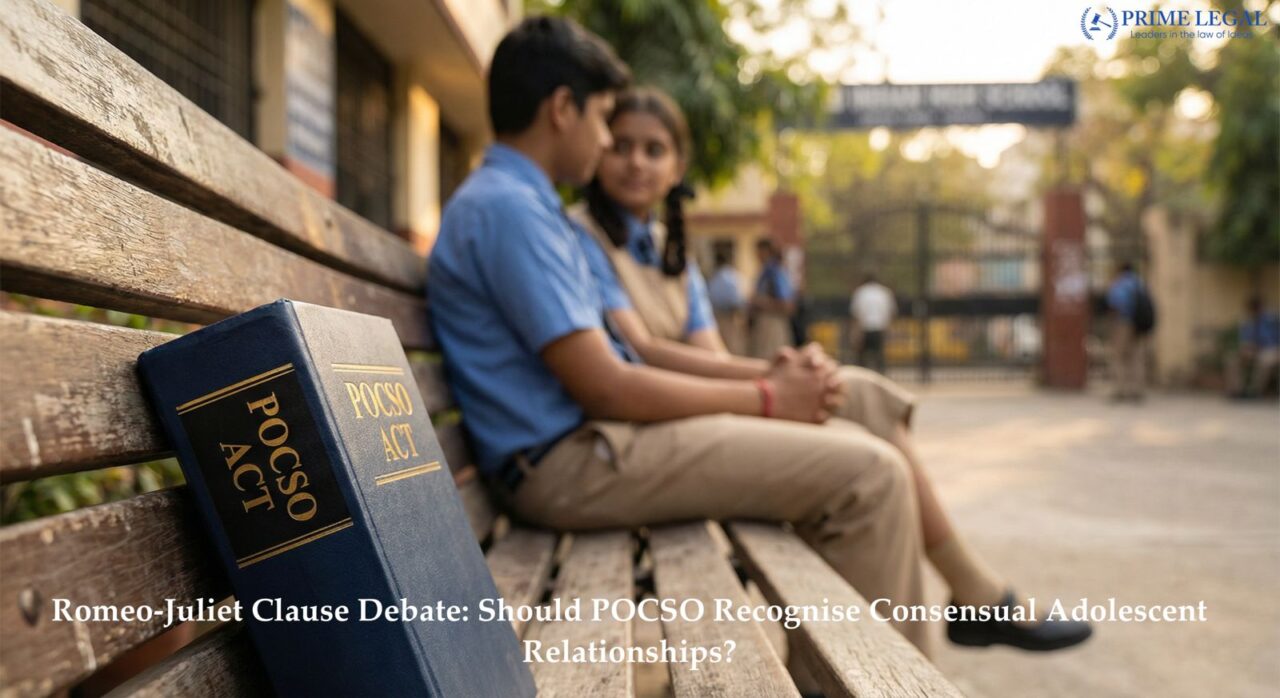
Consensual romantic relationships between adolescents are regularly prosecuted as serious sexual offenses, even in the absence of exploitation or coercion. This has been characterized as creating a “grim societal chasm” between legal intention and reality. This has reignited debate about the use of a Romeo-Juliet clause, which would offer a limited exception for consensual relationships between adolescents who are close in age.
THE LEGISLATIVE SHIFT AND THE POCSO PARADOX
Prior to 2012, the age of consent in India was 16 years, which was unchanged since 1940. Following the enactment of POCSO and the Criminal Law (Amendment) Act, 2013, the age of consent in India was increased to 18 years to bring Indian law in line with the UN Convention on the Rights of the Child, UNCRC.
This amendment brought in a strict liability system, where consent under the age of 18 is no longer relevant. This means that all forms of sexual conduct with a minor are now classified as statutory rape, regardless of consent and proximity of age. The new law also provides for minimum mandatory sentences, which are often tougher than those for sexual crimes committed against adults. What was intended to prevent abuse has instead led to the criminalization of adolescent sex.
EMPIRICAL EVIDENCE OF MISUSE
Empirical evidence shows that a large number of POCSO cases are not related to sexual exploitation. Studies carried out by the Enfold Proactive Health Trust have shown that nearly 24 to 25 percent of POCSO cases in various states were consensual. In some states like Karnataka, the number is 49.1 percent.
Notably, in most of these cases, approximately 80.2 percent are initiated by parents or relatives. These cases usually arise out of elopement, pregnancy, or parental disapproval of inter-caste or inter-religious relationships. The POCSO Act is often employed as a means of parental or social control, rather than as a means of protecting children from actual abuse.
IMPACT OF BLANKET CRIMINALISATION ON ADOLESCENTS
The impact of this strategy is quite severe. Boy adolescents can be arrested immediately, can be detained for a long period, and their education can be interrupted. They may even get registered as sex offenders for displaying normal behaviour for their age. Boys between the ages of 16 and 18 years can be tried as adults for heinous offences such as rape under the Juvenile Justice (Care and Protection of Children) Act, 2015.
Girl adolescents are considered passive victims, even if they claim that the relationship was voluntary. Their words carry little weight. Many are placed in shelter homes against their will if they refuse to return to their families or to testify against their lovers. This practice takes away their agency and damages stereotypes of female sexuality.
MANDATORY REPORTING AND BARRIERS TO HEALTHCARE
Section 19 of POCSO is a reporting requirement for any sexual act involving a child who is a minor. This has made it more difficult for adolescents to access sexual and reproductive health services. Police involvement deters young girls from seeking contraception, prenatal care, and Medical Termination of Pregnancy (MTP) services.
Doctors, fearing criminal charges, may choose not to assist, which may force teens to have unsafe abortions. Although the Supreme Court, in the case of X v. Principal Secretary (2022), provided guidelines to ensure that the privacy or confidentiality of a minor is not violated when she seeks MTP, fear of criminal charges deters them from doing so.
JUDICIAL DISCOMFORT AND THE USE OF ARTICLE 142
Indian courts are concerned about the use of the POCSO Act in situations where teenagers consent to a relationship. Courts have stayed cases based on the facts, but judges are bound by the literal interpretation of the law.
In January 2026, in the case of State of UP vs. Anurudh, the Supreme Court requested the government to consider a Romeo-Juliet clause. The Court explained that the POCSO Act was never intended to punish teens who decide to have a consensual relationship. In some instances, the Supreme Court has relied on Article 142 to render full justice by releasing offenders who were convicted when the couple has married and established a family. However, relying on these special powers of the courts cannot be substituted by the need for changes in the law.
LAW COMMISSION REPORT NO. 283 AND ITS LIMITATIONS
The Law Commission of India, in its 283rd Report (2023), observed that POCSO has resulted in an unjust outcome in consensual cases. However, it did not favor reducing the age of consent to 16 years because of concerns about child marriage, trafficking, and grooming.
Rather, the Commission proposed the allowance of judicial discretion in sentencing. This would enable the courts to impose less severe sentences when young people between the ages of 16 and 18 demonstrated their quiet approval and when there was no more than a three-year age difference. Critics of the change say that this approach is more about addressing punishment than about the trauma of arrest, trial, and public shame.
NEED FOR A STATUTORY ROMEO-JULIET CLAUSE
Legal scholars and child rights advocates argued that judicial discretion alone is not sufficient. The problem is with the criminal justice process itself and not merely with sentencing. They say that close-in-age exemption in the statute would help avoid unnecessary arrests and prosecutions at the threshold stage.
This provision would also be consistent with the constitutional values of dignity, privacy, and autonomy, which apply to minors as well. Minors have evolving capacities and should not be considered incapable of making consensual decisions merely based on their age.
COMPARATIVE INTERNATIONAL APPROACHES
Several nations have introduced close-in-age exemptions to prevent the criminalization of adolescent relationships. In Canada, 14 and 15-year-olds are able to consent if the other is no more than five years older. In South Africa, the Constitutional Court in the case of Teddy Bear Clinic v. Minister of Justice in 2013 invalidated statutes that criminalized consensual acts between minors and established a safe harbor for relationships with an age difference of not more than two years.
These models show that it is possible to safeguard adolescents against exploitation without criminalizing peer relationships.
THE WAY FORWARD
India could bring in a narrowly focused Romeo-Juliet clause that applies to consensual relationships between adolescents with an age difference of two to three years, and does not include situations of force, abuse of authority, or exploitation. This needs to be accompanied by comprehensive sex education, counselling services and access to healthcare.
CONCLUSION
The Romeo and Juliet clause controversy is not about diluting child protection laws but about improving them. Making consensual adolescent relationships between minors an offense will have a negative impact on the Constitution and, more importantly, on the children whom the law is intended to protect. Changes in the law are required to ensure that POCSO makes a distinction between exploitation and consent, predators and peers, and protection and punishment.
“PRIME LEGAL is a full-service law firm that has won a National Award and has more than 20 years of experience in an array of sectors and practice areas. Prime legal falls into the category of best law firm, best lawyer, best family lawyer, best divorce lawyer, best divorce law firm, best criminal lawyer, best criminal law firm, best consumer lawyer, best civil lawyer.”
WRITTEN BY: USIKA K

