
INTRODUCTION
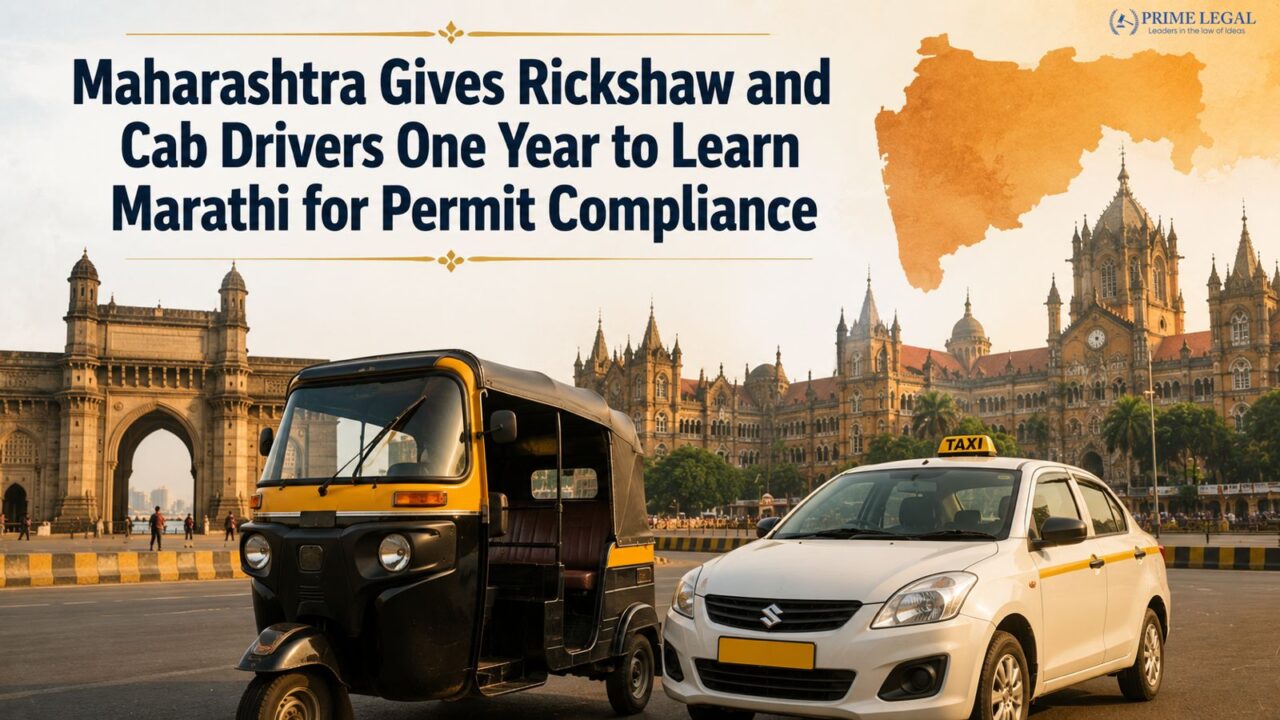
On 29 August 2026, the Bombay High Court, in Mohd Kasim Ahmad v. State of Maharashtra, disposed of a Public Interest Litigation challenging Maharashtra’s mandatory Marathi-language requirement for commercial passenger vehicle drivers, after the State informed a Bench of Acting Chief Justice Ravindra Ghuge and Justice Gautam Ankhad that autorickshaw, taxi and cab drivers across the State would be given one year to learn and master Marathi, with no punitive action to be taken against them during this period.
BACKGROUND
The Maharashtra government had, in April 2026, announced that autorickshaw, taxi and app-based cab drivers would be required to demonstrate a “working knowledge” of Marathi, initially fixing 15 August 2026 as the compliance deadline while organising Marathi classes for drivers. The requirement was formalised through the Maharashtra Motor Vehicles (Amendment) Rules, 2026, which introduced the language condition into the existing 1989 Rules framework and took effect from 12 August 2026, providing for suspension of a driver’s licence authorisation for three months on a first violation and permanent cancellation of the permit on repeated non-compliance. On 20 August 2026, the Transport Department began a statewide verification drive, and on 22 August, of 5,211 drivers tested, 777 were issued notices, 722 of them in the Mumbai Metropolitan Region, directing them to acquire proficiency within a month. Enforcement triggered protests among migrant drivers in areas such as Kandivli, amid reports of harassment and fines ranging from Rs 5,000 to Rs 20,000.
KEY POINTS
Four app-based cab drivers filed the underlying petition through advocate Vivek Shukla, contending that the mandate violated Articles 14, 19 and 21 of the Constitution and exceeded the scope of the Motor Vehicles Act, 1988, which prescribes no language requirement for driving licences, and seeking a stay to prevent hardship to nearly 9.65 lakh drivers across the State. Separately, a delegation of driver unions met Chief Minister Devendra Fadnavis on 27 August, after which he announced a one-year extension, citing the varying ages and educational backgrounds of drivers, while retaining the underlying functional-Marathi requirement for those working in Mumbai and directing the unions to prepare a structured plan for teaching the language. During the hearing, the Bench initially indicated that the petition could be disposed of on the basis of media reports of the extension, but Additional Government Pleader Jyoti Chavan sought time to verify whether a formal policy decision had been taken. On confirmation from the Transport Minister and instructions from the Transport Commissioner, the State’s statement that one year would be granted was placed on record, and the Court disposed of the petition on that basis.
RECENT DEVELOPMENTS
By recording the State’s undertaking rather than ruling on the constitutional validity of the language requirement itself, the Bombay High Court’s order secures an immediate moratorium on suspension or cancellation action against non-compliant drivers for one year, while leaving the notification and the amended Rules otherwise in force and the underlying challenge to the State’s rule-making competence unresolved.
CONCLUSION
The disposal reflects a familiar pattern in which an executive concession, prompted by litigation and organised protest, allows a court to close a matter without adjudicating its merits, leaving open for another day the broader question of how far a State’s rule-making power under the Motor Vehicles Act extends to prescribing language proficiency as a condition for commercial vehicle permits, even as the one-year window offers affected drivers immediate relief from suspension or cancellation.
“PRIME LEGAL is a National Award-winning law firm with over two decades of experience across diverse legal sectors. We are dedicated to setting the standard for legal excellence in civil, criminal, and family law.”
WRITTEN BY: GAURAV VIBHU RANJAN

