
ABSTRACT:
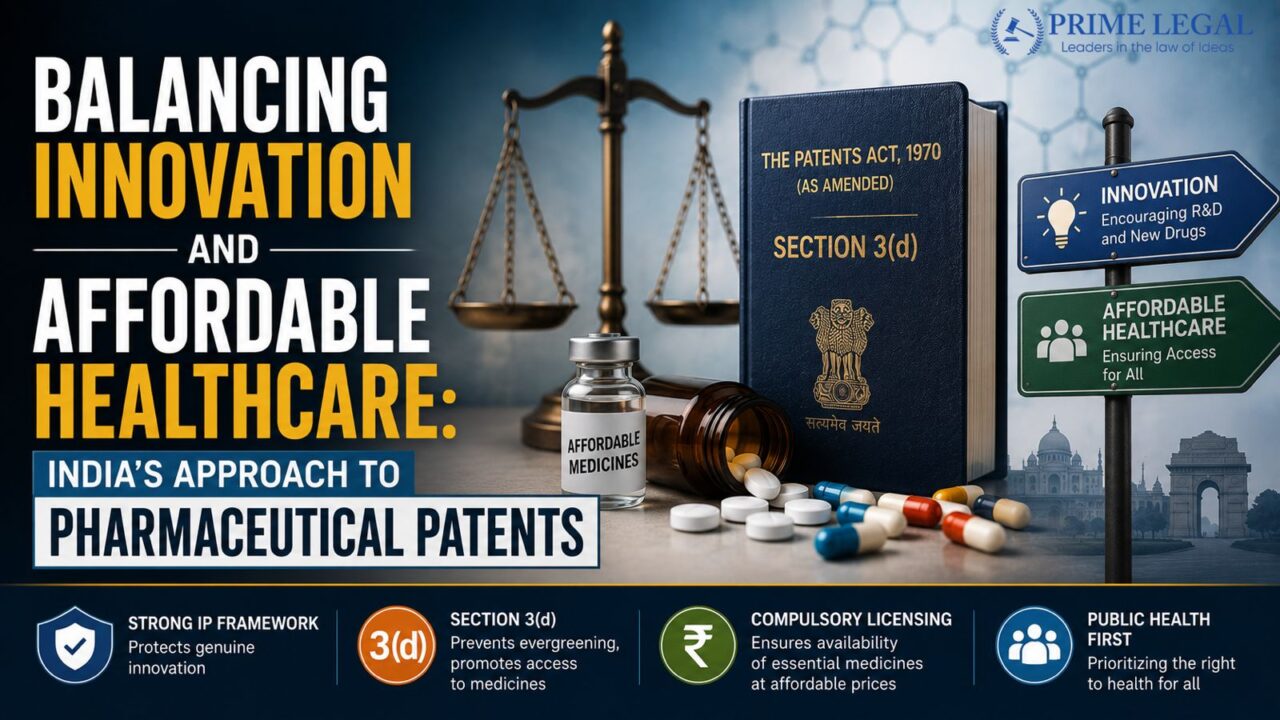
Patent protection encourages innovation and forms the cornerstone of modern research and development. However, patent protection is also faced with considerable criticisms especially with regards to affordability of medicines in the pharmaceutical industries. A large section of the population in developing countries are unable to afford medicines owing to their high costs that result from patent monopoly. Therefore, it becomes extremely important for a country like India to balance patent regimes in the pharmaceutical industry against public health concerns. The author in this article discusses the current legal regime in India with respect to pharmaceutical patents and how statutory provisions and judicial interpretation has shaped a balanced jurisprudence. Further, the author puts forward an analysis on how the provisions such as section 3(d) of the Patent Act 1970, compulsory licensing, and pre-grant opposition etc. ensure mutual existence among innovation and availability of low-cost medicines. The article also discusses the case of Novartis AG v. Union of India as an important illustration of the TRIPS compliant Indian approach towards avoiding patent evergreening.
INTRODUCTION:
The conflict between the patent protection and access to medications is especially prevalent in the pharmaceutical industry owing to its intricate relationship with public health. The Indian law has carved out an exception in this regard. The Patents Act of 1970 allowed only process patents in the field of pharmaceuticals. As a result, product patents were not protected. This led to Indian companies replicating products using alternative techniques and manufacturing procedures. This allowed India to become the largest supplier of generic medicines, accounting for about 20% of the global generic drug exports.
However, with India’s compliance to the World Trade Organization (WTO) and its obligations under TRIPS, product patents were introduced in the pharmaceutical sector from January 1, 2005. This led to a critical dilemma on how to pursue international commitments while still maintaining public health priority in a developing nation. This led to constructing flexibilities within the TRIPS Agreement to ensure protection against patent abuse.
STATUTORY PROVISIONS AND JUDICIAL INTERPRETATIONS:
The key principle against evergreening of patents lies in Section 3(d) of the Patents Act 1970, that was introduced by the amendment of 2005. The Section prohibits patenting the “mere discovery of a new form of a known substance” unless the new form shows an increased efficacy. The aim of Section 3(d) is to eliminate the practice of continuously obtaining successive patents by pharmaceutical companies by adding minor changes in the already existing medicines like new salts, polymorphs, or isomers of the same compound.
Along with Section 3(d), India’s strong compulsory licensing system under Sections 84-92 permits any person to apply for a compulsory license after three years of grant of patent if the contented invention is not available to the public at a reasonable price or if the public requirements have not been satisfied or if the invention is not “worked” in India. The provision was used for the first time in India in the Natco vs. Bayer case.
The Patent Act, 1970 also recognises pre-grant and post-grant opposition systems provided under Sections 25(1) and 25(2) by which third parties can oppose patents based not only on their novelty or obviousness but also on the grounds mentioned under Section 3(d).
The Supreme Court’s judgement in Novartis AG v. Union of India 2013 establishes the interpretation for section 3(d). Novartis applied for a product patent for the beta-crystalline form of imatinib mesylate, which is used in a drug treating critical leukemia. The Court held that the new form of the drug had not satisfied the “enhanced therapeutic efficacy” requirement under Section 3(d) of the Patents Act.
Section 3(d) does not impose a complete prohibition against patenting of any incremental innovations but sets a higher threshold of efficacy for known substances only which guarantees that only true innovations get long-term patent protection. This allows for Indian compliance with TRIPS requirements in that TRIPS do not stipulate any patentability requirements besides novelty, inventive step, and industrial use leaving the efficacy issue among the ones at the discretion of the governments.
In 2012, India awarded its first compulsory license to Natco Pharma for Bayer’s drug known as Nexavar. It was made using a compound named sorafenib tosylate used for the treatment of liver and kidney cancer. Bayer’s version of the drug was marketed at approximately ₹2,80,000 per month, which was priced beyond the reach of more than 98% of patients who required it. The patent authority believed that Bayer’s pricing failed to satisfy its obligations under Section 84 that require fulfilment of both the reasonable requirements of the public and the availability of affordable drugs. The license was awarded to Natco for producing and marketing the drug at a price point of approximately ₹8,800 per month. This decision established compulsory licensing as an important provision in Indian Patent Law even though its application remains a rare phenomenon.
CRITICISMS:
Although India has achieved considerable accomplishment in terms of public health, its policies have become the subject of continued criticism by multinational pharmaceutical firms and others who claim that Section 3(d) and the compulsory licensing method discourage investment and impede innovation with respect to the Indian market. The Indian government states that its legal framework is completely compliant with TRIPS and the public health exceptions mentioned in the Doha Declaration on TRIPS.
CONCLUSION:
The Indian patent regime has proved compliance with the TRIPS agreement while still prioritizing public health protection. With such measures as including special legislative provisions, Judiciary’s approach towards interpreting difficult standards from a public perspective, India produces cheaper medicines while abiding by commitments made to the international community. The decisions made in the Novartis and Natco cases have evidenced Indian values and overall experience in terms of access to healthcare rather than only relying on the theories and doctrines.
“PRIME LEGAL is a National Award-winning law firm with over two decades of experience across diverse legal sectors. We are dedicated to setting the standard for legal excellence in civil, criminal, and family law.”
WRITTEN BY: SOMSUTA PAUL.

