
INTRODUCTION
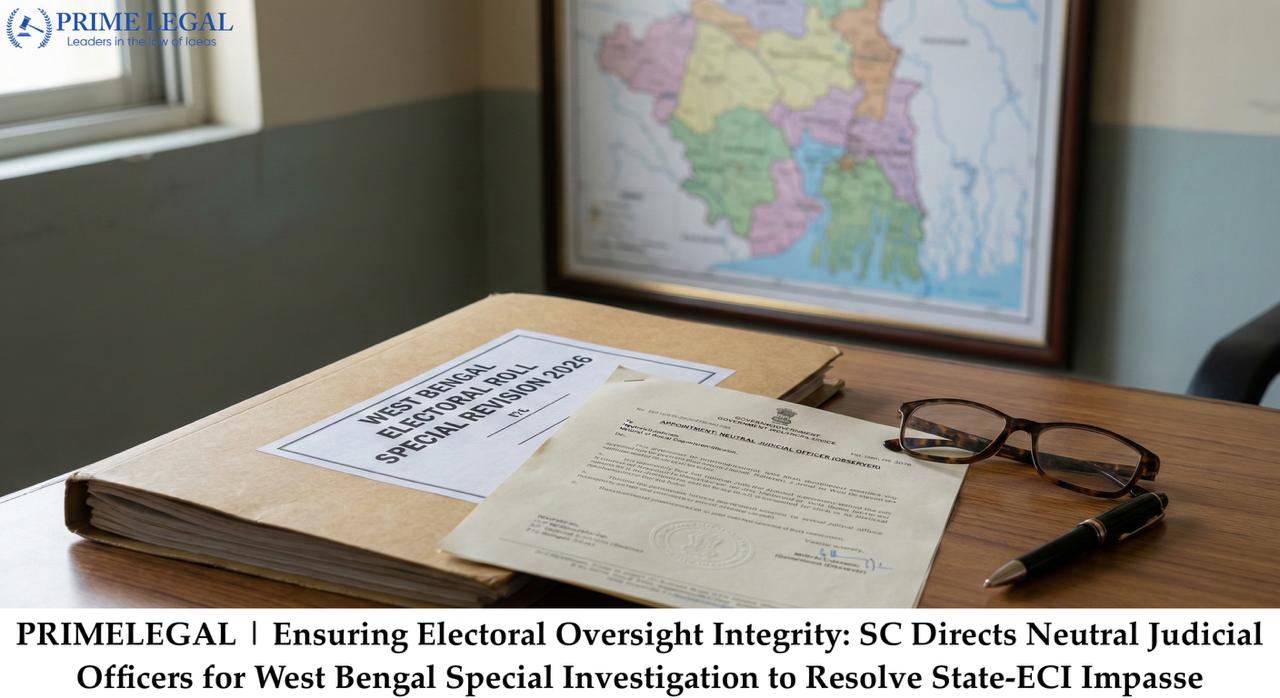
Recently, the Supreme Court of India ordered the Calcutta High Court to appoint District or Additional District Judges, current and former judicial officers of impeccable integrity, to oversee and help the Special Intensive Revision (SIR) process in West Bengal. The court stated a lack of trust between the West Bengal State Government and the Election Commission of India, explaining that the unprecedented judicial intervention was undertaken due to the extraordinary situation, under Article 142 of the Constitution of India.
BACKGROUND
The Special Intensive Revision exercise is being carried out in poll-bound states by the Election Commission of India (ECI) to ensure the accuracy of the electoral rolls. The SIR exercise began in West Bengal on 4th November 2025, post which the Chief Minister of West Bengal, Mamta Banerjee, opposed the conduction of the SIR exercise. She approached the Supreme Court of India to oppose it, stating protection for citizens’ voting rights, which led to the ongoing controversy and the unfolding of a courtroom battle.
KEY POINTS
- The counsel appearing on behalf of the State Government argued that the Commission had appointed a new category of officers, known as the Special Roll Officers, and that they shall be placed above the Electoral Registration Officers (EROs). With regard to this, the Chief Justice of India observed that the situation might require appointing judicial officers or even IAS officers from another cadre, with clean records, to resolve the disagreements between personnel and procedural.
- The counsel on behalf of the Election Commission stated that the West Bengal government had failed to provide suitable officers to assist in the process. The Chief Justice raised concerns and expressed the expectation of a cooperative approach from the state.
- The Bench comprising Chief Justice Surya Kant, Justice Joymalya Bagchi, and Justice Vipin Pancholi, had directed the state government to make available Class II officers for the SIR exercise. The bench pulled up the state for failing to comply with its previous order to provide Grade A officers. The bench raised concern that the West Bengal state government and the Election Commission would have to understand that unless the SIR is completed, there would be serious consequences.
- Further, it was argued by the state that although the court had extended the deadline for document verification and examining objections related to inclusion and exclusion in the voter list from 14th February to 21st February, the Election Commission stopped uploading documents from 15th February. The court sought clarification from the Commission with regard to compliance with its earlier order.
- The Supreme Court further inquired and asked the West Bengal government to respond to allegations of violence committed against Election Commission Officials.
- The Court noted that constant disagreements between the State government and the Election Commission had stalled the progress, particularly in relation to the scrutiny of voters placed under the logical discrepancy category. The bench observed that independent judicial oversight had become necessary to ensure that the revision process remains fair, transparent, and lawful.
RECENT DEVELOPMENTS
The Honourable Supreme Court sought a status report on the alleged incidents of violence in West Bengal. The bench directed the Chief Secretary and the Director General of Police of the State, along with the State Election Commissioners, to hold a meeting with the Advocate General and Solicitor General to complete the SIR exercise speedily and ordered the Election Commission to publish the processed list of electoral rolls, which shall be 95% of the total list, on 28th February 2026. The remaining inclusion claims are yet to be decided.
CONCLUSION
To conclude, the Supreme Court’s action of directing neutral judicial officers to oversee the Special Intensive Revision has affirmed its constitutional duty to protect and safeguard the electoral integrity, transparency in the system, and the confidence of the public in democratic processes. It highlights the judiciary’s role as a stabilising force when executive cooperation falters and ensures the voting rights of the citizens are protected.
“PRIME LEGAL is a National Award-winning law firm with over two decades of experience across diverse legal sectors. We are dedicated to setting the standard for legal excellence in civil, criminal, and family law.”
WRITTEN BY: STUTI ANVI

