
INTRODUCTION
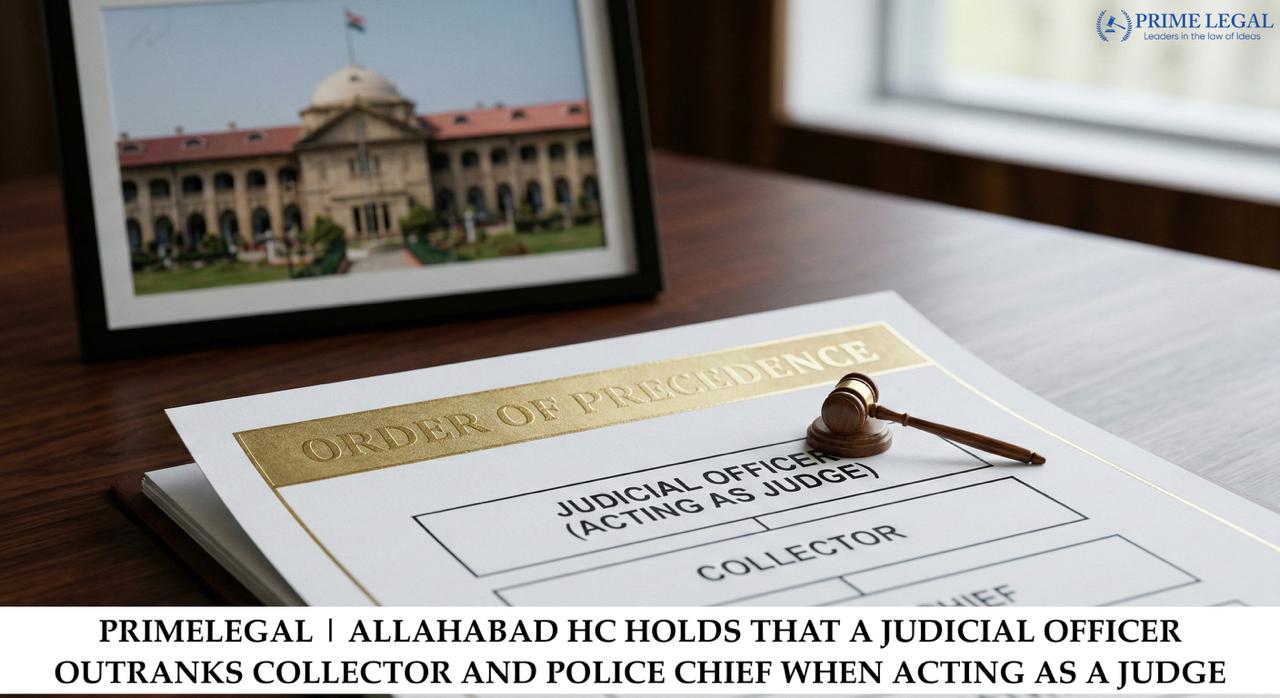
Recently, the Allahabad High Court observed that while discharging judicial functions, a Judicial Officer stands above the District Magistrate, the District Police Chief, and even the political executive of the State. The Court made this significant observation while dealing with a bail application that revealed deliberate non-compliance of repeated orders passed by the Chief Judicial Magistrate (CJM), Lalitpur.
The Court emphasised that disregarding the orders of a Judicial Magistrate is not merely administrative indiscipline amounting to a violation of the accused’s fundamental rights, but also constitutes contempt of court and a challenge to the authority of law.
BACKGROUND
The present matter arose from a bail application filed in the case of Sanu @ Rashid vs. State of U.P., involving sections 318(4), 338, 336(3), 340(2), 61(2) of BNS at Police Station-Kotwali, Lalitpur, where the applicant sought release during the pendency of trial. The applicant alleged that he had been taken into custody on 14 September 2025, while his formal arrest was shown only on the morning of 17 September 2025, as conveyed by the DGC (Criminal).
Taking note of the allegation, the CJM directed the concerned police station on 17 September 2025 to submit a report and produce the CCTV footage of the police station. The Magistrate also sought an explanation as to why a co-accused, Rashida, had been arrested at 4:00 a.m., despite the settled legal position that a woman cannot ordinarily be arrested between sunset and sunrise.
Despite repeated directions, the CCTV footage was not produced. Eventually, the Investigating Officer, Narendra Singh, and Anurag Awasthi submitted that the police station had a storage capacity of 10 terabytes, which allowed footage to be preserved only for about two months. On that basis, they claimed the relevant footage was no longer available.
KEY POINTS
- The High Court found that the SHO and Investigating Officer wilfully disregarded the CJM’s orders. The court considered their explanation that CCTV footage was deleted due to limited storage capacity and found it unsatisfactory and contrary to the Supreme Court directions given in Paramvir Singh Saini Vs. Baljit Singh And Others reported in (2021) 1 SCC 184.
- The Court also cited D.K. Basu v. State of West Bengal (1997) 1 SCC 416, in which the Supreme Court established comprehensive protections against unlawful detention and arrest. These include creating an arrest memo that is witnessed by a family member or other respectable person, keeping accurate arrest records, etc. The Court further ruled that any disregard for these instructions would be considered contempt and that they must be clearly posted in police stations.
- The Court also referred to an Apex Court ruling in All India Judges Association v. Union of India (2024) 1 SCC 546 that judges perform sovereign judicial functions and are not comparable to executive or administrative officers. The Court made it clear that when it comes to exercising judicial duties, a Judicial Officer is much superior than the District Magistrate, the District Police Chief, and even the State’s political leadership.
- The Court laid down that defying a magistrate’s order is nothing less than a direct challenge to the authority of the law, rather than just contempt, because District Judicial Officers are the foundation of the judiciary and frequently serve as the first point of relief for common people.
- Invoking Section 10 of the Contempt of Courts Act, 1971, the High Court held both officers guilty of contempt for deliberate non-compliance of the CJM’s orders and sentenced them to remain in custody till the rising of the Court.
- The Court directed the State Government to pay ₹1 lakh as compensation to the applicant for illegal detention, with liberty to recover the amount from the respective salaries of the responsible officers.
- The Court further observed that CJMs and the concerned Judicial Magistrates may conduct random inspections of police stations to verify compliance with CCTV directions of the Paramvir Singh Saini judgement, treating such inspection as part of official judicial duty.
RECENT DEVELOPMENTS
The High Court granted bail to the applicant, Sanu @ Rashid, subject to furnishing a personal bond and two sureties to the satisfaction of the trial court. However, the relief was conditional. The court directed the applicant not to tamper with evidence, try to influence witnesses’ minds, or break the law in any way. He has also been told to fully cooperate with the investigation and appear in court whenever required.
The Court also noted that the applicant had promised to send ₹15 lakhs to the right finance company. It was made clear that breaking any of these rules would mean the bail would be cancelled.
The Court further directed verification of the applicant’s identity and sureties before release. To avoid procedural delay, the trial court was instructed to process the release order through the Bail Order Management System (BOMS), and copies of the order were directed to be circulated to the concerned jail authorities, the Director General of Police, and all District Judges in Uttar Pradesh for compliance.
CONCLUSION
The Allahabad High Court’s decision goes beyond merely granting bail. It strengthens a basic constitutional principle. It provides that the executive’s refusal to act or failure to do so cannot weaken the power of the courts. By finding the officers guilty of contempt and ordering them to pay for the illegal detention, the Court made it clear that under the rule of law, personal freedom and following court orders are not up for negotiation by finding the officers guilty of contempt and ordering them to pay for the illegal detention.
“PRIME LEGAL is a National Award-winning law firm with over two decades of experience across diverse legal sectors. We are dedicated to setting the standard for legal excellence in civil, criminal, and family law.”
WRITTEN BY: KISLAY RAJ

