
INTRODUCTION
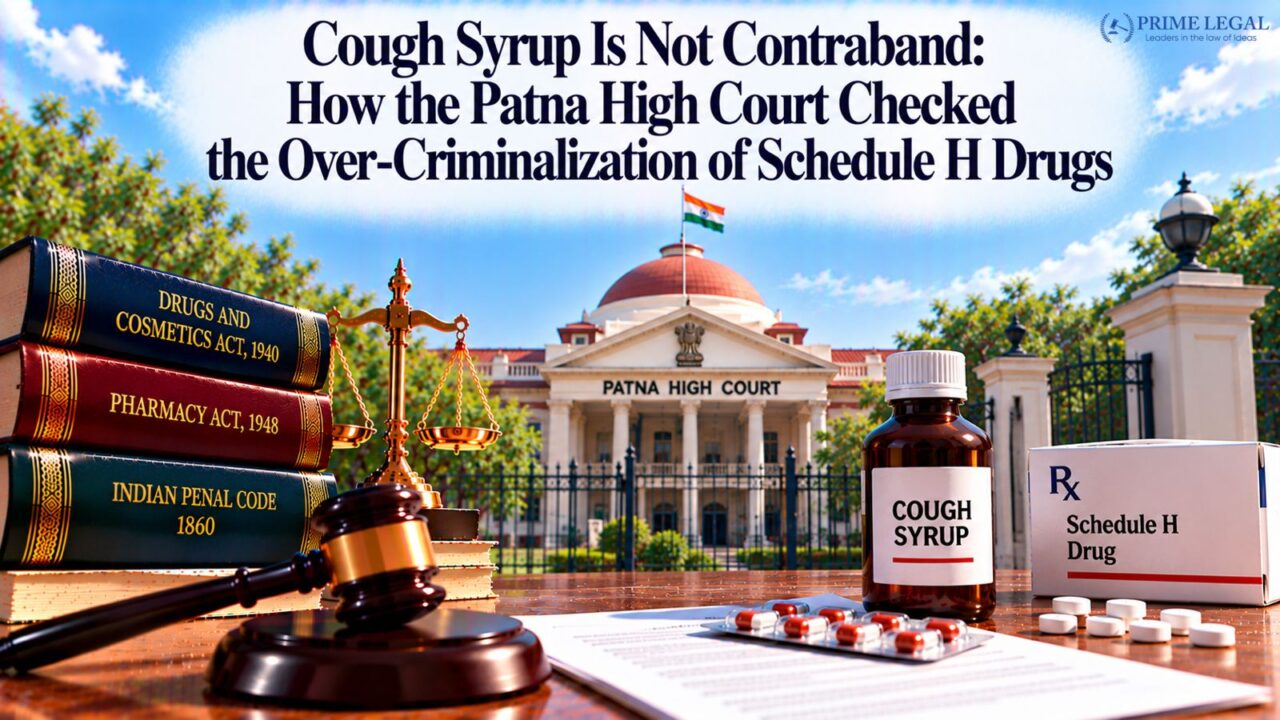
As a significant bail decision in Bharat Kumar v. The State of Bihar, the Patna High Court criticised the routine misapplication of law by police in drug recovery matters. The Patna High Court held that a person accused of possessing 484 litres of codeine-based cough syrup was entitled to bail under the Narcotic Drugs and Psychotropic Substances (NDPS) Act, 1985. By doing so, the Court held that trade in medicinal cough syrups with codeine content within prescribed limits is not contraband under the NDPS Act. Therefore, a drug recovery case in such circumstances should be filed under the Drugs and Cosmetics Act, 1940, and not by misuse of powers under the NDPS Act.
BACKGROUND
The initiation of case was when the police intercepted a pick-up van and recovered 484 litres of “Cough Linctur RJT-SCEN”, a mixture of syrup having codeine. After the seizure, the police filed a criminal case against the accused, Bharat Kumar under Sections 8(c), 21(c) and 29 of the NDPS Act. Section 21(c) of NDPS Act deals with commercial quantity of narcotics and has heavy punishment and bail restrictions.
On grounds that the petitioner’s arraignment under the NDPS Act was unsustainable and lacked jurisdiction, the petitioner filed a petition in the High Court for getting regular bail. Advocate Vijay Kishore Bharti appeared for the petitioner and Additional Public Prosecutor Surendra Prasad Singh represented the respondent-State of Bihar.
KEY POINTS
The petitioner drew attention to the Central Government Notification No. S.O. 826(E) dated 14 November 1985 as issued under the NDPS Act and Rules, which as per the petitioner excepts medicinal preparations containing codeine from being contraband unless the latter exceeds 2.5% as prescribed. The defense proved that the syrup seized contained less than 2.5% of codeine which makes it a Schedule-H prescription drug under the Drugs and Cosmetics Act.
Since the syrup satisfied the statutory requirements for medicinal preparations, the petitioner submitted that the recovery could only have been for a breach of licensing/ record keeping provisions of the Drugs and Cosmetics Act and not for a narcotics offence.
Application of the procedural safeguards: Court finds a pattern in the issuing of mandams against police, who often repeatedly act in contravention of necessary procedural safeguards to take possession of cough syrup.
ANALYSIS
In the decision, Justice Ashok Kumar Pandey found that incorporating the NDPS Act in relation to common medicinal cough syrups is not a proper process. The High Court pointed out that the notified codeine content as per Notification No. S.O. 826(E), i.e. less than 2.5% is not known as contraband under the NDPS Act.
The Court held that “cough syrups containing permissible level of codeine are Schedule-H drugs. Retail sale of such drugs is permissible subject to availability of valid licence and keeping sales register. These offences are committed under Drugs and Cosmetics Act and not under NDPS Act in respect of drug trafficking. Justice Pandey was worried that “police are invariably misusing the procedure and preferring NDPS cases with regard to pharmaceutical products. Under the NDPS Act the drug seized was not an ‘article’ of contraband as per the quantity specified under the Act and thus the prosecution under section 21(c) of NDPS Act was not sustainable.
JUDGMENT
The High Court granted the bail application and directed that the petitioner be released on the furnishing of the bail bonds of ₹10,000 and two sureties of like amount each, to the satisfaction of the Special Judge, NDPS Act, Khagaria. The Court observed in the order by stating that cases in respect of recovery of codeine-based cough syrups within permissible limit shall be registered under the Drugs and Cosmetics Act.
CONCLUSION
This judgment demarcates a legal space between pharmaceutical regulation and narcotics prosecution. Holding that cough syrups containing codeine within the permissible limit can be dealt with under the Drugs and Cosmetics Act, the Patna High Court reduced the possibility of misuse of the NDPS Act in day-to-day drug seizures. The judgment reiterated the fact that statutory exemptions that pharmaceutical formulations are entitled to cannot be rendered irrelevant due to the procedural requirements demanded by the narcotics law.
“PRIME LEGAL is a National Award-winning law firm with over two decades of experience across diverse legal sectors. We are dedicated to setting the standard for legal excellence in civil, criminal, and family law.”
WRITTEN BY: AASTHA KEDIA

