
ABSTRACT
“Digital arrest” has grown into one of the most popular forms of cybercrime in India. Criminals act as law enforcement or government officials, tell their victims that they have committed a serious crime, and watch them on video until the money they are asked for is transferred. Since digital arrest is not recognised by the law in India, offenders are charged under normal criminal rules for cheating, impersonation, extortion, and identity theft. The following article discusses how a person committing such acts can be brought to justice, the issue of impersonation of the police, and the problem of victims’ recovery. It argues that the law needs clearer penalties, faster financial intervention and a stronger framework for victim protection.
- INTRODUCTION
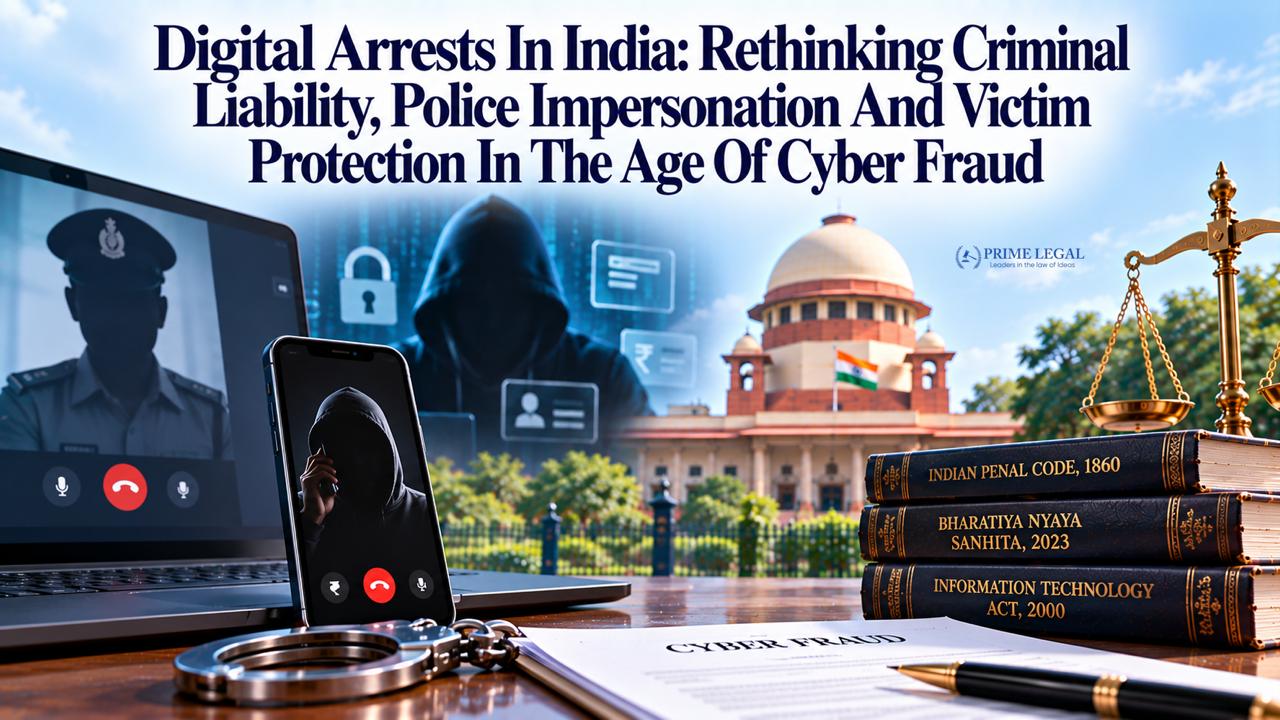
The rapid move towards digital banking and communication in India has resulted in new possibilities for fraud. The fraud typically involves the victim receiving a phone call accusing them of receiving a parcel containing drugs in their name or of being involved in money laundering, supposedly by the police, CBI, ED, or customs. The call is then switched to a video call, with the victim being told not to disconnect from the call or inform anyone, after which he/she is pressured into transferring money from his/her bank account for “verification” or “bail” purposes.
The term digital arrest is somewhat misleading. The Bharatiya Nagarik Suraksha Sanhita (BNSS) 2023 only provides for arrest through lawful means, which involves physical custody, grounds verbally communicated to the person, and judicial oversight. No law allows for the arrest of an individual or interrogation via a video call. Hence, the process by which such digital arrests are being done is not legal but rather a criminal way of instilling fear in the mind of the citizen. However, whether existing law is equipped to deal with such cases is still a question.
- HOW THE SCAM WORKS
The crime revolves around psychological coercion. Scammers typically have sensitive information like Aadhaar numbers, telephone data, or shipping details. They use uniforms, forged notices, imitation police stations from courts or agencies. Victims are alone and filmed for hours or even days on end.
The people mostly affected are elderly, professionals, or those people unfamiliar with digital systems. Many of them are more worried about their reputation than money. This is the reason the fraud works: the victim does not want to pay but is offended and pressured into doing it. Courts and investigators must keep this element of coercion in mind while assessing the liability of the offenders and the role of the victims.
- THE CRIMINAL LIABILITY FRAMEWORK
There is no law that specifically pertains to the issue of digital arrest. Instead, prosecutors utilize laws in such situations.
The Bharatiya Nyaya Sanhita, 2023 (BNS) only states the following aspects of the law:
- Definition of cheating and cheating by impersonation (Sections 318 and 319);
- Definition of extortion (Section 308);
- Definition of criminal intimidation (Section 351);
- Forgery of different kinds of documents and electronic records (Section 336);
- Impersonation of a public servant (Section 204).
The Information Technology Act, 2000 includes Section 66C (identity theft) along with Section 66D (cheating by means of personation using a computer resource). The sections related to organised crime in BNS may also be applicable for cases involving operations in multiple states or even countries.
The specific provisions are workable in nature but are also fragmented. The penalties specified in the IT Act are comparatively low. For instance, one can charge a scam affecting the retirement savings of a retiree based on parameters applicable to ordinary cheating. Moreover, the very nature of the crime has to be taken into account. The crime includes coordinated operations by the groups, mule bank accounts along with foreign handlers and layered transfers. Thus, prosecuting each offence separately does not consider the organised nature of the crime and would be conducive to treating the use of technology for impersonation of the authority as an aggravated crime.
- POLICE IMPERSONATION AND THE ABUSE OF PUBLIC TRUST
The impersonation of law enforcement representatives is a more serious crime than standard scamming because it violates the authority of the state and creates distrust towards real investigating bodies. Each scamming success instils fear of legitimate police communication in people and makes them less eager for it.
Public authorities have publicly stated that no agency ever makes arrests or conducts interrogations through video calls, and numerous information campaigns have been carried out. However, this information alone is not enough.
Two structural gaps remain.
The first one is attribution. Scammers resort to the use of virtual numbers, messaging services and accounts opened illegally and often act from outside India. Investigations stop at the stage of mule accounts, which belong to poor and ignorant people, while real organisers are still untraceable.
The Second is accountability of the platform. Messaging and video calls are the primary mediums used in these frauds. There should be specific obligations for the platforms and telecom operators relating to recognising dubious activity, responding quickly to requests for help from the authorities, and blocking accounts engaged in repeated impersonation.
The issue has been acknowledged by the Supreme Court of India. It has recognised the growing problem of digital arrest scams, and it has thought of the need for consolidating and centralising investigations. Because cases that cross state and national borders cannot be handled effectively by separate local police stations.
- VICTIM PROTECTION AND RECOVERY
Simply laying criminal charges will not help the victim recover lost money. India runs a cybercrime reporting portal and a helpline 1930. The Indian Cyber Crime Coordinator Centre provides technical support and can freeze accounts quickly after filing a complaint. Recovery depends on the speed of reporting, as money can be transferred from one account to another soon after the scam.
Three shortfalls are apparent.
- Delay in reporting. Fear and embarrassment prevent people from reporting crime until the money has been lost.
- Limited liability of the banks. The regulatory protection of clients from online crime is greatest in cases of illegal transactions. In digital theft cases, the victim actually allows the transfer to take place, although the permission is obtained through deception and intimidation. Therefore, it is possible to view these cases as transactions authorised by clients, and banks refuse to assume responsibility.
- Lack of Support. People very seldom get any psychological support or legal advice, although many suffer traumatisation.
A much more just method would be to keep in mind that consent acquired through fear of false prosecution is in fact not real consent. Regulators could flag payments made by elderly persons if they are unusually large in amount, introduce a holding period for questionable payments for the needed verification and arrange a proper procedure for refunds in case of fraud is reported without delay. It would also bring the legislation closer to the victim-oriented approach.
- CONCLUSION
Digital arrest scams demonstrate the dual use of technology and state authority by criminals. The existing provisions on cheating, impersonation, extortion, and identity theft in India provide a framework for prosecuting criminals; however, they were not created for organized, cross-border, technology-driven crime. The reforms must focus on three key issues: strengthening penalties for impersonating public officials on digital platforms, clarifying the responsibilities of banks and communication platforms, and creating a system of protection for victims that classifies coerced payments as fraudulent instead of voluntary transactions.
The main challenge is how to strike a balance between greater regulation of platforms and banks while ensuring that privacy and ordinary use of digital tools are not compromised. But without urgent measures, the public’s trust in digital systems and law enforcement can only decline.
“PRIME LEGAL is a National Award-winning law firm with over two decades of experience across diverse legal sectors. We are dedicated to setting the standard for legal excellence in civil, criminal, and family law.”
WRITTEN BY: SWETHA DUTTA

