
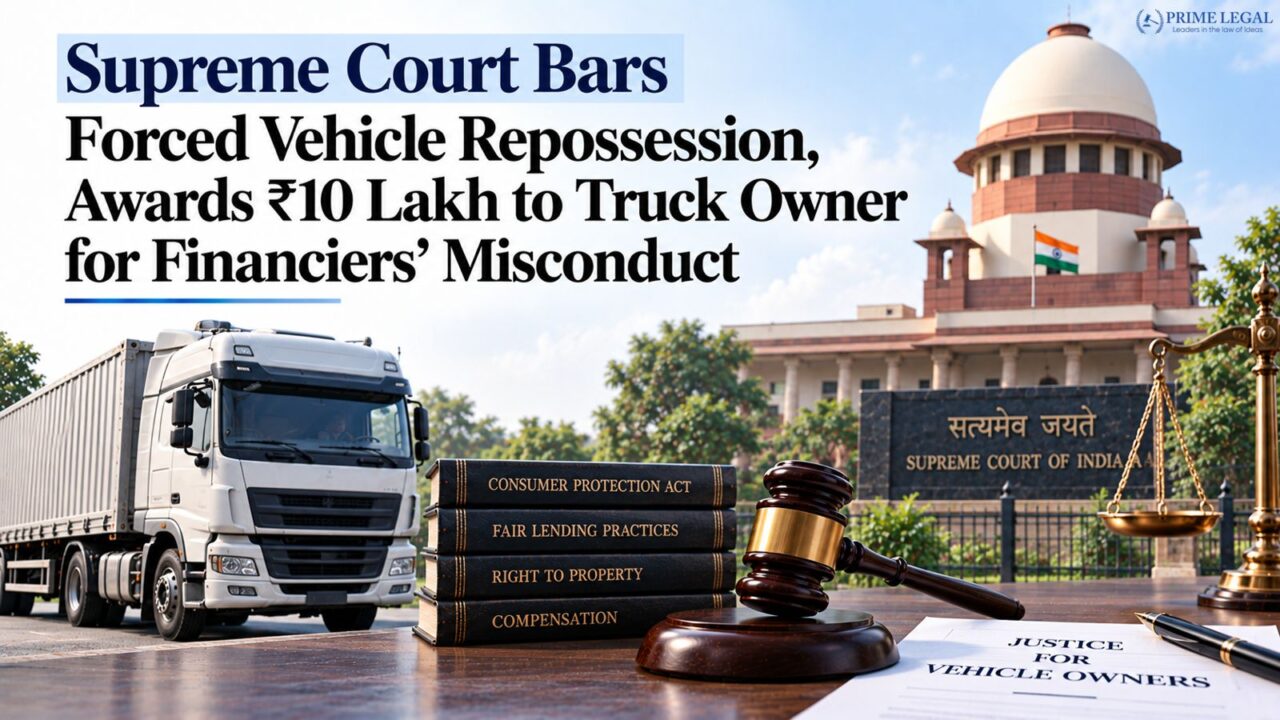
CASE NAME: Hari Dutta Sharma v State of UP & Ors
CASE NUMBER: Civil Appeal No(s). of 2026 (@ S.L.P. (C) No(s). of 2026; @ Diary No. 10952 of 2026)
COURT: Supreme Court of India
DATE: 16 September 2026
QUORUM: Justice Pamidighantam Sri Narasimha and Justice Alok Aradhe
FACTS
The Appellant had availed a commercial vehicle loan from Cholamandalam Investment and Finance Company Limited in respect of Tata SFC 407 truck which was mortgaged with the Company under the charge of hypothecation. Following default notices by the Company, the vehicle had been previously seized by the Company, but the same was returned by the Company after partial payment by the Appellant. Thereafter, according to the Appellant, on 9 April 2023, four unknown individuals opened the steering lock of the vehicle around 1:00 am and drove away the same. The Appellant filed e-FIR and came to know later that the Company had taken possession of the vehicle and sold it on 31 August 2023 for ₹4,50,000. The High Court dismissed his writ petition, principally relying upon the delay and his loan defaults.
ISSUES
Whether the Company could repossess the vehicle without complying with the seven-day notice requirement under Article 11 of the loan agreement.
- Whether the financier could employ force or unlawful means for repossession.
- Whether Article 11 of the loan agreement was consistent with the RBI Guidelines and the Indian Contract Act, 1872.
- Whether the High Court was justified in dismissing the writ petition on the ground of delay.
- Whether the appellant was entitled to compensation for violation of his rights and loss of livelihood.
LEGAL PROVISIONS
- Article 14, Constitution of India – protection against arbitrary action.
- Article 21, Constitution of India – protection of life and livelihood.
- Section 35-A, Banking Regulation Act, 1949 – empowers the RBI to issue directions to banking companies; such directions have statutory force.
- Indian Contract Act, 1872 – contractual repossession clauses must satisfy legal and fairness requirements.
- RBI Fair Practices Code Guidelines, 2003 and subsequent Master Circulars/Guidelines – prohibit undue harassment, use of muscle power and unlawful recovery practices.
- Orix Auto Finance (India) Ltd. v. Jagmander Singh, (2006) 2 SCC 598 – contractual repossession rights may exist but cannot be exercised contrary to law.
- Sundaram Finance Ltd. v. T. Thankam, (2015) 14 SCC 444 – considered regarding the contractual right of financiers to repossess secured assets.
- Internet and Mobile Association of India v. Reserve Bank of India, (2020) 10 SCC 274 – cited regarding the statutory force of directions issued by RBI.
- ICICI Bank Ltd. v. Prakash Kaur, (2007) 2 SCC 711 – recovery agents cannot use force and seizure of vehicles must be through lawful means
ARGUMENTS
APPELLANT:
The Appellant maintained that the High Court made an erroneous decision in dismissing the petition for having been filed late. In addition to this, he maintained that the Company was in breach of Article 11 of the contract which required giving seven days’ notice before repossession. Lastly, he argued that repossession could not be carried out forcibly or deceptively as per contractual provisions of a financier.
RESPONDENTS:
According to The Company, the appellant was a chronic defaulter and he had not repaid his loan. It stated that pre-seizure intimation, inventory, post-seizure intimation, and pre-sale notice were properly given. Moreover, the vehicle had been sold at ₹4,50,000, which was a reasonable price as per the terms of the loan agreement.
ANALYSIS
It has been established that although a financier is entitled to his right of repossessing the hypothecated vehicle on contractual terms, yet the right can only be exercised strictly according to the terms of the contract, RBI requirements, and legal procedure. Article 11 was held by the Court to be problematic as it gave the company the right to decide upon the borrower’s rights without any notice, to go into places for seizing the vehicle, to control the process of repossession and sale in an arbitrary manner, and even to waive the requirement of giving notice at its discretion.
In this case, there was no issuance of a seven-day notice prior to repossession. Breaking up of the steering lock at around 1 a.m. was not compatible with peaceful repossession. In addition to that, the possession memorandum lacked the signature of the appellant. It was concluded that the contractual right of repossession had not ever accrued to the Company because the mandatory notice condition had not been fulfilled.
The Court further disregarded the delay-based argument adopted by the High Court. The appellant had filed an FIR immediately after the occurrence and had even sought legal remedy. Moreover, traffic challans were being issued even in the years 2024 and 2025 despite the assertion of the Company that the vehicle was sold in August 2023. Hence, it was incumbent upon the High Court to look into the merits of the case rather than just dismissing it for delay.
JUDGMENT
The appeal was accepted by the Supreme Court, and the order of the High Court was set aside. It ruled that the repossession and sale of the vehicle by the Company was unauthorized and arbitrary. The Court, being unable to recall the sale, having been done before, held that the right of the appellant guaranteed under Articles 14 and 21 had been violated because he had been deprived of his livelihood in an arbitrary and unfair manner.
The company was ordered to wind up both loan accounts, repay the ₹4,50,000 sale consideration along with interest at the rate of 6% p.a. from the date of sale and pay ₹10,00,000 as compensation for the mental torture and loss of means of livelihood. The appeal was allowed with ₹50,000 as costs. The Court also asked the RBI to take necessary measures to ensure proper adherence to the Guidelines and Master Circulars issued by NBFCs and Scheduled Commercial Banks.
CONCLUSION
The judgment establishes that although financiers have a legitimate contractual right to recover secured assets, such right is not an unrestricted licence to use force or bypass procedural safeguards. Repossession must comply with the loan agreement, RBI requirements and lawful procedure. The decision further recognises that arbitrary deprivation of a vehicle used for livelihood can implicate Articles 14 and 21, making procedural fairness an important limitation on debt-recovery mechanisms.
“PRIME LEGAL is a National Award-winning law firm with over two decades of experience
across diverse legal sectors. We are dedicated to setting the standard for legal excellence in
civil, criminal, and family law.”
WRITTEN BY: KHWAISH SACHDEVA

