
INTRODUCTION
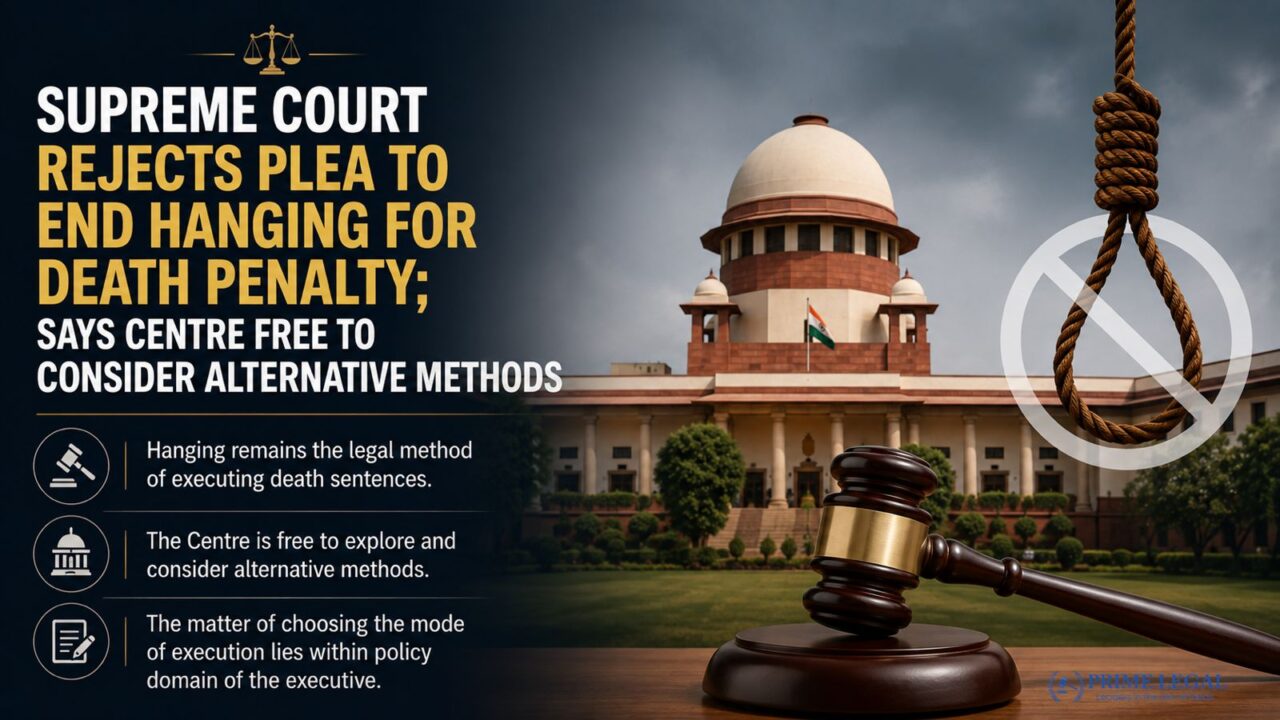
The debate over how India carries out its death sentences has been running for nearly a decade, ever since a petition first asked the Supreme Court to declare hanging unconstitutional. That question has now been answered, though not the way the petitioner hoped. On 18 August 2026, a Bench of Justices Vikram Nath and Sandeep Mehta dismissed the plea seeking to replace hanging with methods like lethal injection, shooting or electrocution. Hanging stays. But the Court left a door open, making clear the Union government remains free to review the method of execution on its own, should scientific or medical evidence eventually justify a change.
BACKGROUND
The petition was filed back in 2017 by Senior Advocate Rishi Malhotra, challenging the constitutional validity of the provision that prescribes hanging as the mode of execution, originally under Section 354(5) of the CrPC, now carried forward under the BNSS. Malhotra’s case rested on Article 21, arguing that the right to life with dignity necessarily includes a right to a death that isn’t needlessly painful or prolonged, and that hanging fails that standard. Notably, the petition never challenged the death penalty itself, only how it’s carried out once imposed. The Centre opposed the plea throughout, telling the Court at one point that making the execution process too comfortable or painless risked diluting its deterrent value, a submission that drew sharp criticism at the time. The Bench reserved its judgment on 22 January 2026 after hearing full arguments, and delivered its verdict roughly seven months later.
KEY POINTS
- The Court held that the material placed before it did not establish any real advantage of lethal injection, or any other suggested method, over hanging as a way of carrying out a death sentence.
- It declined to refer the matter to a larger bench, meaning three earlier judgments upholding hanging as constitutional still stand undisturbed.
- The ruling draws a clear distinction between the imposition of the death penalty, which the Court didn’t touch, and the procedure used to carry it out, which is what this case was actually about.
- Despite dismissing the plea, the Bench clarified that its verdict does not stop the Central government from setting up an expert body to comprehensively review the existing method of execution.
- Any such review, the Court said, should examine whether an alternative method better serves the constitutional goal of minimising unnecessary pain while preserving the dignity of the condemned prisoner.
- The door was explicitly left open for the issue to return before the courts in the future, if credible scientific or medical evidence emerges showing hanging falls short of that constitutional standard.
RECENT DEVELOPMENTS
This ruling arrives against the backdrop of a broader, recurring debate in India over capital punishment, one that periodically resurfaces without ever quite settling. Capital punishment itself remains firmly part of India’s criminal justice framework, reserved for what courts have long called the “rarest of rare” cases, and this judgment does nothing to disturb that principle. What it does settle, at least for now, is the narrower procedural question of method. Internationally, the picture looks different, with courts elsewhere continuing to grapple with disputes over lethal injection, nitrogen hypoxia and firing squads, often centred on whether specific methods amount to cruel and unusual punishment. India’s approach, by contrast, has stayed comparatively settled on hanging since independence, and this verdict extends that continuity rather than breaking from it.
CONCLUSION
What this judgment really preserves is institutional restraint. The Court chose not to legislate a new method of execution from the bench, opting instead to leave that policy call with the Centre, where it arguably belongs given the scientific and administrative complexity involved. Whether the government actually takes up that invitation and constitutes an expert review remains to be seen; nothing in this ruling compels it to. For now, the legal position is unambiguous: hanging remains the lawful mode of execution in India, but not necessarily the last word on the subject.
“PRIME LEGAL is a National Award-winning law firm with over two decades of experience across diverse legal sectors. We are dedicated to setting the standard for legal excellence in civil, criminal, and family law.”
WRITTEN BY: MAHFUZA FATHIMA

