
INTRODUCTION
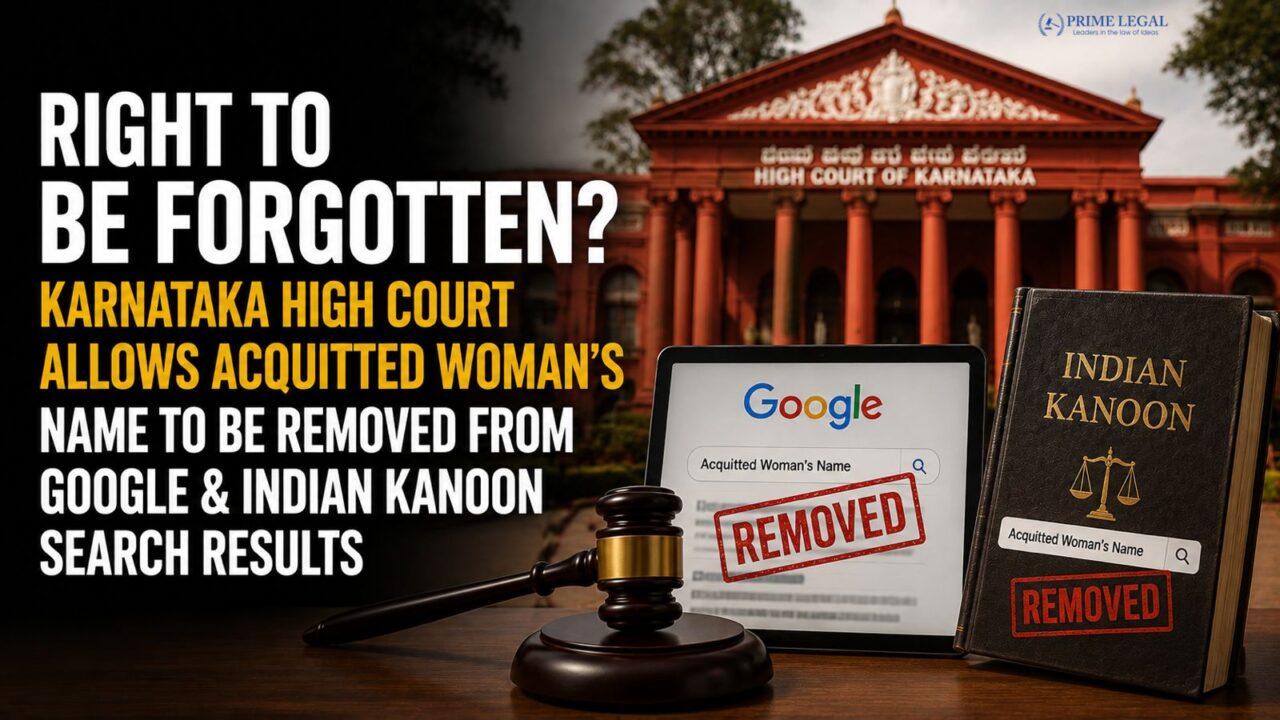
Getting acquitted doesn’t actually close the book on a criminal case anymore, not really. You can be cleared of every single charge, walk out of the courtroom with a clean order in hand, and your name is still sitting on Google the next time someone types it in. The FIR shows up. The chargesheet shows up. Sometimes the whole judgment, uploaded on Indian Kanoon, with your name printed right there for anyone doing a background check to find. Justice M. Nagaprasanna of the Karnataka High Court has just dealt with this exact problem again, ordering Google, Indian Kanoon and other platforms carrying judicial records to mask the identity of a woman who was acquitted in a 2019 case. The point he made, more or less, was this: an acquittal that only exists inside the courtroom and not on the internet isn’t much of an acquittal at all.
BACKGROUND
The woman in question had been acquitted in 2019. That should have been the end of it. Instead, the case kept turning up in search results years later, with Indian Kanoon hosting the full judgment, name and all, freely accessible to anyone who searched for her. She went to the High Court asking for her name to be masked, arguing this violated her right to privacy under Article 21. The Court agreed with her and passed the direction, essentially saying that leaving an acquitted person’s name attached to a criminal case forever, purely because the internet doesn’t forget, causes a kind of harm the Constitution is supposed to prevent.
KEY POINTS
- A final acquittal, the Court said, can’t just be a courtroom event. If it doesn’t carry over into the digital world, it stops meaning much in practice.
- Google, Indian Kanoon and other platforms hosting or indexing judicial records were told to mask the petitioner’s name so that ordinary searches no longer connect her identity to the case.
- One argument raised against granting this kind of relief is that it opens the door to a flood of similar petitions. The Court didn’t buy that. A fundamental right, it said, doesn’t stop being enforceable just because enforcing it might invite more people to ask for the same thing.
- Karnataka High Court has previously granted similar protection in a case involving a daughter’s name in a quashing petition, and separately in a case tied to a serious offence against a woman.
- There’s a visible pattern in how courts apply these right cases involving women, sexual offences, or matters touching on dignity and reputation tend to get this kind of relief more readily, even though there’s no rule saying it’s limited to only these situations.
- It’s worth being clear about what this relief actually does. It’s not the judgment being deleted or the case disappearing from record. It’s the name being masked. The legal reasoning, the precedent value, all of it stays intact and searchable, just without the identifying detail attached.
RECENT DEVELOPMENTS
This isn’t happening in isolation. Indian courts have been piecing together a right to be forgotten for a few years now, one order at a time, without any single law backing it up. Delhi High Court got there first, back in 2021, granting interim relief to a man still haunted by search results from a narcotics case he’d long been cleared of. Kerala followed the same year, directing Indian Kanoon to take a rape survivor’s name off a published judgment. Gujarat, on the other hand, went the other way entirely and refused to accept that any such right exists. Karnataka’s own line on this goes back to 2017, and this latest order fits right into that pattern. Courts here have been willing to grant this kind of relief straight off Article 21, without waiting for Parliament to pass anything specific.
CONCLUSION
What actually matters in this order is the Court refusing to treat the fear of more petitions as a reason to say no. That’s not a small thing. Rights don’t shrink just because using them becomes inconvenient for the people who have to enforce them. As things stand, the right to be forgotten is a concept developed by the Indian judiciary, developed case by case rather than through any codified framework, and it’s likely to remain the same way until Parliament or the Digital Personal Data Protection Act framework gets around to addressing it directly. Until then, this is the route people will keep using one petition, one name masked, one small fix to how long the internet chooses to remember something the law has already closed.
“PRIME LEGAL is a National Award-winning law firm with over two decades of experience across diverse legal sectors. We are dedicated to setting the standard for legal excellence in civil, criminal, and family law.”
WRITTEN BY: MAHFUZA FATHIMA

