
CASE NAME: National Insurance Co. Ltd. v. Smt. Thungala Dhana Laxmi & Ors.
CASE NUMBER: Civil Appeal No. 14369 of 2025
COURT: Supreme Court of India, Civil Appellate Jurisdiction
DATE: 4 August, 2026
QUORUM: Hon’ble Mr. Justice Sanjay Karol and Hon’ble Mr. Justice Prashant Kumar Mishra
FACTS
On 13 July 1996, T. Ramu was driving from Tirupathi to his village when his Maruti 800 was struck from behind near Singarayakonda by an unidentified lorry driven rashly. He died from his injuries during treatment. His legal heirs sought Rs. 10,00,000 in compensation under Section 166 of the Motor Vehicles Act, 1988, claiming he ran a seafood business earning around Rs. 1,00,000 annually and was the family’s sole earner. The Tribunal dismissed the claim in 2009, accepting the insurer’s evidence that no extra premium had been paid to cover the owner’s personal risk. On appeal, the Telangana High Court reversed this, holding the policy was comprehensive and covered the owner while travelling as a passenger, and awarded Rs. 10,00,500 with 7.5% interest, assessing income notionally at Rs. 4,500 per month. The insurance company appealed to the Supreme Court. Separately, while this appeal was pending, the Court noticed a much larger systemic problem widespread non-compliance with mandatory third-party insurance under Section 146 and impleaded twenty-two insurance companies, the IRDA, the General Insurance Council, and the Ministry of Road Transport and Highways to address uninsured vehicles and inconsistent policy structures nationwide.
ISSUES
- Whether the insurance company was liable to compensate the owner-cum-passenger under a comprehensive policy.
- Whether the near-universal non-compliance with Section 146 of the MVA required systemic, technology-driven enforcement directions.
- Whether a uniform, layered motor insurance policy structure should be mandated across insurers.
LEGAL PROVISIONS
- Sections 146, 147, 149, 159, 166, 196 and 207 of the Motor Vehicles Act, 1988
- Sections 3, 4, 14 and 26 of the IRDA Act, 1999; Sections 64C and 64L of the Insurance Act, 1938
- Article 21 of the Constitution of India
- Case Laws: S. Rajaseekaran v. Union of India, (2018) 8 SCC 447 and 2025 SCC OnLine SC 2555;
General Insurance Council v. State of Andhra Pradesh, (2007) 12 SCC 354;
Jai Prakash v. National Insurance Company, (2010) 2 SCC 607;
M.R. Krishna Murthi v. New India Assurance Co. Ltd., (2020) 15 SCC 493;
Shishu Pal v. Surjeet, 2026 INSC 634;
In Re: Phalodi Accident v. NHAI, 2026 SCC OnLine SC 646;
Surekha v. Santosh, (2021) 16 SCC 467.
ARGUMENTS
APPELLANT (Insurance Company): It was contended that liability could not extend to the vehicle owner travelling as a passenger, since no additional premium had been paid to cover that specific risk, and the Tribunal was correct to hold the claim not maintainable on this ground.
RESPONDENTS / STAKEHOLDERS: The claimants argued that a comprehensive policy, by its nature, covers any occupant of the vehicle including the owner, and that a hyper-technical reading should not defeat a legitimate claim. On the systemic issue, IRDA, the General Insurance Council, and MoRTH broadly agreed that enforcement was weak over half of India’s vehicles remained uninsured and proposed measures including ANPR-camera integration with insurance databases, handheld verification devices for traffic police, enhanced penalties under Section 196, and a layered, standardised insurance structure with clearer customer disclosure.
ANALYSIS
On the individual appeal, the Court held that motor accident claims should not be approached technically, and that an IRDA circular of 16 November 2009 already fixed insurers with liability toward any occupant under a comprehensive policy that covered the owner as passenger, so the High Court’s reasoning was upheld. On the wider question, the Court traced the statutory scheme under the MVA, IRDA Act, and Insurance Act, and found a stark enforcement gap: roughly 56% of Indian vehicles run uninsured, road accidents exceed 4.8 lakh annually, and MACT case pendency remains high. Grounding this in Article 21’s guarantee of a safe environment, the Court found the case for coordinated, technology-enabled enforcement linking ANPR cameras, the VAHAN portal, and the Insurance Information Bureau to be self-evident, alongside a clearer four-layer insurance disclosure structure for consumers.
JUDGMENT
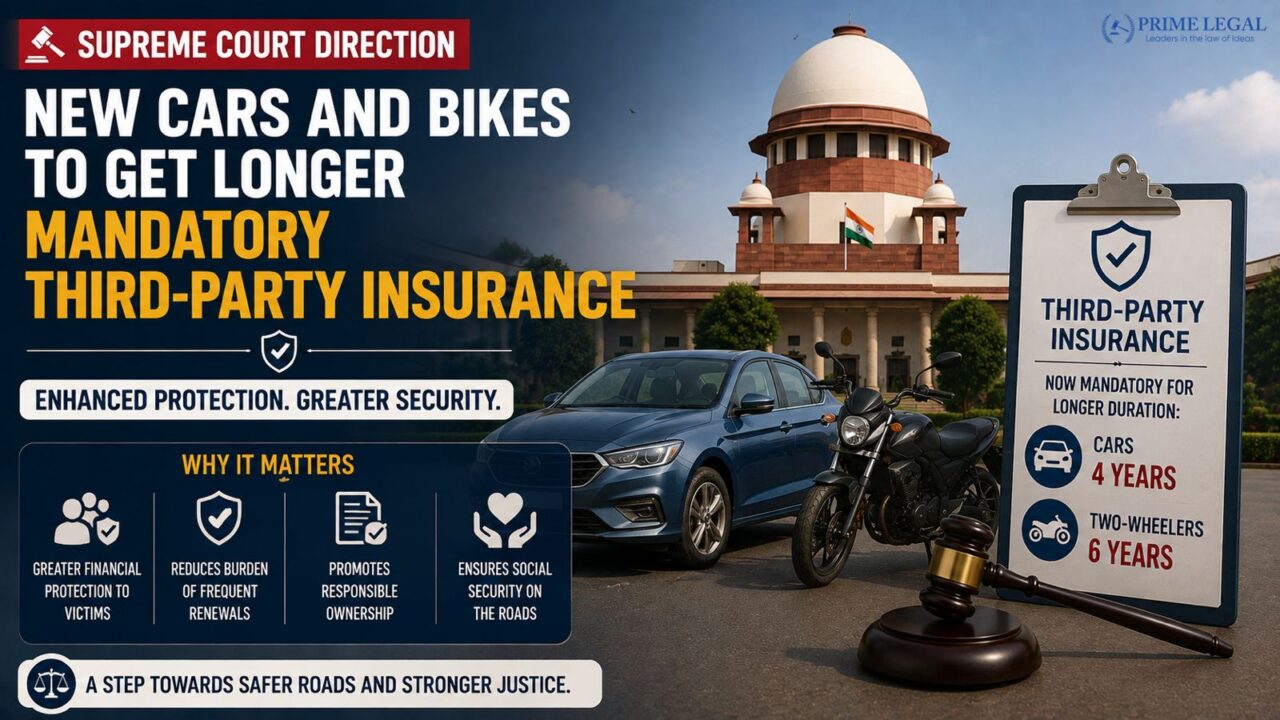
The Court dismissed the appeal on the individual claim, affirming the High Court’s award. On the systemic issue, it issued detailed directions to MoRTH and IRDA: integrating ANPR cameras and VAHAN/IIB data for automatic e-challans on uninsured vehicles; equipping police with real-time verification devices; enforcing the pending amendment to Section 196; adopting a four-layer policy structure (third-party base cover, optional occupant cover, personal accident cover, and own-damage cover) with a mandatory customer option form; extending mandatory third-party insurance tenure to four years for cars and six for two-wheelers; and piloting insurance-linked fuel restrictions and automated toll detection. Directions on MACT case management were also issued to state police. Compliance affidavits were directed to be filed by 14 August 2026.
CONCLUSION
The judgment reaffirms that comprehensive motor policies cover the owner as an occupant, and that courts must avoid hyper-technical readings that defeat genuine compensation claims. More significantly, it converts an individual insurance dispute into a platform for structural reform recognising road safety and insurance compliance as facets of the right to life under Article 21, and mandating a technology-driven, standardised enforcement and disclosure regime across India’s motor insurance sector.
“PRIME LEGAL is a National Award-winning law firm with over two decades of experience across diverse legal sectors. We are dedicated to setting the standard for legal excellence in civil, criminal, and family law.”
WRITTEN BY: MAHFUZA FATHIMA
Read the Judgement copy below:
National Insurance Co Ltd v Smt Thungala Dhana Laxmi

