
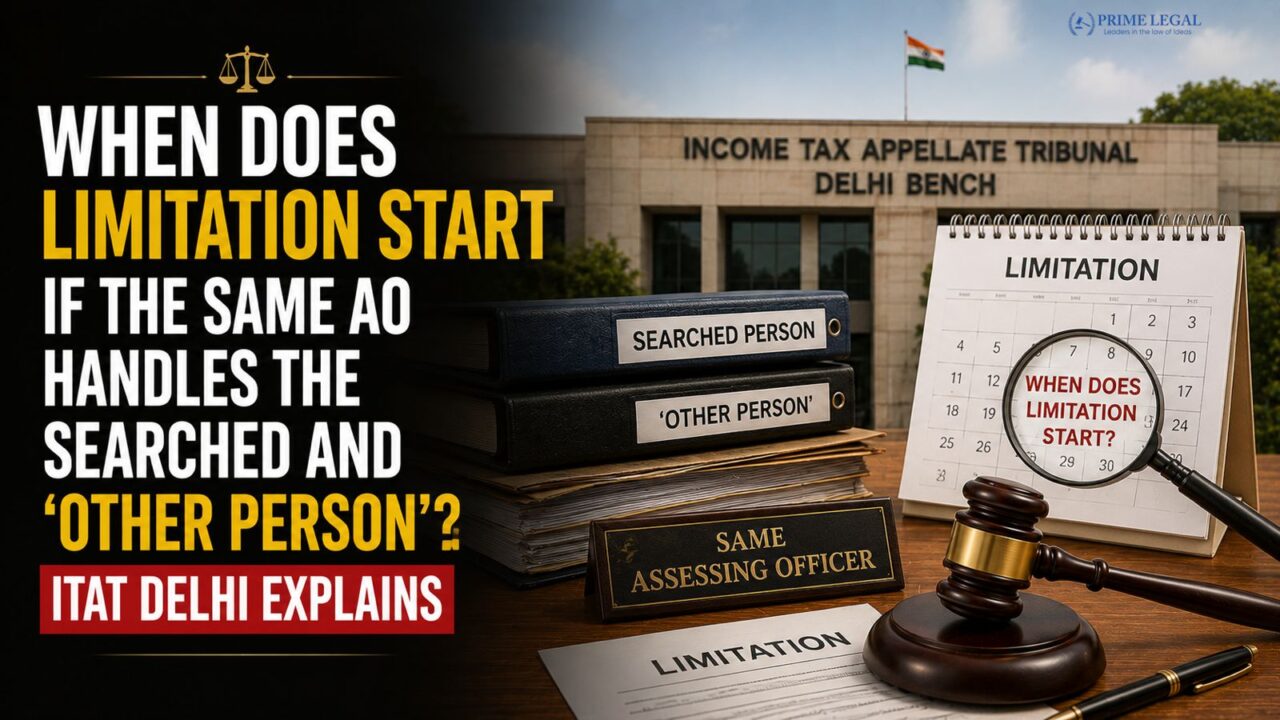
CASE NAME: Sudhir Agrawal v. Deputy Commissioner of Income Tax
CITATION: ITA No. 3823 to 3830/Del/2026
CASE NUMBER: ITA No. 3823 to 3830/Del/2026, A.Y. 2013-14 to 2020–21
COURT: THE INCOME TAX APPELLATE TRIBUNAL DELHI BENCH
DATE OF JUDGMENT: 27.07.2026
QUORUM: Mr. MANISH AGARWAL & Mr. VIMAL KUMAR
FACTS:
A search and seizure procedure u/s 132 of the Income Tax Act, 1961 was carried out on the Alankit Group, Sh. Alok K Agarwal, his son Ankit Agarwal and some associates and key employees of Sh. Alok K Agarwal on 18.10.2019. Incriminating seized evidences recovered were found in the name of the assessee; hence, the case was centralized to Central Circle-28, New Delhi. Notice u/s 153C of the Act dated 28.12.2021 was issued. Further, notices u/s 143(2) of the Act dated 14.12.2022 and notice u/s 142(1) of the Act dated 15.12.2022 were issued. The assessee filed submissions and documents. On completion of proceedings, ld. AO passed an order dated 30.03.2023 for A.Y. 2013-14. Likewise, Ld. AO passed separate orders for another seven assessment years. Against separate eight assessment orders dated 30.03.2023 u/s 153C of the Act, the assessee preferred appeals before Ld. CIT(A) which were dismissed vide common order dated 10.02.2026. Being aggrieved appellant/assessee preferred eight appeals.
ISSUES:
- Whether the evaluations made as per Section 153C were beyond the time limits established by Section 153B of the Income Tax Act of 1961.
- Whether in situations where jurisdiction is exercised by the same assessing officer over both the searched person and another individual would the limitations begin with the day of the transition of the powers under Section 127 or from the day of entry into the satisfaction note.
LEGAL PROVISIONS:
- Section 127 of the Income Tax Act, 1961
- Section 132 of the Income Tax Act, 1961
- Section 142(1) of the Income Tax Act, 1961
- Section 153(B),(C) of the Income Tax Act, 1961
CASE LAWS:
- Ajay Gupta vs. DCIT ITA No. 5149/Del/2025
- Super Malls (P.) Ltd. vs. Principal Commissioner of Income Tax, 8 New Delhi [2020] 115 taxmann.com 105 (SC) [05 03-2020)
- Bhupinder Singh Kapur vs. Income-tax Officer [2025] 175 taxmann.com 690 (SC) [24-01-2025)
- Vijay Bihari Kandhari vs. Assistant Commissioner of Income-tax [2025] 181 taxmann.com 21 (Bombay) [17-11-2025)
- Dilip Prasad Assistant Commissioner of Income Tax vs. Alap Somabhai Patel [2026] 186 taxmann.com 922 (Ahmedabad – Trib.) [14-05-2026].
- Indian National Congress vs. Deputy Commissioner of Income-tax [2024] 160 taxmann.com 606 (Delhi) [22-03 2024]
ARGUMENTS:
Appellant:
The appellants submitted that the impugned assessment order u/s 153C of the Act dated 30.03.2023 passed by Ld. AO was barred by limitation. The opinion expressed was that after being transferred to the same Assessing Officer, the condition of transfer of seized documents was fulfilled. Thus, the limitation period was to begin from the date of transfer, as per Section 127, i.e. 20th October 2020 and not from the date of actual preparation of the satisfaction note. The assessee took the support of the judgement of Super Malls (P.) Ltd and Ajay Gupta v. DCIT, and other court cases to argue that the assessment completed on 30th March 2023 were beyond limitation.
Respondents:
According to the Respondents, recording the satisfaction note is essential and, at the same time, the time limit starts as soon as the satisfaction note is recorded. Since the satisfaction note was recorded on December 24, 2021, and the notice was issued, the assessment made on March 30, 2023 is within time limit. The Respondents relied on the decision of the Supreme Court in the case of Jasjit Singh and Indian National Congress case.
ANALYSIS:
The Tribunal has evaluated the legal framework that is read in conjunction with the principles laid down in case laws cited by the parties. The Tribunal recognized that the Supreme Court, in the case of Super Malls (P.) Ltd., had held that the requirement of transmitting the seized materials will not apply in a situation where the Assessing Officers of the searched person and the other person involved are the same but recording of satisfaction will still be necessary. The Tribunal made the decision referring to Ajay Gupta v. DCIT, where it was concluded that the limitation period takes effect from the date of transfer of jurisdiction from one assessing officer to another, as per section 127, which means that the evidence seized becomes the property of the relevant assessing officer at that point. The Tribunal mentioned the fact that the transfer was executed on 20th October 2020 and all assessments made following the order on 30th March 2023 had already gone beyond the limitation period prescribed by Section 153B.
JUDGEMENT:
The ITAT accepted the appeals filed by the taxpayer and, therefore, annulled the assessments made under Section 153C for the Assessment Years 2013-14 to 2020-21 because those assessments were time barred. Since these assessments had been cancelled on the basis of limitation, the Tribunal did not address the other grounds of appeal and left them undecided.
CONCLUSION:
The judgment stresses the significance of compliance with statutory limitations relating to searches. The point made by the Tribunal was that in the case where the jurisdiction is vested with the same assessing officer in respect of both the searched person as well as another person, the limitation period as per Section 153B would start from the time of transfer of jurisdiction under Section 127.
“PRIME LEGAL is a National Award-winning law firm with over two decades of experience across diverse legal sectors. We are dedicated to setting the standard for legal excellence in civil, criminal, and family law.”
WRITTEN BY: SOMSUTA PAUL
Read the Judgement copy below:

