
INTRODUCTION
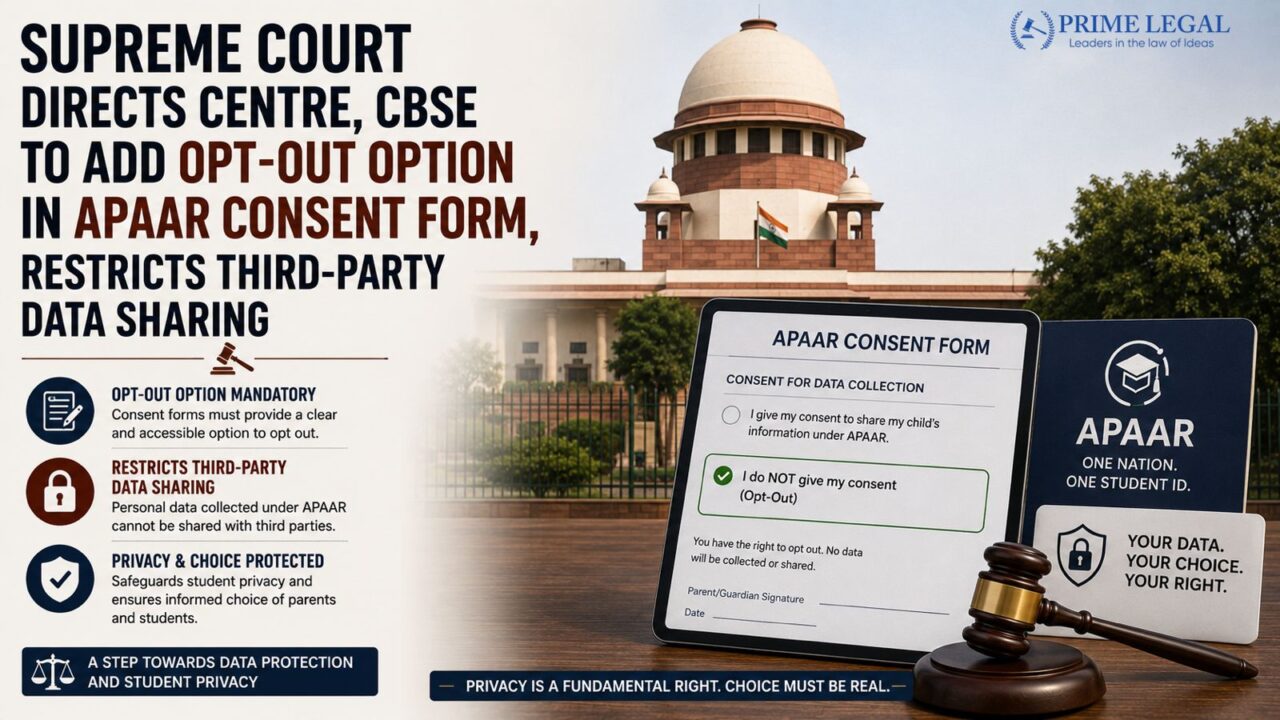
In Abhishek Baxi v. Union of India (2026 LiveLaw (SC) 719), the Supreme Court of India directed the Central Government and the Central Board of Secondary Education (CBSE) to amend the model consent form in the Automated Permanent Academic Account Registry (APAAR) scheme.
Chief Justice of India Surya Kant, Justice Joymalya Bagchi, and Justice V. Mohana presided over a bench that had suggested that there must be a provision for parents and guardians to opt-out or refuse. The Court highlighted that the collection of data has to be done in compliance with the Digital Personal Data Protection Act, 2023, and explicitly clarified that the data of students cannot be shared with third parties.
BACKGROUND
The petitioner Advocate-on-Record Paras Nath Singh had filed the writ petition on behalf of the petitioner on behalf of which Senior Advocate Indira Jaising had appeared before the court. CBSE had announced in August 2025, that the APAAR ID will be mandatory for all the students of Classes IX to XII, appearing for board exams from the academic session 2026 onwards.
The petitioner contended that the APAAR ID is directly linked to Aadhaar and the same was a compulsion on children to enroll in Aadhaar, thereby violating Supreme Court’s Aadhaar judgment of 2018. The petitioner also argued that the consent forms currently in place did not provide an “opt-out” mechanism and did not contain explicit detail on what data would be collected, how, or for how long. This blanket data collection, they said, did not meet the proportionality and legitimate state aim test in the K.S. Puttaswamy judgment (2017), which guaranteed the fundamental right to privacy.
KEY POINTS
- The Supreme Court asked the Centre and CBSE to revise the APAAR consent form to give parents and guardians an appropriate “opt-out” option that is meaningful, informative, and clear.
- The bench directed the relevant authorities to put the safeguards mentioned in paragraph 19 of the Orissa High Court’s judgment in Rohit Anand Das v. State of Odisha (2025) (W.P.(C) No.8285 of 2025) in place in all parts of the country.
- The Court has imposed strict adherence to the rules and fiduciary duties laid down under the Digital Personal Data Protection Act, 2023 in the collection, processing, storage and retention of personal data under the APAAR scheme.
- It had said that no third party can share, disclose or avail personal data collected under APAAR.
- It is clear that sharing the information beyond the scope of the scheme, or for other reasons from those expressly legally provided is prohibited in any way.
- The authorities have two months to issue the required orders about these changes.
ANALYSIS
The Supreme Court’s order will be a critical balance between the state’s push to digitise academic records and various basic constitutional rights to privacy. In so doing, the Court reiterated earlier precedents established in 2018, which held that the APAAR ID is essentially a way to enforce Aadhaar in minors.
Incorporating an “opt-out” option means parents are not being forced to sign a consent form, but rather are making an informed choice. Moreover, the Court has set a robust safeguard against commercialization, unauthorized profiling and misuse of such sensitive student information by private parties and third parties, by attaching the scheme to the high-level protections of the Digital Personal Data Protection Act, 2023.
CONCLUSION
The Supreme Court has substantially reduced the uncontrolled digitization of the students’ records through the APAAR system. The Court has placed a strong emphasis on the need for students’ and guardians’ privacy and informational autonomy, by urging the government and the CBSE to include an opt-out option and explicitly barring any third-party transfers of information.
This ruling remains consistent with the basic rule of law, that the use of educational registries in administrative systems can be modernized, but this cannot infringe upon statutory provisions on data protection or the constitutional rights to privacy.
“PRIME LEGAL is a National Award-winning law firm with over two decades of experience across diverse legal sectors. We are dedicated to setting the standard for legal excellence in civil, criminal, and family law.”
WRITTEN BY: SHEEN

