
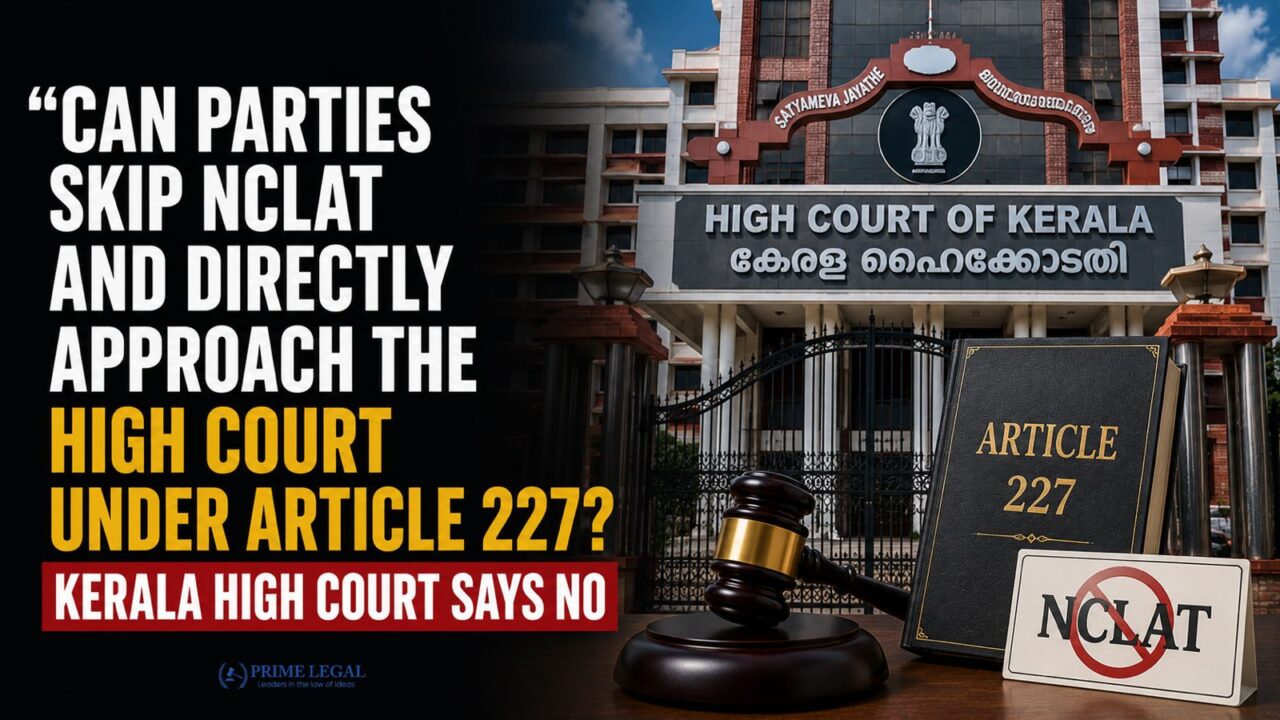
CASE NAME: The Erattupetta Municipality V. The National Company Law Tribunal
CITATION: 2026:KER:51384
CASE NUMBER: OP(C) NO. 2718 OF 2023
COURT: The High Court of Kerala at Ernakulam
DATE OF JUDGMENT: 14.07.2026
QUORUM: T.R. Ravi Judge
FACTS:
Union Bank of India initiated the Corporate Insolvency Resolution Process (CIRP) against M/s Raihan Healthcare Pvt. Ltd (corporate debtor). The Erattupetta Municipality had entered into an agreement with the Liquidator (2nd respondent) during the liquidation process on 10.05.2021 to run the hospital as a temporary health centre in wake of the COVID-19 emergency. As the petitioner did not have the required facilities to run the hospital, it assigned the work to a private management agency named M/s. Irattupetta Medical Centre. However, the arrangement did not work. This led to unpaid electricity bills and other contractual liabilities pending. When the liquidator demanded money from the Municipality, it was denied by them on the ground that, it was the liability of the private agency.
The Liquidator went to NCLT for collecting the pending dues. As, the Municipality did not appear even after the service of a notice, it was proceeded against ex parte. The NCLT ordered the Municipality to pay a sum of ₹19,57,637 along with an annual interest of 6%. The NCLT on 19 July 2022 did not allow the petition filed by the Petitioner for dismissal of the ex parte proceeding. Contempt case was filed by the Respondent against the Petitioner for violation of order and notice issued. Appeal was filed by Municipality (Petitioner) before High Court under Article 227.
ISSUES:
-
- Whether the writ petition was maintainable or not.
- Whether the High Court should intervene in the NCLT’s ex parte order when other remedies are available.
LEGAL PROVISIONS:
- Article 227 of the Indian Constitution.
- Section 60, 61, 63 & 231 of Insolvency & Bankruptcy Code, 2016.
- Rule 11 & 49 of National Company Law Tribunal Rules, 2016.
CASE LAWS:
- State of U.P. & Ors. v. Raghvendra Nath Srivastava & Ors. [2026 SCC OnLine SC 995]
- Ouseph Mathai v. M. Abdul Khadir, (2002) 1 SCC 319
- State v. Navjot Sandhu, (2003) 6 SCC 641 : 2003 SCC (Cri) 1545
- Surya Dev Rai v. Ram Chander Rai, (2003) 6 SCC 675
- Waryam Singh v. Amarnath (1954) 1 SCC 51 : AIR 1954 SC 215
- L. Chandra Kumar v. Union of India, (1997) 3 SCC 261
- Laxmikant Revchand Bhojwani v. Pratapsing Mohansingh Pardeshi [(1995) 6 SCC 576]
- Koyilerian Janaki v. Rent Controller (Munsiff) [(2000) 9 SCC 406
- Shalini Shyam Shetty [(2010) 8 SCC 329 : (2010) 3 SCC (Civ) 338]
ARGUMENTS:
Petitioner: The petitioner argued that its role had only been of a facilitator for the functioning of the hospital during the COVID-19 emergency and therefore the private management agency must bear the liabilities. It was further contended that the NCLT had erred in giving an ex parte order and that the petitioner should be given a fair chance to be heard before the court.
Respondent: According to the liquidator, the prayer made by the petitioner was not maintainable since s. 61 of the IBC 2016 explicitly provided for an appeal before the NCLAT. Additionally, it claimed that the municipality had violated its contractual duties, considering the reminders sent to it in terms of its payment dues prior to filing the petition with the high court.
ANALYSIS:
The High Court held that the Insolvency and Bankruptcy Code provide for a complete mechanism for adjudication and remedy via appeals filed from decisions of the National Company Law Tribunal that are presented before the National Company Law Appellate Tribunal is given under Section 61 of the code. While relying on the Supreme Court ruling in State of U.P. v. Raghvendra Nath Srivastava, the Court stated that Article 227 is a special power of supervision and should not be abruptly used where statutory remedy exists. The Court remarked that the municipality was aware of both the ex-parte order and the decision to reject their application for restoration. However, it did not apply for the statutory remedy available in the Insolvency code. Further, the writ was filed only after a contempt suit was instituted against the petitioner.
JUDGEMENT:
The Court did not find any reason to interfere with the proceedings which have been initiated against the petitioner as provided in the statute. The original petition failed and was dismissed, However, it was stated by the court that, if the petitioner chose to avail the statutory remedies against any of the orders which have been passed by the NCLT, the time spent before the Court in the proceedings will be deducted for the purpose of calculating the period of limitation.
CONCLUSION:
The judgement reestablishes the principle that the extraordinary constitutional remedy cannot be used as a substitute for the appellate process. It emphasizes that Article 227 of the Constitution should only be exercised sparingly, when necessary, and when the parties have exhausted all other statutory remedies available.
“PRIME LEGAL is a National Award-winning law firm with over two decades of experience across diverse legal sectors. We are dedicated to setting the standard for legal excellence in civil, criminal, and family law.”
WRITTEN BY: SOMSUTA PAUL
Read the judgement copy below:
The Erattupetta Municipality v. The National Company Law Tribunal and Anr

