
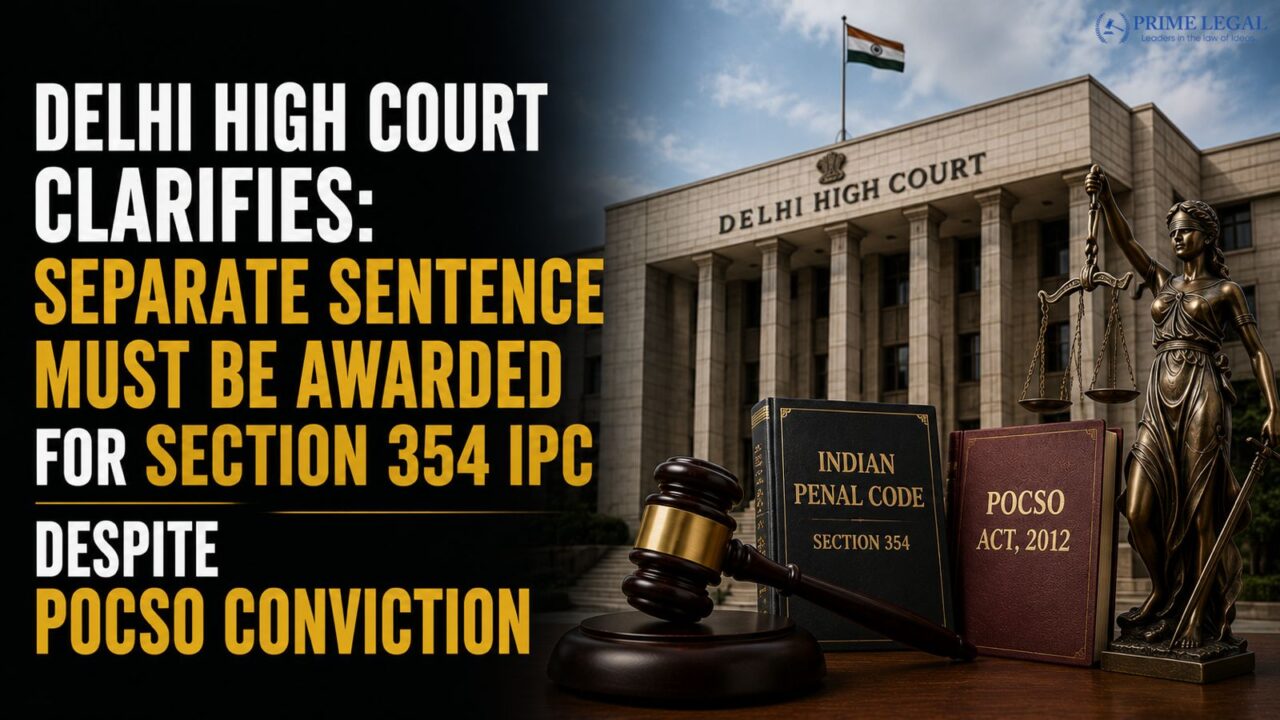
CASE NAME: KANHAIYA LAL v. STATE (NCT OF DELHI)
CITATION: CRL.A. 880/2025 & CRL.M.(BAIL) 1381/2025
CASE NUMBER: Criminal Appeal No. 880 of 2025
COURT: High Court of Delhi at New Delhi
DATE OF JUDGMENT: 9th July, 2026
QUORUM: Hon’ble Ms. Justice Chandrasekharan Sudha
FACTS
The present appeal has been filed by the accused challenging the impugned judgement dated 15th May, 2025 and order dated 17th May, 2025 passed by the Additional Sessions Judge (PoCSO), North-West Rohini Courts, New Delhi. The case of the prosecution is that the accused aged about 62 years who was selling ice had sexually assaulted a minor girl aged about 6 years, and committed criminal intimidation in his shop/room on 19th August, 2022.
The victim complained of pain to her mother while bathing and disclosed this incident to her in the FIR registered on 21st August, 2022. The accused was convicted by the trial court under Sections 354, 354A, 354B and 506 of the Indian Penal Code (IPC) and Section 9(m) of the PoCSO Act and was sentenced to 7 years of rigorous imprisonment.
ISSUES
- Different claims of incorrectness, if any, of the judgment of conviction passed by the trial court, which warrants interference by the High Court.
- Whether the incident was in itself improbable due to the shop being located in a locality which was very populated and where the accused would have been a known person.
- Whether non-examination of two child witnesses results in a fatal gap of evidence in the prosecution case.
LEGAL PROVISIONS
- Sections 354, 354A, 354B, 506, and 71 of the IPC, 1860.
- The Protection of Children from Sexual Offences Act, 2012 (PoCSO Act) .
- Sections 164, 207, 232 and 313(1)(b) Cr.P.C.
- Section 415(2) with Section 528 of BNSS, 2023.
Case Laws Referred:
- Moidu K. vs. State of Kerala, 2009 (3) KHC 89.
- Ganesan v. State, (2020) 10 SCC 573.
ARGUMENTS
APPELLANT
The advocate for the appellant contended that the incident was highly improbable since the khokha was located in a dense locality where there was constant movement of people in the public domain which would make such an act unnoticed. The prosecution had not investigated two key child witnesses, ‘P’ and ‘A’, who were allegedly at the scene, it was argued. The defence contended that the accused had made a complaint to MCD for the victim’s grandfather store in the past and that he got into a fight with the victim’s father earlier as a result of which the accused had been falsely implicated. The counsel pointed out an unexplained delay in lodging the FIR. There was a request for leniency as the accused was of the age of 62 years and that he should be sentenced to a mere 5 years as prescribed by the law.
RESPONDENT
The Additional Public Prosecutor filed that the judgment of the trial court was correct and based on the overall appreciation of the evidence. The victim’s counsel had contended that the sentence of 7 years was justified, in view of the seriousness of the offence committed by the accused against a child of 6 years and the accused’s age, and his criminal antecedents pertaining to an earlier case under Section 307 IPC.
ANALYSIS
The Court carefully reviewed the evidence and dismissed the appellant’s arguments. It noted that the victim always said that no one else was in the vicinity and, therefore, did not make the crime impossible to commit. The failure to examine ‘P’ and ‘A’ (who were subsequently identified as the accused’s nieces) was not fatal as per settled law, a conviction could be safely based on the sole, trustworthy and reliable evidence of the victim.
In respect of prior enmity, the Court observed that there was no evidence other than that of the defence which also failed to provide any documentary or independent evidence, such as a copy of the MCD complaint or notice, to support the claims of prior enmity, expressly denied by the victim’s mother. The delay of two days in lodging the FIR was considered justified because the mother had promptly informed the police of the incident after the child came to her with the information. The Court held that aggravated sexual assault under Section 9(m) with Section 10 of the PoCSO Act could be successfully established. But, bearing in mind the facts, circumstances and the age of the accused, the Court found that the minimum statutory sentence would be an end to justice.
JUDGEMENT
The Appeal was partially allowed by the High Court. The conviction of the accused for the offences under Sections 354, 354A, 354B and 506 IPC and Section 9(m) of PoCSO Act was confirmed. The sentence of rigorous imprisonment for the offence under Section 10 of PoCSO Act was altered and reduced from 7 years to 5 years. The conviction and punishment for the offence under Section 506 IPC was upheld to run concurrently.
CONCLUSION
The judgment reaffirms that the child victim’s consistent and reliable testimony is enough to win the conviction of the accused in PoCSO cases even in the absence of any corroborating witnesses. It also emphasizes that general charges of past bad will or physical impossibility must have strong supporting evidence to undermine a prosecution case. At the same time, the Court applied its discretion, taking into account the facts and circumstances of the case, and the appellant’s advanced age, to sentence him to the statutory minimum.
“PRIME LEGAL is a National Award-winning law firm with over two decades of experience across diverse legal sectors. We are dedicated to setting the standard for legal excellence in civil, criminal, and family law.”
WRITTEN BY: SHEEN
Read the judgment copy below:
Kanhaiya Lal v. State (NCT of Delhi)

