
ABSTRACT
The growth rate in India’s aviation industry has been tremendous, offering convenience but also often causing disruptions in flights. The regulatory regime under the Directorate General of Civil Aviation (DGCA) protects passengers from unfair conduct by airlines. The Civil Aviation Requirements (CAR) Section 3, Series M, Part IV was passed to ensure that passengers are not financially and emotionally distressed because of flights which are delayed, cancelled or rescheduled.
This Article analyses the legal rights of air passengers in India, the mandatory compensation, refunds and amenities that the airlines are required to provide, and the exceptions like force majeure that often make claims tricky.
INTRODUCTION
Air travel is a key component of contemporary connectivity which has been transformed from an indulgence to a necessity. This increased reliance on the flight makes any delay, cancellation or rescheduling a huge mess for the passenger. The rules aimed to control these disruptions are drafted such that the inconvenience is not solely shouldered by the traveller.
Despite the fact that airlines are in genuine operational difficulties, the current aviation rules in the country have certain rules for care and compensation. This has resulted in a system that ensures airlines are legally bound to make provision and to compensate passengers when the airlines have control over the disruption.
HISTORICAL BACKGROUND
The 1940s were the most critical years. Even with these developments in regulation, the problem was the requirement of a case-by-case approach from customer service agents because passengers were not aware of the issue. A traveller who has been stranded at the airport was typically at a disadvantage, as they were forced to pay out of pocket for lodging, transport and meals.
The process of claiming rights was very difficult, due to the technical jargon and complicated policies of the airlines. Many passengers put up with bad service, believing that the weather or some nebulous “operational reason” excuses the airline. Even when mandated by law, airlines were increasingly giving travellers travel vouchers rather than cash. This information gap necessitated an update and enforcement of these charters to fix this misuse.
Proving the exact length of a delay and the lack of prior notification may be challenging and time consuming for the passenger. The process can also be considered as a punishment, resulting in an annoying customer service call, financial burden, and psychological anguish for the customer. Many passengers waived their claims because of the possibility of problems. This is a reminder of how important it is to have a clear system that’s enforced and available to stranded travellers.
THE STATUTORY POSITION OF INDIA
India’s passenger rights regime is a complex web of civil aviation regulations, based on the enforceable Civil Aviation Requirements (CAR), Section 3, Series M, Part IV. The regulation, issued by the DGCA, is applicable to all scheduled flights from, to and from India, irrespective of the nationalities of the airlines.
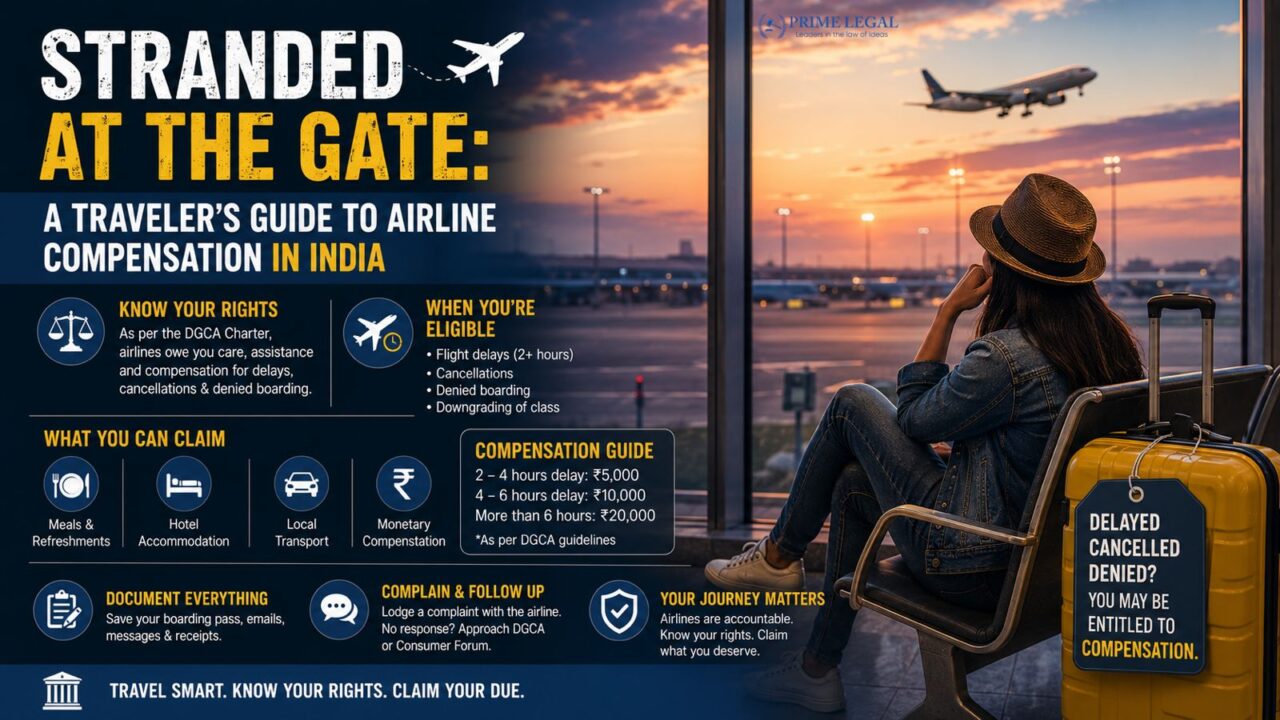
In case of a flight cancellation, less than 24 hours before the scheduled departure, the airline shall offer an alternative flight or a full refund with cash compensation of INR 5,000 to INR 10,000 depending on the block time of the flight. If either occurs, the airline shall rebook the passenger on a comparable flight or full refund if notified within 2 weeks to 24 hours.
If the delay is more than 2 hours, airlines are required to serve free food and beverages. In the event of a delay of more than 6 hours, passengers are entitled to be rebooked or to obtain a full refund. If your flight is delayed overnight (or more than 6 hours between 8.00pm and 3.00am), the airline has to by law give you a hotel room and free transfers to the airport. If there is a delay of more than 24 hours, cash compensation is added to the previous benefits.
If a disruption is caused by extraordinary circumstances that are out of the control of the airline, e.g. due to severe weather, natural disaster, political unrest or a call from air traffic control, then the airline is not obliged to pay monetary compensation. But the general obligation to give a refund or alternative flight, and meals while waiting, remains intact.
REDRESSAL MECHANISMS
To obtain these rights of passengers, a systematic strategy should be followed, based on a first line of communication and then escalation. The first most important step is that the passenger approaches the Grievance Redressal Mechanism (GRM) of the airline with a clear demand and a PNR with the boarding passes to register a formal complaint directly with the airline.
If the airline cannot reach a satisfactory resolution within 30 days, there are simple avenues to take the matter up a level. Passengers can submit their documented complaints directly to the Ministry of Civil Aviation on their official grievance redressal forum for regulatory action.
Airlines are required to have appointed Nodal Officers and Appellate Authorities for grievance redressal and the direct contact details are published on their respective websites.
In the absence of regulatory avenues, the District Consumer Disputes Redressal Commission, under the Consumer Protection Act, may be approached by the passengers who often get compensation for the delays and shortfalls in service that are documented.
In addition to legal action, a constant campaign of passenger awareness has to be carried out. The lack of knowledge that prevents people from getting what they deserve needs to be corrected. To make the aviation environment more transparent, it is important to inform the public of what is actually meant by these DGCA laws, and to demonstrate some of the successful claims.
CONCLUSION
In conclusion, the particular DGCA provisions for flight disruptions have been drafted with the modern traveller in mind in a growing aviation market. The authorities have made sure these rules are passenger-centric, with a focus on care and financial compensation rather than airline convenience, through strict CAR provisions. However, the need is great to raise awareness among the public so all carriers can apply the rules equally and fairly. It is impossible for air travel to be fair without enforcement of regulations, but also the greater societal pressure to ensure transparency and accountability from the service providers.
“PRIME LEGAL is a National Award-winning law firm with over two decades of experience across diverse legal sectors. We are dedicated to setting the standard for legal excellence in civil, criminal, and family law.”
WRITTEN BY: SHEEN.

