
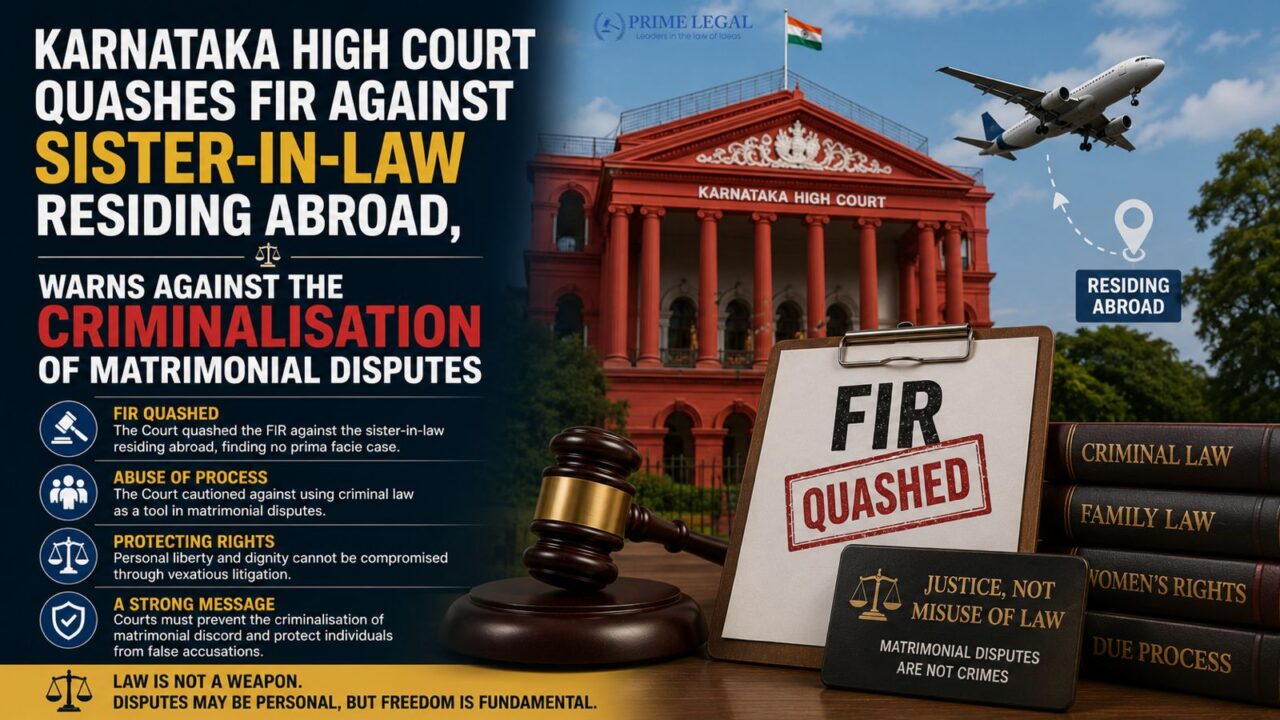
CASE NAME: V v. State of Karnataka & Anr.
CITATION: NC: 2026: KHC:31937
CASE NUMBER: Criminal Petition No. 10716 of 2024
COURT: High Court of Karnataka at Bengaluru
DATE OF JUDGMENT: 25th June, 2026
QUORUM: Hon’ble Mr. Justice M. Nagaprasanna
FACTS
The present Petition is filed by Accused No. 4 who is the sister-in-law of Respondent No. 2 (complainant). Respondent No. 2 was married to Accused No. 1 on 23rd July, 2022. But after a year of marriage, the marital relationship began to fail and the husband and wife went through a series of litigations against each other.
Later a complaint was lodged with jurisdictional police against four persons namely Accused No. 1 (husband), Accused No. 2 (mother-in-law), Accused No. 3 (father-in-law) and Accused No. 4 (Petitioner herein). The FIR was filed for offences under Sections 498A, 312, 504 and 506 of the Indian Penal Code (IPC) and Sections 3 and 4 of the Dowry Prohibition Act (DP Act).
The Petitioner, who had been married in 2017 and been living in Luxemburg long before the subject marriage, approached the High Court under Section 482 of CRPC for quashing proceedings initiated against her.
ISSUES
- Alleged telephonic conversations and instigation by an absent relative who is not residing in the country is enough to fit the ingredients of an offence under Section 498A of the IPC.
- General and omnibus charges can be deemed an abuse of process.
- If the basic elements of Sections 312, 504, and 506 of the IPC are met against the Petitioner.
LEGAL PROVISIONS
- Sections 498A, 312, 504, and 506 of the Indian Penal Code, 1860.
- Part 4 of the Dowry Prohibition Act.
- Section 482 of the Code of Criminal Procedures, 1973.
Case Laws Referred:
- Kahkashan Kausar v. State of Bihar (2022) 6 SCC 599.
- Rajesh Sharma v. State of U.P., (2018) 10 SCC 472.
- Arnesh Kumar v. State of Bihar, (2014) 8 SCC 273.
- Preeti Gupta v. State of Jharkhand, (2010) 7 SCC 667.
- Geeta Mehrotra v. State of U.P., (2012) 10 SCC 741.
- K. Subba Rao v. State of Telangana, (2018) 14 SCC 452.
- Maram Nirmala v. State of Telangana (2025) SCC OnLine SC 2913.
- Mohammad Wajid and Another v. State of U.P. (2023) SCC OnLine SC 951.
ARGUMENTS
PETITIONER
The learned counsel that appeared on behalf of the Petitioner had contended that Petitioner is a sister-in-law of the complainant and resides in Luxemburg. It was submitted that she got married in 2017, long before the complainant’s marriage, and flew to Luxemburg where she stays even today. So, there is no justification whatsoever for any allegation to be made against her; she has been dragged into the legal proceedings for no good reason.
RESPONDENT
The counsel for Respondent No.2 argued that the Petitioner was not residing in India but she tormented the complainant on the telephone. It was therefore argued that the ingredients of the offences were satisfied and it needed to be investigated further. The learned Government Pleader for the State, who appeared on its behalf, also filed a reply stating that the Petitioner’s complaint contained certain allegations which warranted an investigation.
ANALYSIS
The Court carefully read over the complaint and noted that there was only one complaint brought against the Petitioner, that she was “filling in the ears” of her parents with their constant phone calls from Luxemburg. The Court strongly upheld that such instigation by telephone does not constitute the ingredients of section 498A of IPC.
In harks back to the landmark judgements of Kahkashan Kausar v. State of Bihar and Maram Nirmala v. State of Telangana, the Court pointed out the increasing trend for people to use Section 498A IPC as a personal vendetta to involve extended family members on flimsy and generalized charges.
It affirmed that “a prosecution against a family member(s) residing in a different city or country on the basis of an omnibus allegation without evidence of any involvement is an abuse of the legal process.
Moreover, the Court observed that the basic conditions of the remaining charges of Section 312, 504 & 506 of IPC were missing in the Petitioner. The Court strongly cautioned that the complainant’s argument would be dangerous and allow the criminal law to be expanded so that every communication through the phone between an in-law and a daughter-in-law would be deemed to be criminal culpability.
JUDGEMENT
The High Court has granted the criminal Petition. The Court quashed the FIR in Crime No. 377/2024 pending before the 30th Additional Chief Metropolitan Magistrate, CMM Court, Bengaluru against the Petitioner (Accused No. 4).
CONCLUSION
The judgment is a good reminder that criminal courts need to be very careful in handling matrimonial disputes, so as to not harass distant relatives. In the absence of any specific or particular allegation against in-laws staying in another country the same cannot be used to hold them liable for a criminal prosecution and to let the interference as envisaged under Section 482 in CRPC. for prevention of a grave miscarriage of justice.
PRIME LEGAL is a National Award-winning law firm with over two decades of experience across diverse legal sectors. We are dedicated to setting the standard for legal excellence in civil, criminal, and family law.
WRITTEN BY: SHEEN
Read the judgment copy below:

