
INTRODUCTION
The digitalization of communication has made the relationship between technology and law more prominent than ever and the proposed WhatsApp username feature is a case in point. This standoff is significant in two ways: – the messaging platform and the Union Government both call for the same goal: the preservation of informational privacy. To appreciate the seriousness of this debate one needs to refer to the order of the nine-judge Bench of the Supreme Court of India dated 20th August 2017. In this broad declaration, the Supreme Court firmly established that the right to informational privacy is an intrinsic aspect of the right to privacy as guaranteed under Article 21. In addition, the court acknowledged that there are grave threats to an individual’s privacy by either the State or non-State actors in the cyber context.
BACKGROUND
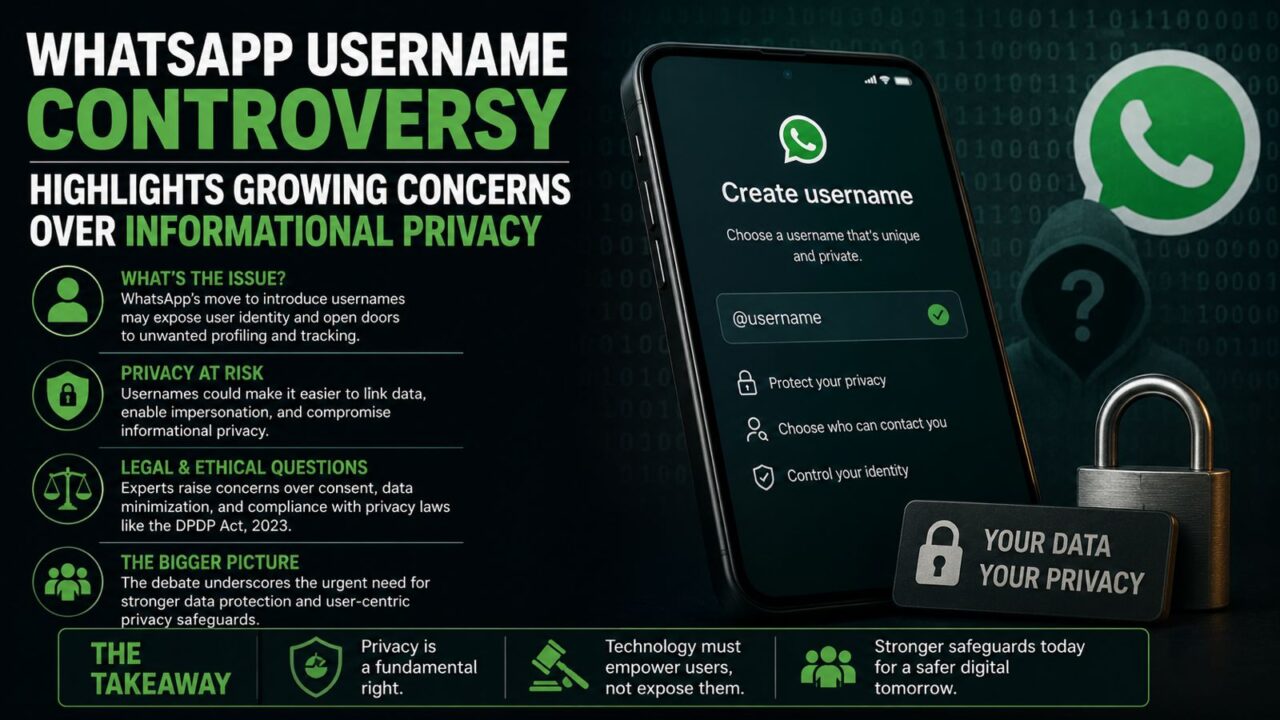
The tussle officially started as WhatsApp have announced that it will launch a new optional username feature, a tech change that has not been officially rolled out in India. The feature would ensure that users can have a different login name on their phone for their communication, to prevent strangers from having access to their private phone number if it was not already saved to the phone by the user.
According to WhatsApp, this enhancement will help to fortify users’ privacy as unique usernames will act as a shield for the unsuspecting users and make them harder to be impersonated and defrauded. But the MeitY. has voiced a host of concerns on the implementation of this feature.
The Ministry fears that such nickname names are likely to facilitate a huge surge in advanced cybercrimes if the anonymity provided by the nicknames is not respected. MeitY is worried about the ease with which digital criminals can take on false identities and impersonate vulnerable individuals across the country and infringe on their informational privacy.
KEY POINTS
- According to WhatsApp, its new and optional username feature will be a proactive step to improving user privacy and help to prevent users from being impersonated and defrauded by unknown contacts.
- The Ministry of Electronics and Information Technology is worried about the anonymity that usernames afford being misused by cybercriminals for online fraud, phishing and digital arrest scams.
- One of the main concerns for the Ministry will be the possibility of large-scale identity spoofing by bad actors using names that are similar to those of a government or financial institution or public authority.
- Critics of the government’s move say that the State cannot tell a tech firm what function it can provide its users and cannot stop providing it even if it is deemed “unlawful” unless there are specific laws to the contrary.
- The government is relying on the principles enunciated in the K.S. Puttaswamy judgment, which states that the government’s action is completely consistent with the legitimate objectives of the State to ensure national security, avert widespread crime and ensure the welfare of the public.
ANALYSIS
At the heart of this developing legal and technological controversy is the thin line between informational privacy, freedom of choice regarding corporate technology design, and appropriate state action.
However, critics vehemently assert that there is no need for a private company to infringe on design if there is no clear legislation in place. But the government has a very strong legal counter argument, which is based on the constitutional obligation to protect the public.
The government could make a strong case that privacy is a fundamental right and that the State has a duty to get involved when the life, savings and overall privacy of citizens is in serious danger. The web, while a huge area of legal personal and business activity, can still be used by terrorists to cause chaos in civilised societies, and cyber-attacks can have a fundamental impact on the financial systems of the world, according to the judgment.
To cope with this, the courts have been using the proportionality test in law. The Constitution Bench has held that any violation of privacy has to be supported by a legitimate aim and has to show a rational connection between the purpose of the invasion of privacy and the form of invasion.
CONCLUSION
The controversy around WhatsApp’s name feature is a vivid illustration of the complex and evolving nature of our digital age, where technological progress can sometimes outstrip the existing laws and regulations. True informational privacy needs to be done without hampering innovation or dealing the same blow from today’s cybercrime threats. Achieving this is incredibly nuanced and well thought out. It is essential that the new regulations are constitutionally consistent, and further enhance the security and freedom of citizens’ digital lives.
“PRIME LEGAL is a National Award-winning law firm with over two decades of experience across diverse legal sectors. We are dedicated to setting the standard for legal excellence in civil, criminal, and family law.”
WRITTEN BY: SHEEN.

