
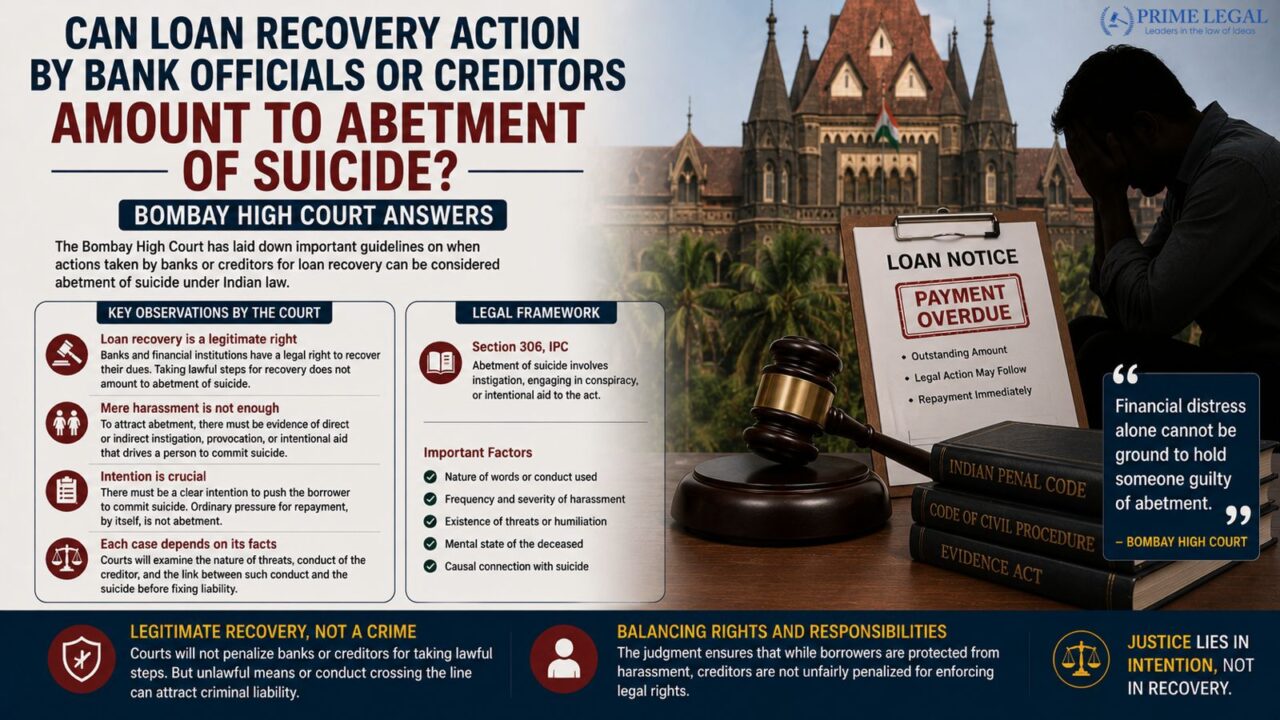
CASE NAME: Amit Padmakar More & Others v. The State of Maharashtra & Another
CASE NUMBER: Criminal Application No. 412 of 2025
COURT: High Court of Bombay at Kolhapur
DATE: 08 May 2026
QUORUM: Hon’ble Mr. Justice Ranjitsinha Raja Bhonsale
FACTS
This case is based on a FIR filed by the wife of the deceased, Mr. Dilip Babsaheb Mande (Respondent No. 2) against the Applicants (who owe money to the deceased), alleging that the deceased committed suicide due to extreme mental harassment from the Applicants. Respondent No. 2 further alleges that on August 9, 2022, the deceased consumed a pesticide as a result of the Applicants’ abuse and harassment for the repayment of a loan, and died from it on August 10, 2022. However, both the postmortem report and the Chemical Analysis (CA) report showed no signs of poisoning. It established the cause of death as being “auto myocardial infarction leading to cardiorespiratory arrest.” Thus, despite there being medical proof that the deceased died of a natural heart attack, the police registered an FIR against the Applicants for abetting the deceased’s suicide and submitted a chargesheet to the court. Therefore, the Applicants have filed this application to quash the FIR and all criminal proceedings associated with it.
ISSUES
- Whether demanding the repayment of a loan constitutes “abetment of suicide” under Section 306 of the IPC.
- Whether the criminal proceedings should be quashed when decisive medical evidence directly contradicts the allegations of suicide by poisoning (Mr. Dilip Babsaheb).
LEGAL PROVISIONS
-
- Section 528 (Saving inherent powers of High Court) of the Bharatiya Nagarik Suraksha Sanhita, 2023.
- Constitution of India- Articles 226, 227.
- Indian Penal Code- Sec. 306 (Abetment of suicide) and Sec. 107 (Abetment of a thing) read with Sec. 34 (Acts done by several persons in furtherance of common intention).
ARGUMENTS
APPLICANTS:
The Applicants asserted that the post-mortem and CA reports confirm that the deceased died from natural heart failure and that no poison had been found in his system. They opined that merely requesting the return of a loan was insufficient to establish abetment. They also pointed out that the Investigating Officer acted with mala fide by filing a chargesheet in full knowledge of the medical cause of death.
RESPONDENTS:
Respondent No. 2 has shown that the continuous threats made by the Applicants for the repayment of the borrowed money caused the deceased to develop severe mental distress, which in turn caused him to ingest pesticides. Additionally, the Respondent asserts that any issues relating to the alleged poisoning of the deceased are medical questions that must be decided during a full trial and not at the quashing stage.
ANALYSIS
The Court reviewed the legal provisions under Sections 306 and 107 of the IPC. It recognised that for an act to be counted as “abetting” a suicide, that act must be an intentional and physical behaviour which was intended to lead another person into committing suicide. The Court noted that simply asking someone to repay an advance is not sufficient grounds for a criminal charge of “abetting a suicide”. Additionally, the Court also found that the entire evidentiary basis for the prosecution’s case was directly disputed by the findings of the post-mortem and CA reports, since both reports say that the deceased did not commit suicide by taking poison.
JUDGMENT
The Court granted the application and quashed the criminal proceedings against all the Applicants. The Court found that the offence of “abetting a suicide” under Section 306 was not established based on the facts of the case, as all were frivolous, contradictory and contrary to existing medical evidence.
CONCLUSION
The High Court has ruled that seeking repayment of a validly advanced loan does not meet the elements of assisting another to commit suicide. Additionally, when there is credible medical evidence definitively rebutting the essential elements of an allegation of suicide as outlined in a FIR, the continuation of criminal proceedings constitutes an abuse of the process of the Courts, warranting the quashing of those proceedings.
“PRIME LEGAL is a National Award-winning law firm with over two decades of experience across diverse legal sectors. We are dedicated to setting the standard for legal excellence in civil, criminal, and family law.”
WRITTEN BY: VINEET SEERVI
Read The judgment copy below:
Amit Padmakar More & Others Versus The State of Maharashtra

